Mr Blue Sky
When it comes to whether a plant does well in the garden, a lot depends on finding the right spot. You can struggle for years if you put the right plant in the wrong place. Most common garden plants have the happy capacity to thrive in a variety of spots. I am always pleased to plant these because, though I love a challenge, it is better for the nerves to have some plants that are reliable. Over the years I have found that one such plant is Tritelia laxa, a bulb from California and Oregon.
It has a very confusing taxonomy, of which more later, but here is a small bulb that seems to thrive in all sorts of places in the garden provided the soil is not too wet and it is more or less sunny. In the wild it grows in a variety of habitats, from woodland edges to grassland and seasonally wet meadows. It is very inexpensive to buy, rapidly increases and, for a few weeks, is spectacular. It is also a great cut flower. You can see how well they have done if you look at last year’s post.
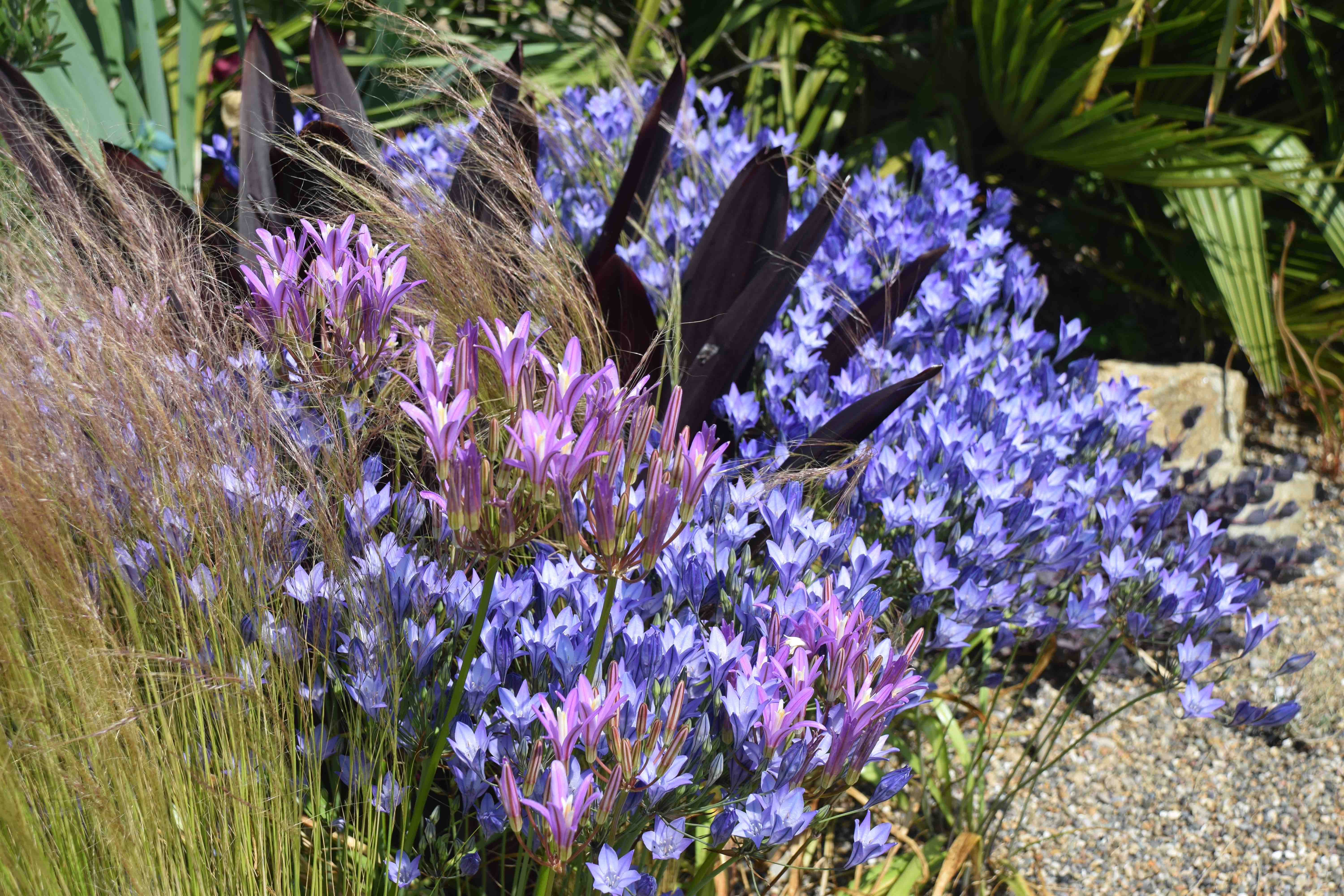
My bulbs are in a raised bed, with the less common ‘Pink Heaven’ and surrounding a purple-leaved eucomis which provides an effective contrast, both in colour and texture, although it blooms much later.
Tritelia laxa is most commonly available as the cv ‘Queen Fabiola’ but I think this is probably a seed strain because my plants do show some variation in colour. A slight problem with them is that the foliage, which emerges early, is dying when the flowers open and, of course, after flowering, by late July, the plants leave a gap. I grow Stipa tenuissima (as was) with them to help cover the gap.

The flowers are held on slender scapes and all the flowers emerge from a central point, rather like an allium (onion). In the past these have been put in the allium family, but also in the Amaryllidaceae and the Liliaceae. They are also often called brodiaeas, a different genus. Now they are in the Themidaceae which is a new family that includes several genera found in western North America. With the exception of one Mexican species, the 14 Tritelias are Californian and Oregon natives. The flowers have six tepals and stamens and small appendages attached to these. Brodiaeas have glossy tepals while tritelias are matt. Tritelias have six fertile stamens and brodiaeas have only three.
As the flowers of tritelia age they close and don’t wither but turn brown, which can be a nuisance when picking but there are lots of flowers on a scape, that open over many weeks and you can easily snap them off.
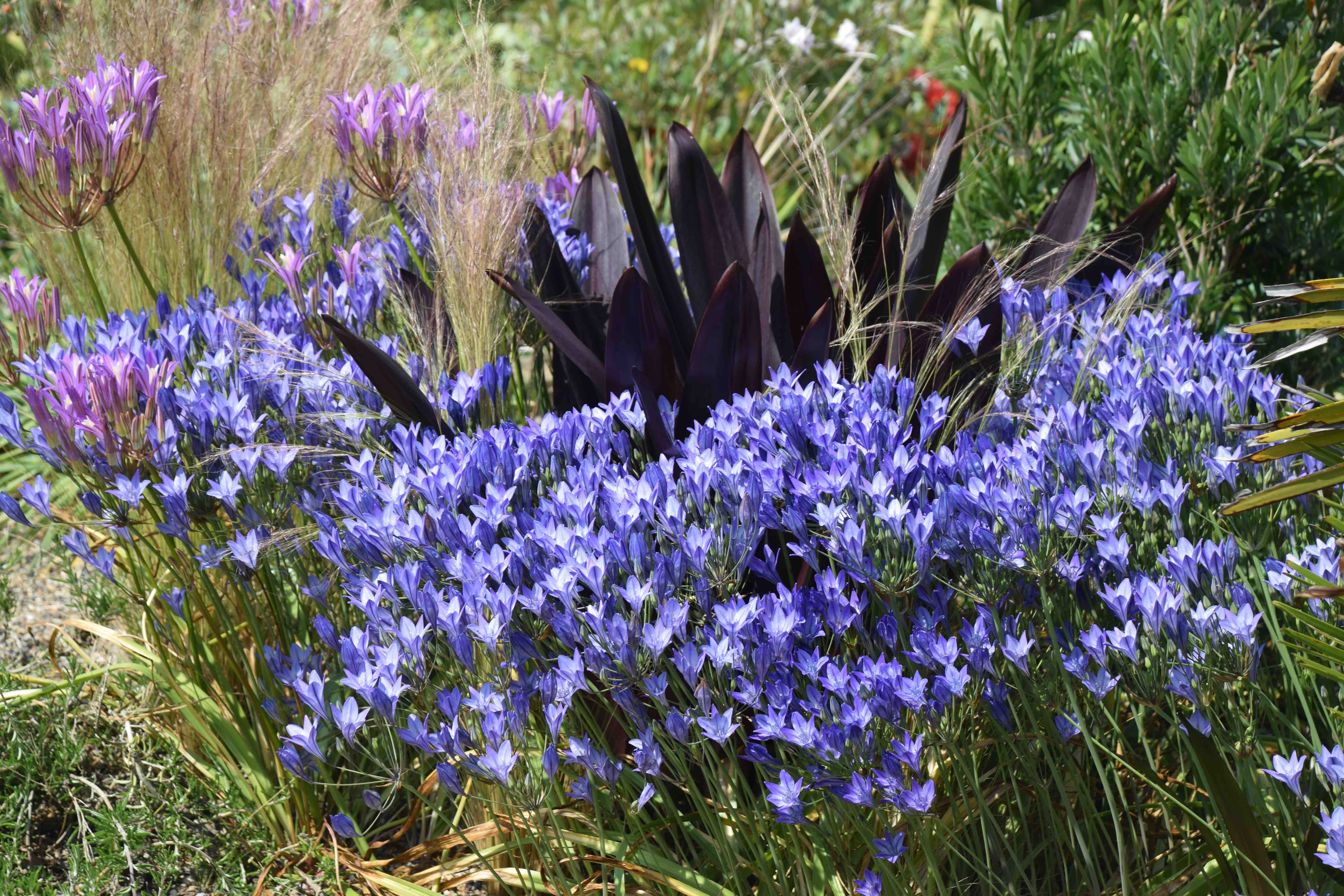
You could think of this as a ‘budget agapanthus’. It will bloom earlier in the season but gives the same hit of wonderful blue. It seems to be reliably hardy whenever I have planted it. My bulbs have increased quickly and it is possible that it may crowd itself out – I will have to see if it declines and needs thinning. But when you want something inexpensive and beautiful, I can think of few better flowers.
They coincide with sweet peas and they combine beautifully with them in bunches.
 The Biking Gardener
This is one for my shopping list… such an intense blue!
I have found they self-seed very generously but their display of blue is very attractive. I find the foliage, which I remove earlier in the season, is a bit of a nuisance.
On another note – I noticed Daylily Gall Mite had affected plants at Mount Congreve and I wonder who gave them the plants? Shhhhh!
Mine are behaving themselves at the moment. Yes the leaves are a slight problem but I can forgive them that as long as they flower prolifically. It seems that gall midge on daylilies is now established. It may affect what we plant. My H. lilioasphodelus does not seem to be affected at all (so far). Some of the spider daylilies have it but at least it is easy to identify affected buds on those.
These are exceptional specimens. I have never grown them like that. Like so many of these desirable natives, they tend to appear where we do not want them, and are then difficult to eliminate. False Solomon’s seal and at least one species of Trillium seem to do the same. Their bulbs somehow get rather deep into the soil, and are not easy to find without foliage to follow down. In the wild, they are scattered about, so do not bloom with such compact profusion. These pictures are interesting in that regard. After seeing how the native Solomon’s seal performs with intentional cultivation in odd places like England, I tried cultivating it here. I merely relocated an unwanted specimen to a more appropriate situation. It performs splendidly! I could do the same with this particular species. I would not expect it to be comparable to Agapanthus though. That grows like a weed.
Agapanthus have a bit of a reputation of being tender. The evergreen types get damaged in an average winter though the deciduous kinds are hardier than generally considered. I saw Tritelia (or was it brodeia?) when I was in your neck of the woods.
Yes, a few species are native, although they do not look as flashy as yours.
On seeing your fantastic Tritelias I rushed out to see if my ‘one or two’ were out and sure enough there was one! I planted about 6 years ago and now there are fewer! They are in a poor ,very dry place in full sun. Could that be the problem? Perhaps if I tried again in my spring border and adjacent to my Erythroniums they would fill the gap and be happier in better soil and semi shade.
My brother in California, out for hikes, sends me photos of them in the wild, but not in big numbers like yours.
Mine are in a raised bed. But bear in mind the clump is young – they may yet get overcrowded and start to die out. Nothing in the garden is static. Yes I saw them in the wild, scattered around and not as dense as mine are this year. But it is bound to change.