Euphorbias 2
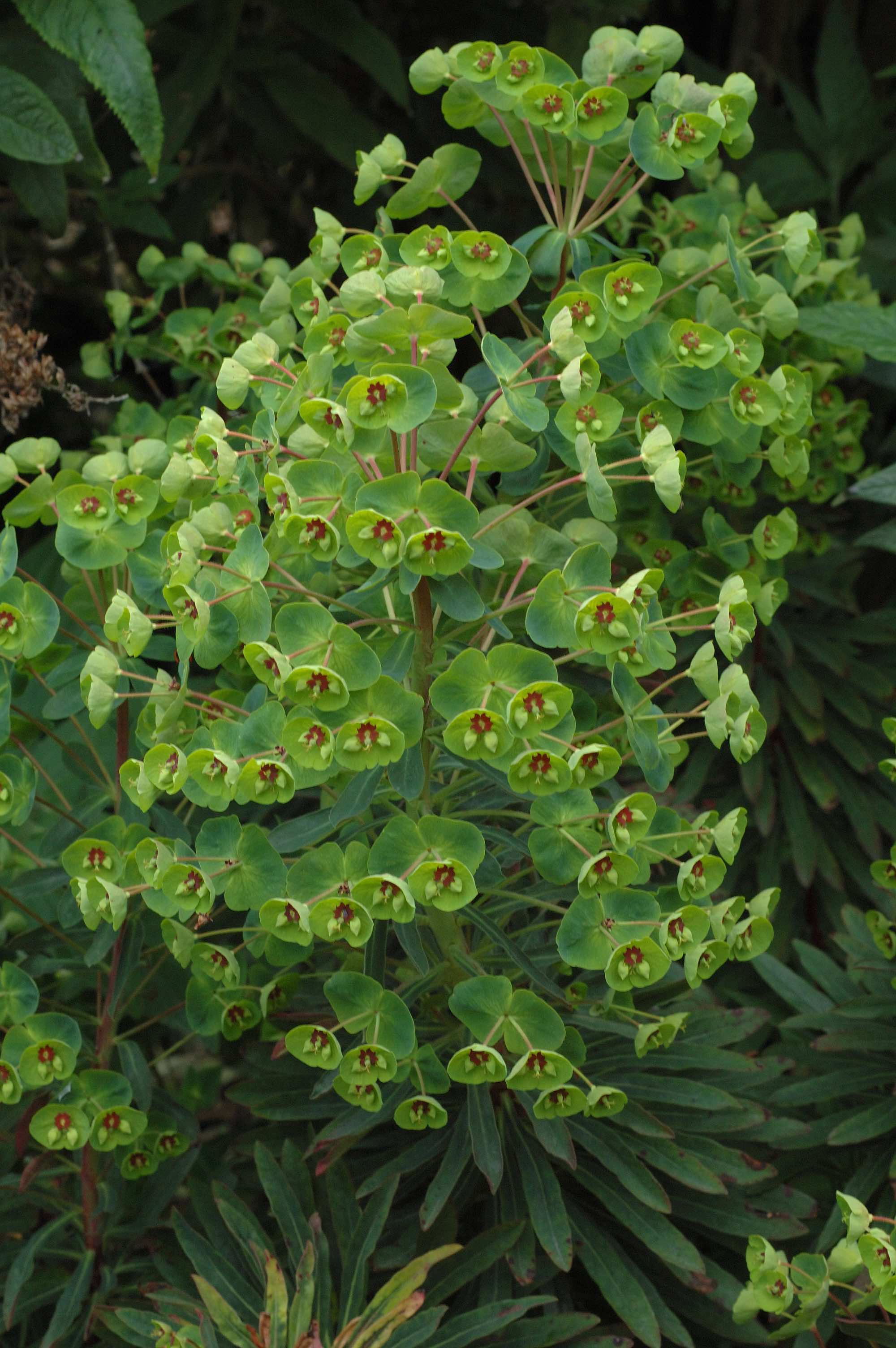
Welcome back. Now that we have reached the shrubby and hardy herbaceous species we can take a look at the flowers, which characterise the euphorbias.
The flowers, which have no petals or sepals, are grouped in clusters called a cyathium. In a cyathium there is one female flower, that becomes a round capsule with three chambers and large seeds, surrounded by four or five male flowers which are just a single, pollen-bearing stamen. There are also four or five nectar glands, providing food for pollinators, that are often yellow or reddish. These cyathia are each surrounded by a pair, or more, of floral leaves which contribute most of the colour of the inflorescence (group of flowers).
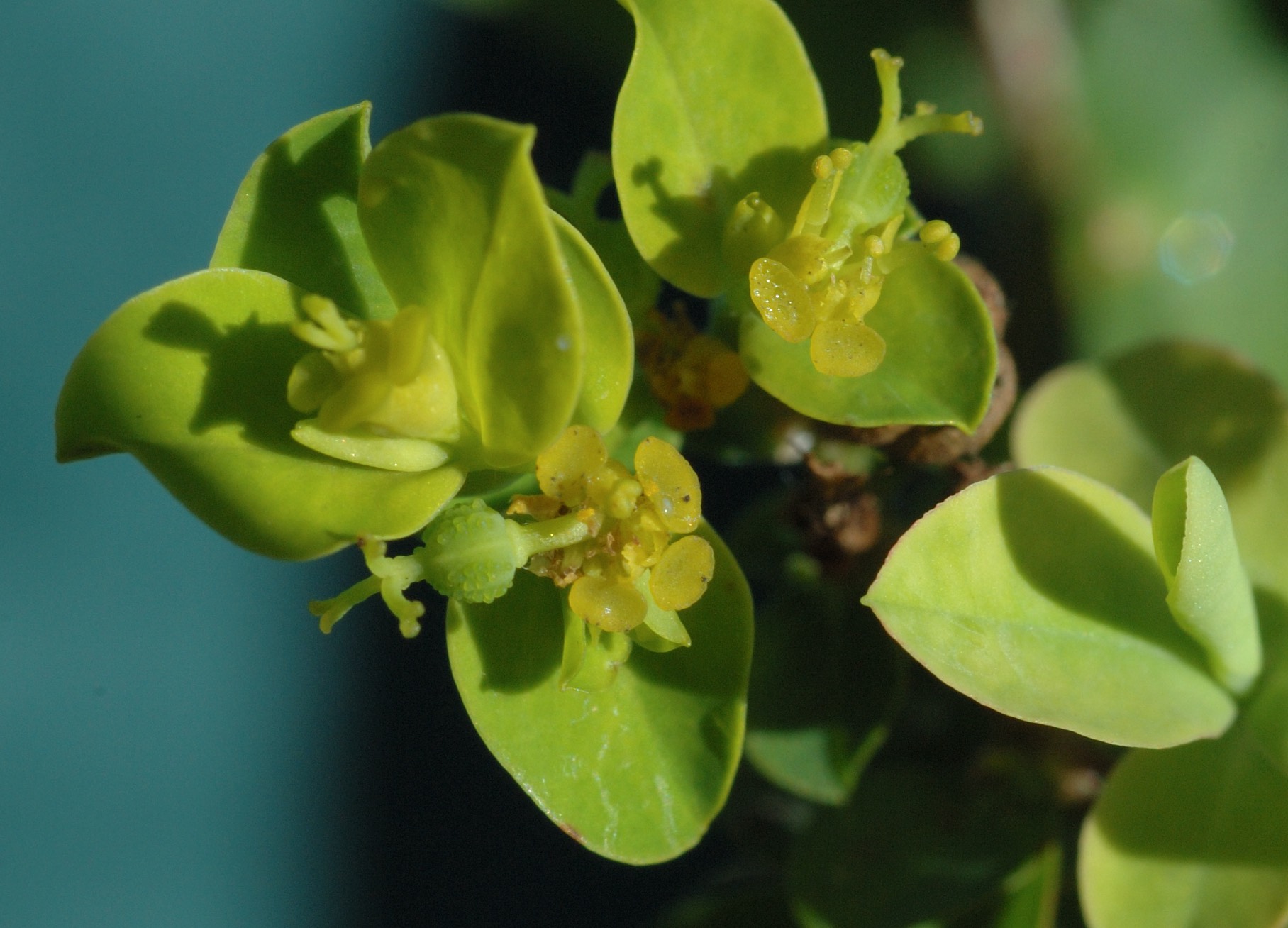
In most herbaceous species the stems are rarely branched until the flowers are produced. The cluster of flowers, which may be present as soon as the shoots start to grow, are surrounded by many leaves, often coloured. Then the stem branches a lot, sometimes resembling an umbel. As each cluster of flowers open, more side branches appear from below this and the head of flowers expands. Usually there are two floral leaves behind each cyathium which, in most shrubby species, are rounded. In herbaceous species new growth appears from below the inflorescence to eventually cover the old blooms.
These floral leaves (or bracts) are most often lime green or lemon yellow and remain colourful long after the real flowers have done their job and are developing into seed pods. This is similar to other plant families and particularly the Asteraceae. In many plants of that family the ‘flowers’ are actually ‘flower heads’ with a ring of sterile ray florets that are persistent and attract pollinators as the many fertile flowers in the centre open. A similar technique is present in lacecap hydrangeas and Viburnum plicatum, among others. This division of labour – long-lasting bracts or floral parts that attract pollinators to small, highly efficient flowers – saves a lot of ‘energy’ compared to flowers that have to both attract and be functional.
From a gardeners point of view, most of these shrubby euphorbias are quite similar to hellebores where we have truly herbaceous kinds and shrubby kinds. In both genera the stems are generally biennial, growing from the base one year and then blooming at the tip, setting seeds and dying when they should be cut away. In euphorbias there is a complication because some are truly woody and grow into shrubs. I will get those out of the way now.
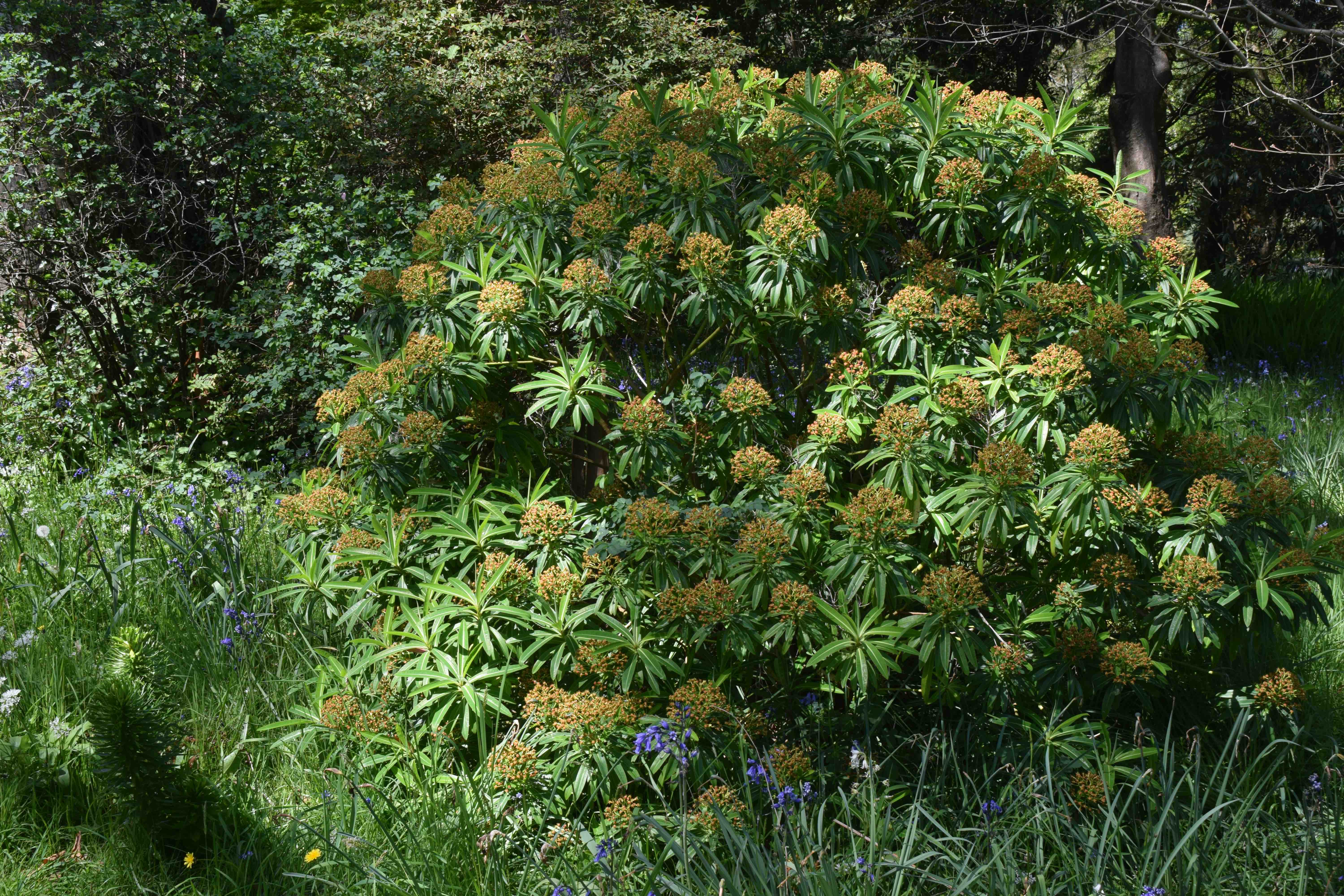
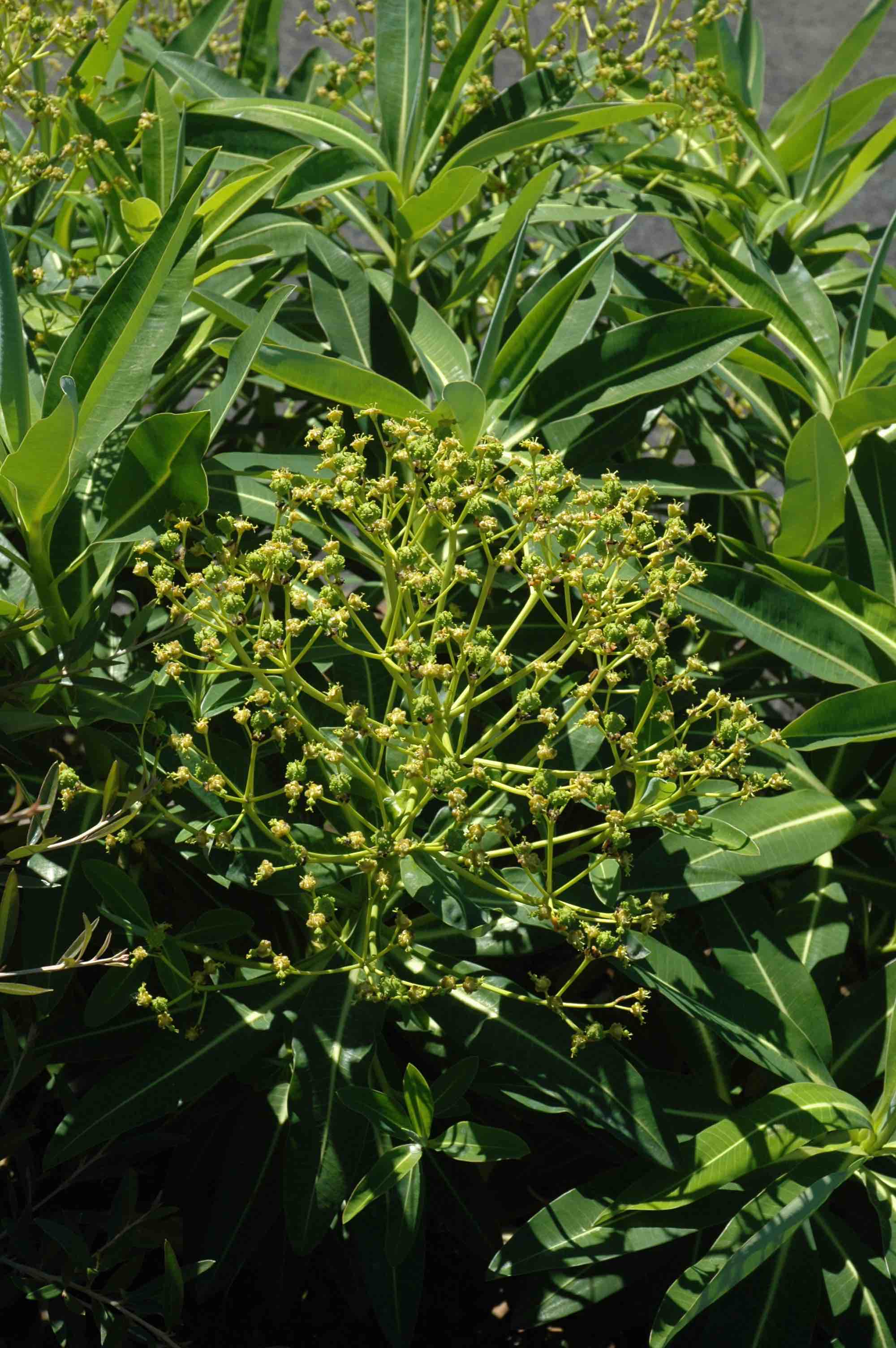
The most common is Euphorbia mellifera, a wonderful, evergreen plant with late spring blooms heavily scented of honey. According to source, the flowers can be golden or copper brown. In most of the UK it is decidedly tender, native of the Canary Islands and Madeira. But it thrives in mild, coastal areas. Near here, along the Wexford coast, it has naturalised and is a gorgeous sight. I have never dared plant one in this garden but I have noticed that there is a large plant ‘up the road’ that seems impervious to wind and frost so I will add one this year. Near the house, planted in the hardcore drive, where I have experimented with other shrubby species, it should be able to cope because of the ultra-dry soil. The flowers attract bees and also flies. It can reach 3m high and wide.
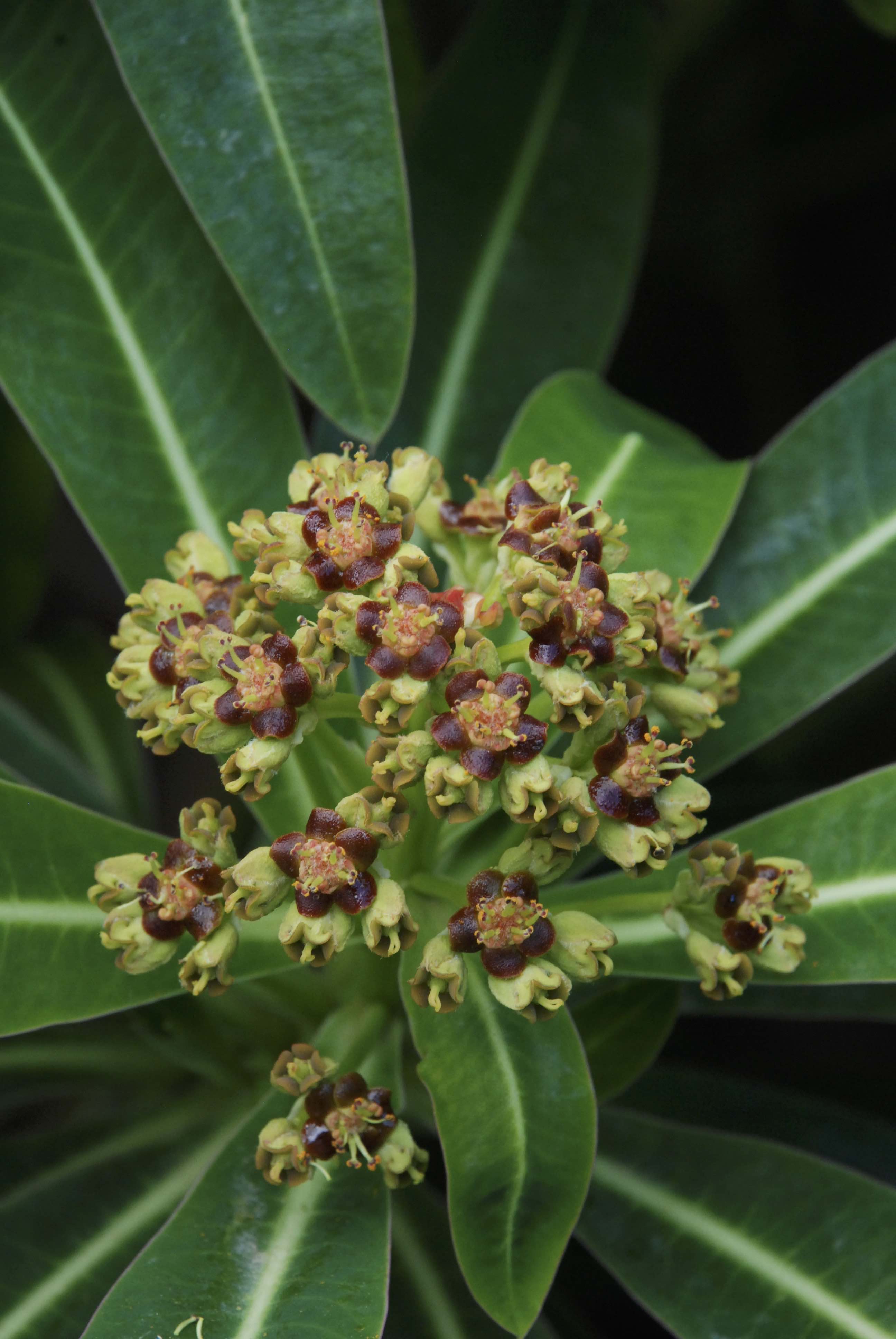
Euphorbia stygiana is similar but even taller and the foliage is even more striking. Native of the Azores it is of similar hardiness and also has flowers scented of honey.
So we finally come to something everyone knows: Euphorbia characias. This is small shrub from the Mediterranean region. It has upright stems, often tinged with red, clothed with narrow, greyish leaves which are often hairy, especially in the variety ‘Portuguese Velvet’. The main ‘trunk’ makes new shoots at the base which are biennial. At the end of the first growing season the shoot tips bend over to protect the developing flowers and they unfurl in February and March to create an, often cylindrical, head of blooms. After flowering, the fading inflorescences are prone to aphid attack, again in common with hellebores, and should be removed at the base to allow the next set of stems to grow.
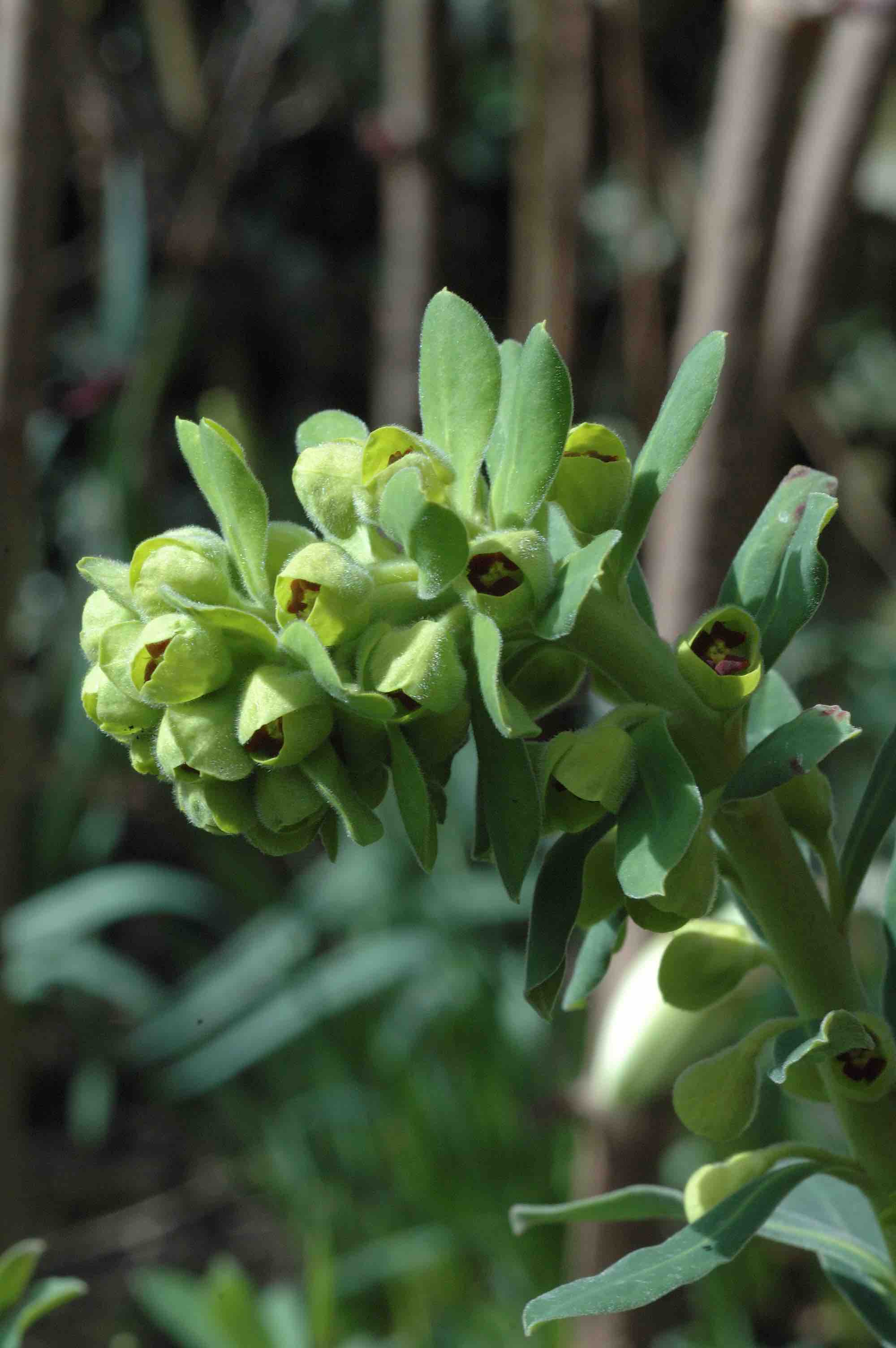
There are two subspecies. Euphorbia characias subsp. characias is from the Western Mediterranean and has dark red or purple or brown nectaries. From the eastern part of the range subsp. wulfenii is found and is slightly larger in habit, sometimes approaching 1.5m in bloom. The nectaries are golden and I much prefer these because of the sheer amount of colour they produce when blended with the lime or yellow bracts.
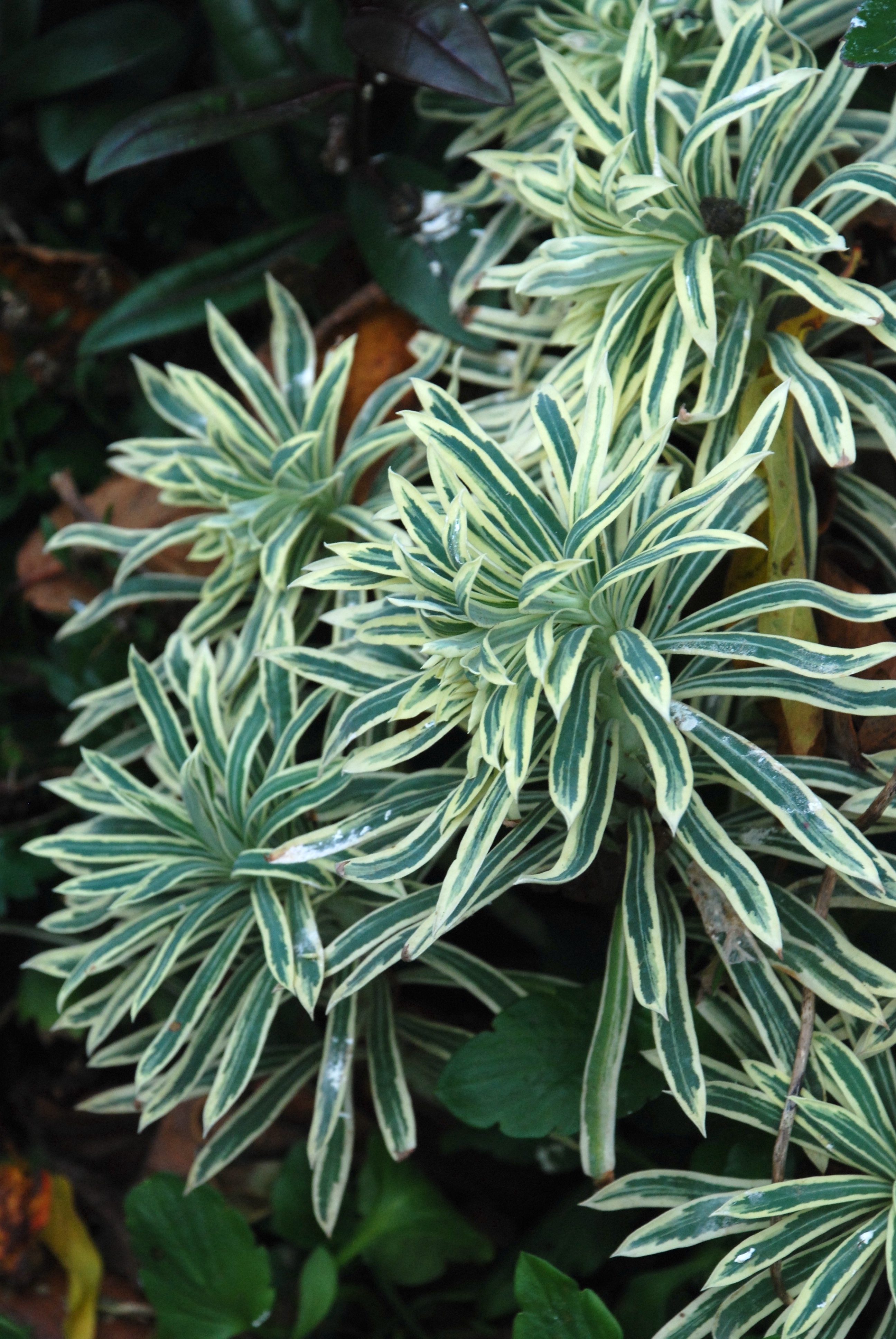
Because I am contrary it happens that of the many cultivars for sale, I have, at present, ‘Purple and Gold’ which has leaves flushed with maroon at the moment which fades in warmth but will still muddy the brightness. Over the years several variegated kinds have been introduced. Most have leaves edged with white. Some are annoyingly unstable. I currently have ‘Tasmanian Tiger’ which is behaving itself. Once again, the impact of the flowers is rather spoiled by the variegation and the flower heads are smaller than normal because of lack of vigour but it is a nice thing.
All are pretty hardy but they do need good drainage and full sun. Where they are established, and in mild gardens, they can seed around and pop up. They always look best when growing in gravel or among rocks.
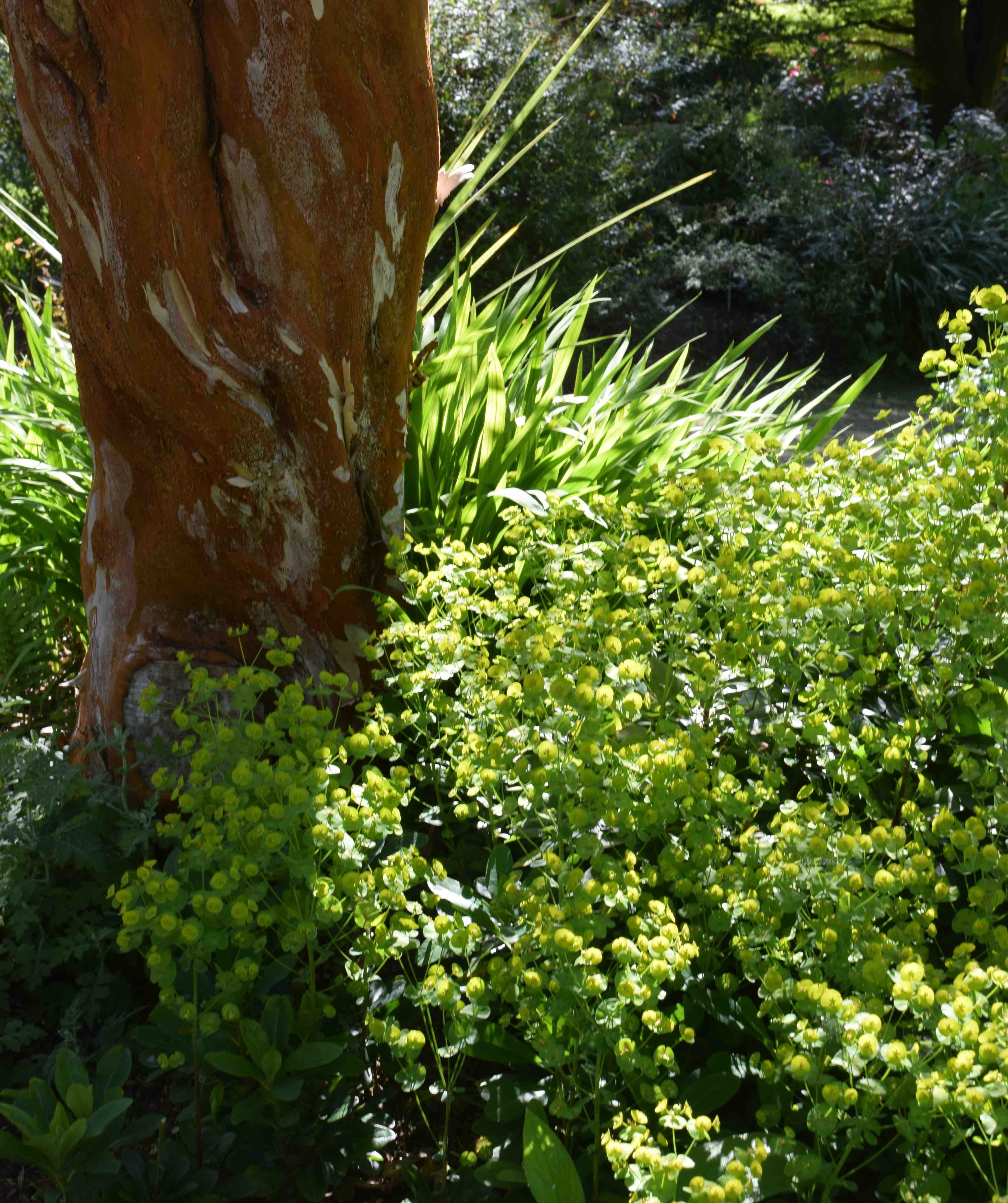
Although not obviously similar, the native E. amydgaloides, which grows in light woodland, is also ‘shrubby’ though much smaller. It has a subtle beauty and is not often planted in gardens apart from the forms with purple leaves which are delightful. It is important because, in nature and in gardens, it has hybridised to create E. x martini. But before I ignore it completely I must mention a form, called Mrs Robb’s Bonnet, (E. amydaloides var. robbiae) because it is such a useful plant. It has a creeping rootstock and upright stems set with glossy, deep green leaves and forms good ground cover in shade, even under trees. The rather loose flowers are very attractive in late spring, gradually changing to burnished shades, after which they should be clipped off. It was found and collected by Mrs Robb in Turkey in 1891 and brought to the UK. She was travelling near Istanbul, noticed the plant, had the car stopped, and dug it up. Having no other receptacle, she kept it in her best-hat box, presumably wearing the hat, to bring home.
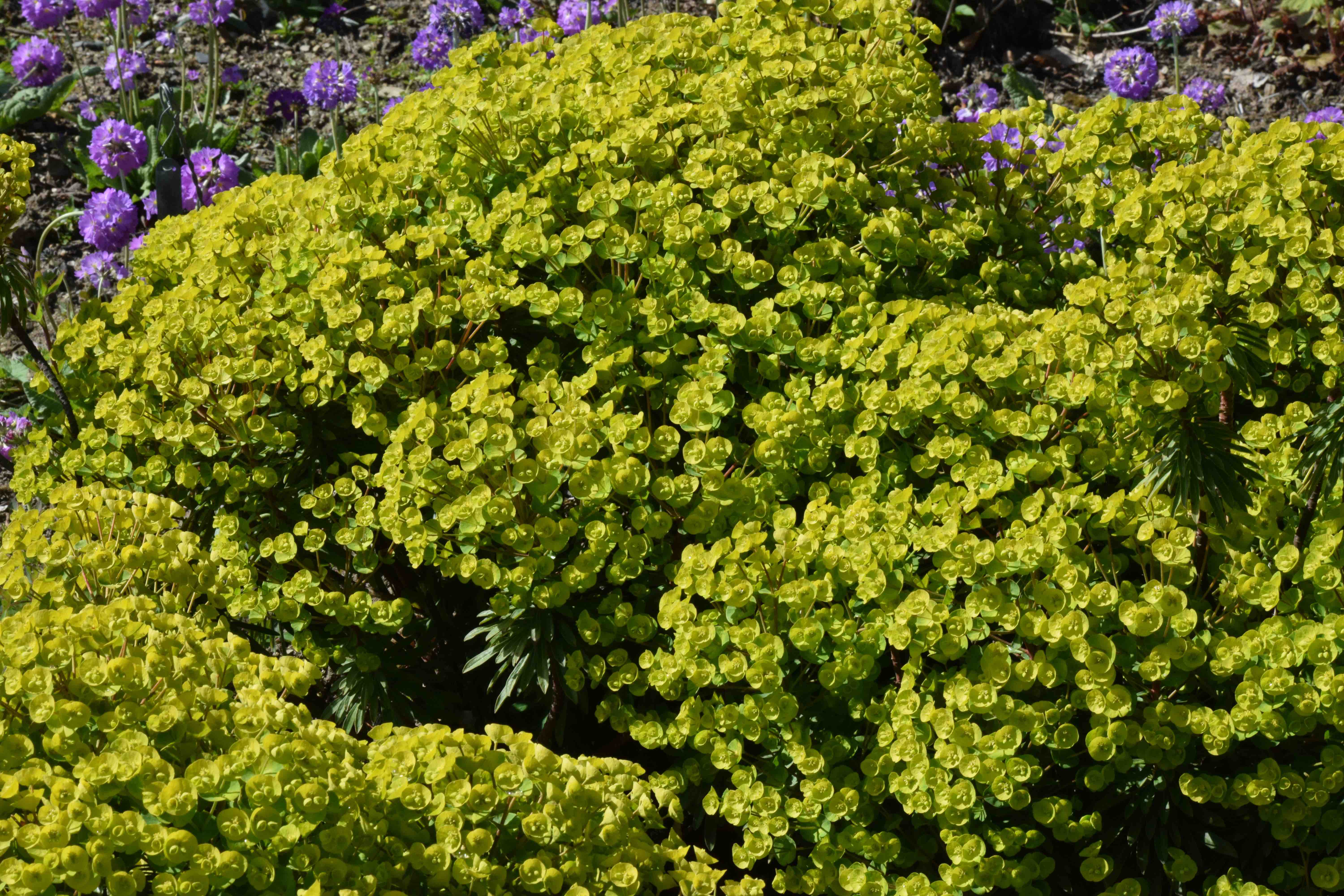
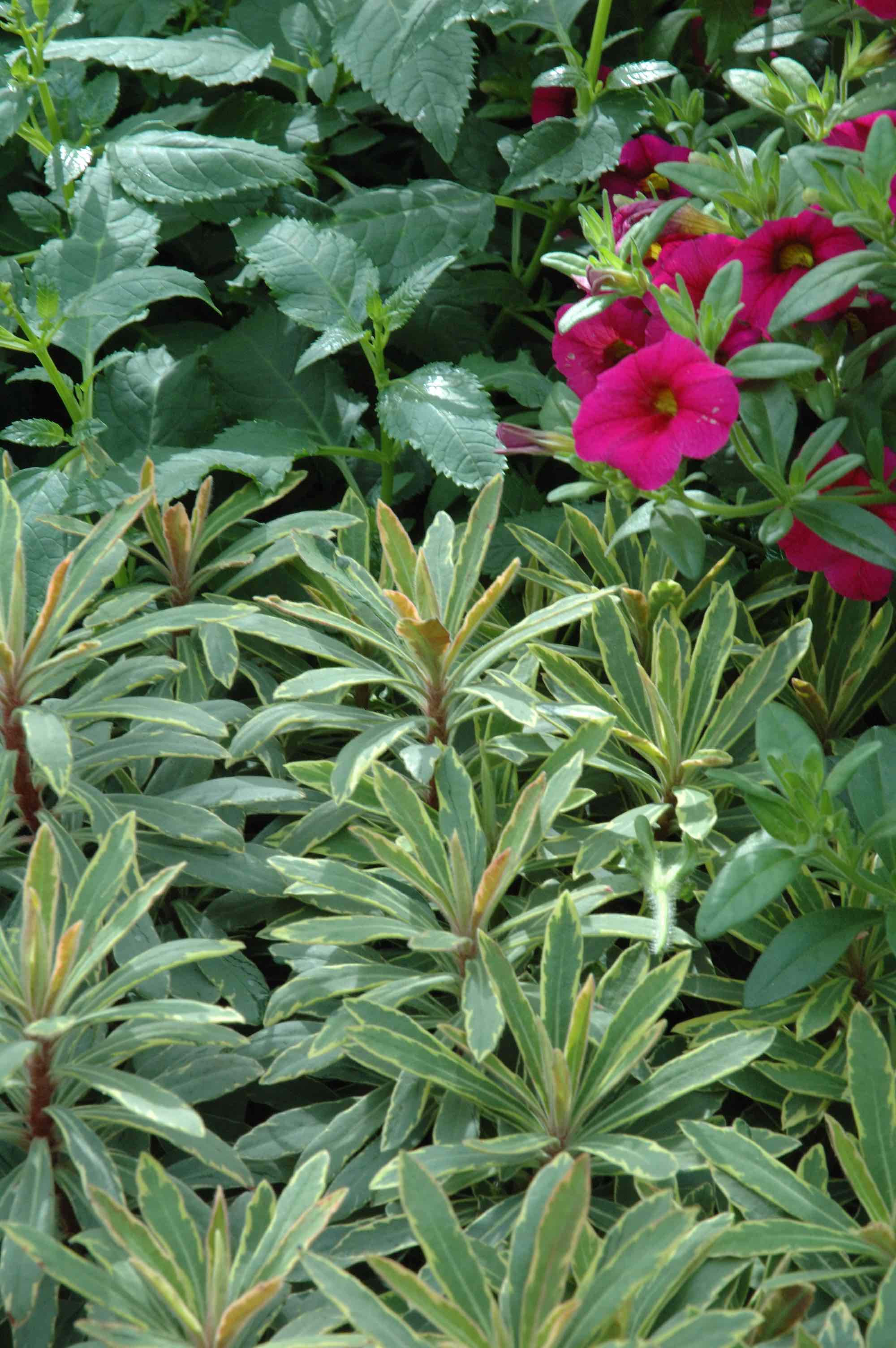
Euphorbia x martinii combines the best of both parents. The leaves are usually green and slightly hairy. Stems are usually flushed with red and plants are compact, no more than 60cm high when in bloom. They make neat, domed plants but tend to get congested and scruffy after a few years unless studiously tidied of old stems. They now make up a major proportion of the small plants sold for winter containers and they are very effective and hardy though the very small plants in 9cm pots will take a year to reach a size where they will make much impact. The flowers are lime green and the nectaries are usually reddish. The most popular is probably ‘Ascot Rainbow’ which is pattered with yellow on red-flushed leaves. It is a plant for all seasons although I do prefer plants that look less like a dropped trifle.
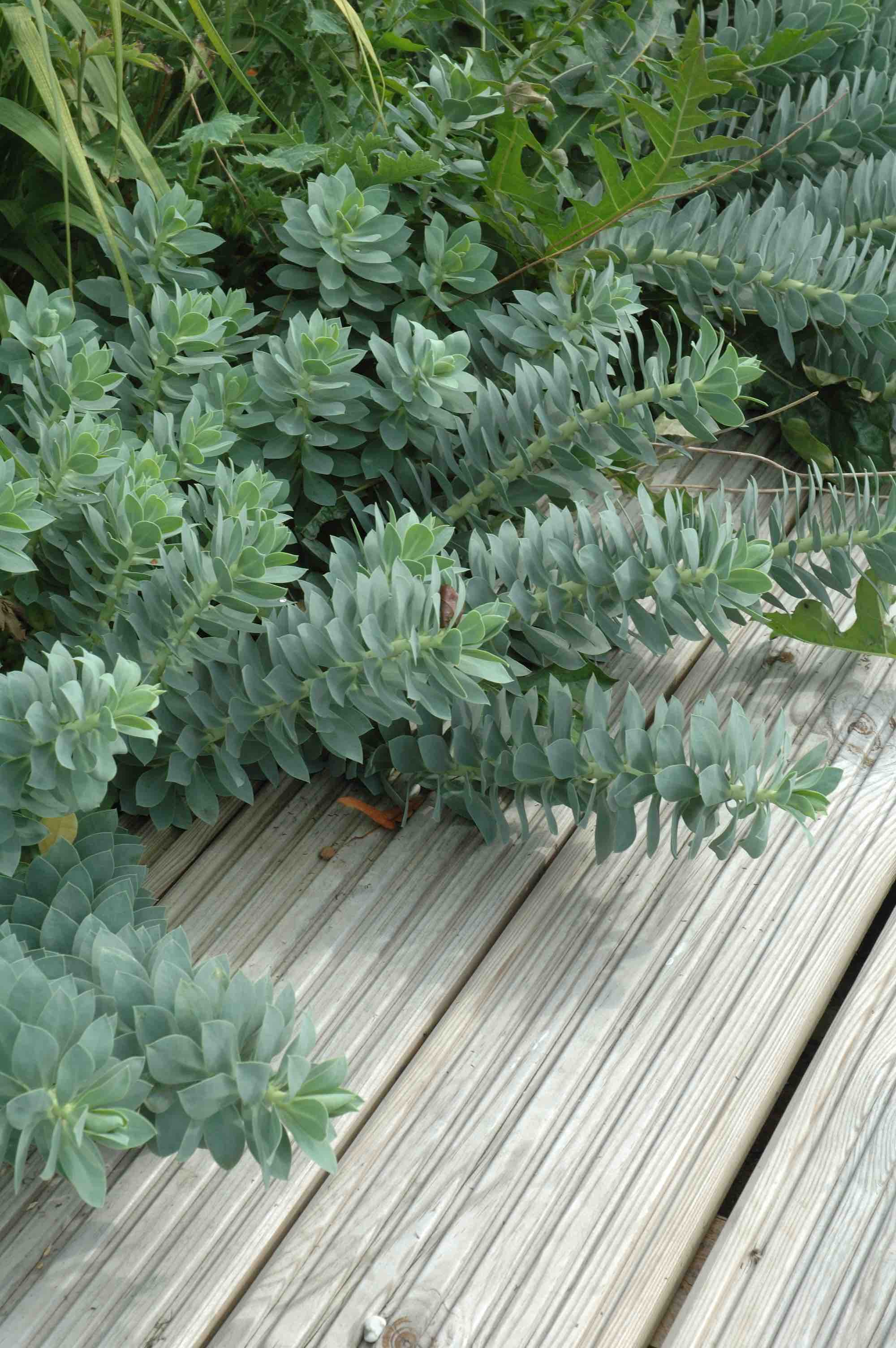
As I conclude the shrubby species, although I am sure you know more, we come to E. myrsinites. A sunlover that demands well drained soil, it is native to the eastern Med. It produces rambling stems set with pointed leaves of blue grey that form loose (rarely weed-suppressing) mats. In the second year the tips carry neat heads of lemon yellow flowers. It is a lovely plant to ramble over rock walls and gravel. New shoots grow from the base of the old stems.
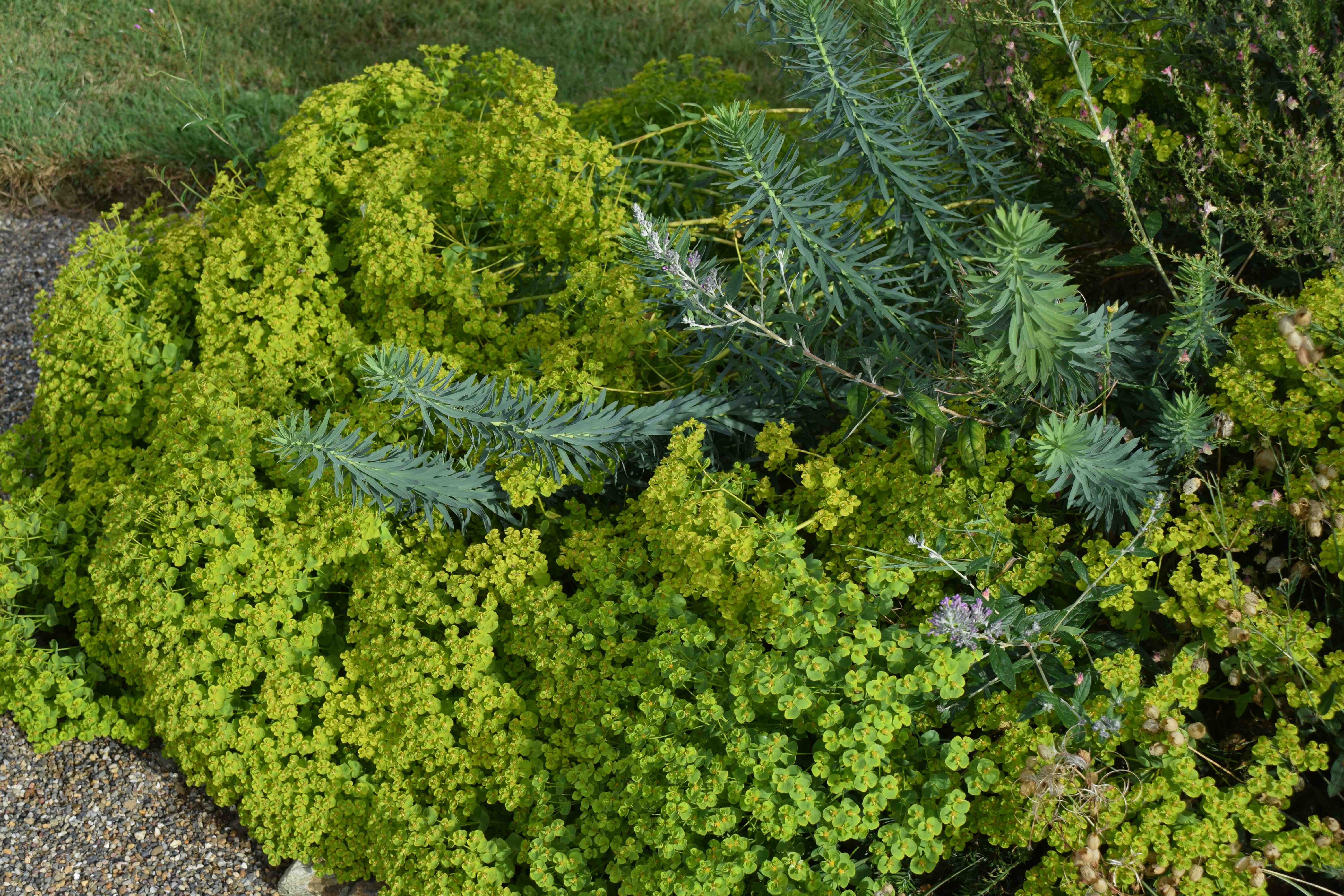
Euphorbia seguieriana subsp. niciciana is similar but has finer foliage and stems and huge heads of flowers. I have it at the edge of a bed where it spreads over the lawn and gravel path when in full flower, a minor error. I chose the spot because it is well drained, at the base of my cork oak. I really need to take cuttings this spring and plant more in the gravel patio.
All these can be propagated from young shoots in spring. The base of the cuttings should be placed in dry, fine sand or dry soil (old books say ash) to staunch the flow of latex before rooting.
Euphorbia characias is frequently raised from seed, even the named cultivars, which is unfortunate because many named cultivars are now just seedlings and not the same as the plants which we read about including Margery Fish’s ‘Lambrook Gold’ and ‘John Tomlinson’ which were the first I ever grew, and magnificent, but are now considered poor because they are not the real thing.
Next post will be some herbaceous species.
 The Biking Gardener
No comments yet.