In for a penny
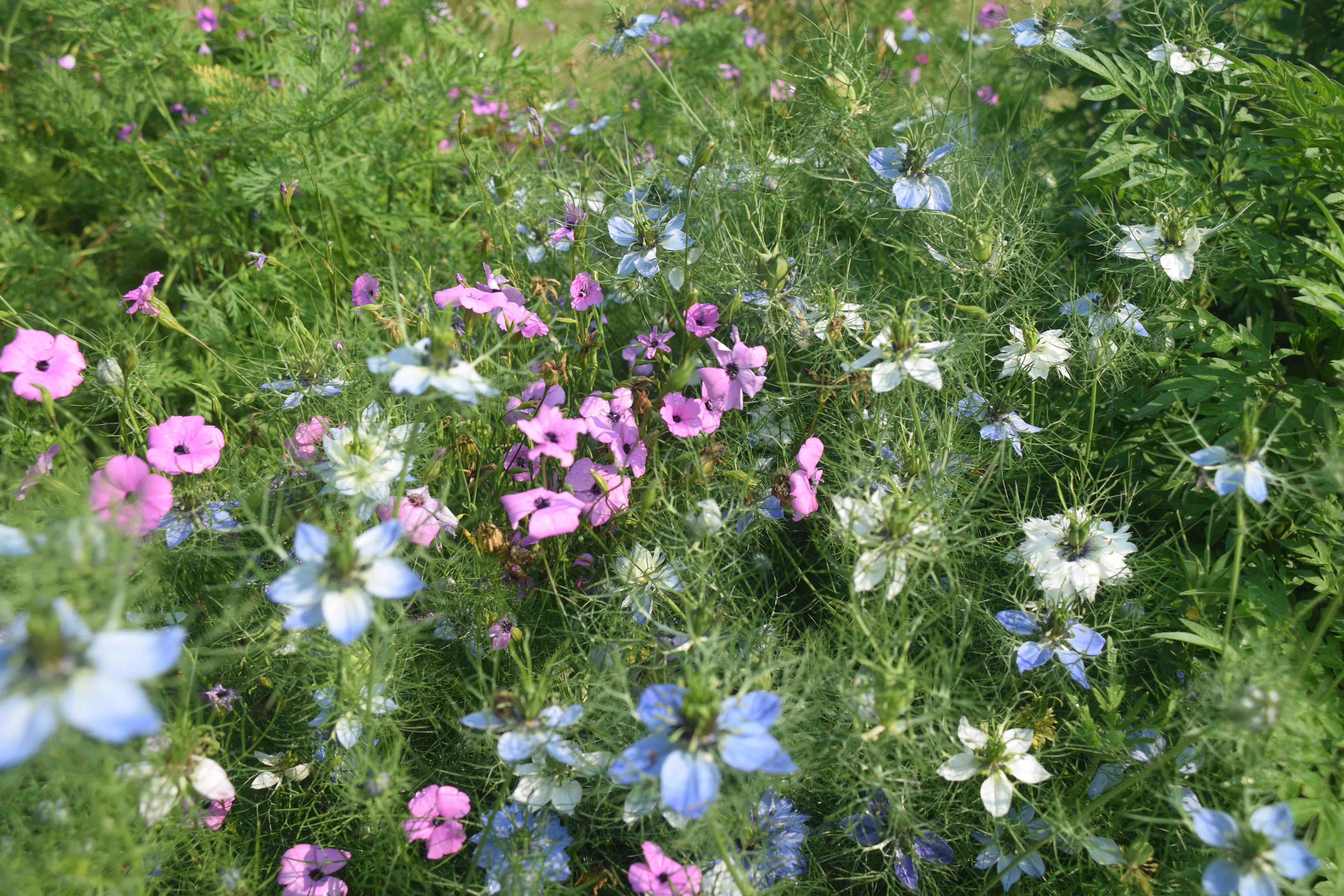
Hardy annuals are among the cheapest way to add colour to the garden. While they may not quite cost pennies (or cents) they are certainly often inexpensive. They are also often wonderful for pollinators. I grow lots each summer and some please me more than others.
In my raised bed where I attempted carrots this year (with some success) I sowed some annuals. This was to fill gaps left where the carrots did not germinate well. It was dry in spring and I struggled to keep the bed constantly moist, having to carry cans down the garden to them. Germination was a bit erratic. I also sowed some annuals every third row. These were viscaria. Viscaria occulata is an old-fashioned annual with slender leaves and a wispy habit. It has the virtue of flowering over a long period compared to most annuals though the habit is a bit straggly – not a problem when it is flopping against the carrot leaves. Unfortunately it has suffered some really severe nomenclatural ‘fiddling’ and is listed as both Silene coeli-rosea and, it seems, more recently Eudianthe coeli-rosa which is really annoying! I sowed an inexpensive mix and hoped there would be plenty of the lavender flowers that I like the most but I really should have sown ‘Blue Angel’ to be sure of that. The mix is pretty though but is strangely completely ignored by bees of all kinds.

In the areas where the carrots failed to germinate I sowed a pack of mixed nigella. Most nigella in gardens are derived from Nigella damascena, commonly called love-in-a-mist or devil-in-a-bush, the first derived from the lovely flowers set among wispy, thread-like foliage, the latter after the horned seed pods on the plants. Some have edible seeds but it is best not to experiment with others because they are in the Ranunculaceae, which includes some very poisonous plants, including aconitum. Another feature of the family is that the showy parts of the flowers are sepals and not petals (clematis) or both (aquilegias). Nigella flowers have showy blooms thanks to the large, colourful sepals but in the single forms and in the species, there are also petals. But they are small modified into nectaries. They are often intricately patterned but small and drop off the blooms before the sepals.
Watching the bees on the flowers it was interesting to see that they completely ignored the double forms, without nectaries but were busy visiting the single forms where they landed on the sepals and went straight to the centre of the blooms feeding on each nectary in turn.

The flowers are also intriguing for the way the stamens curve down, a few at a time, as the flowers mature.

The mixture was not as ‘balanced’ as I had hoped and was largely just ‘inferior’ forms of N. damascena but there were some others. These included the yellow-flowered N. orientalis. The flowers are not large or showy but they have some charm and it has large seedheads. Each carpel can be opened on the dry seed pods and bent back to ‘create’ a showy dried flower if you like doing such things. It is often sold as ‘Transformer’ though you have to do the transforming yourself!

And there were a few plants of Nigella bucharica, one of my favourite species. Here the nectaries, which are usually ‘two-pronged’ are linear and quite showy, creating a ‘crown’ of filaments that could be said to resemble a passion flower if you were desperate to sell the seeds (my comparison, not one I have seen in print). The flowers are small but very pretty. The seeds of this one can be eaten but I am in no hurry to try.

 The Biking Gardener
A good selection!