The best fruit in the world?
Humans love to classify things and divide them into groups. I think people can be divided into ‘strawberry people’ or ‘raspberry people’. I am definitely a strawberry person and although I like raspberries, I prefer the soft, sweetness of strawberries. This is logically reinforced by my preference for milk chocolate; I like dark bitter chocolate but I can only eat a little whereas I could eat vast quantities of milk chocolate (good quality of course and never ‘Hershey’s’). I know this is what food manufacturers rely on, which is why processed food is bland and sugary. It is why modern Brussels sprouts are being bred to reduce their natural bitterness. Unfortunately these bitter compounds are what often make foods beneficial nutritionally. As an aside, I love olives but only a few. My craving for their bitterness is quickly sated, but those two or three are delicious.
Anyway, I suppose I have tastebuds that were trained by my Western diet to desire bland and sweet. I would always pick out the red ‘Opal Fruits’ or wine gums as a child.
Therefore it is odd that my favourite fruit is the mulberry. I know that all fruits are delicious; they are designed by nature to be irresistible, so their seeds are dispersed. I suspect that the title of the best fruit is most often applied to good mangoes, though pineapples are pretty exciting. A fully ripe apricot picked off the tree is a fine thing and the same is true of peaches. Apples are so common-place that we take them for granted but a good apple is also a superb gustatory experience.
Most people are unaware of how fine good fruit can be because ‘exotic’ fruits are shipped long distances and picked unripe. Even apples are frequently imported so familiar varieties are available year round. I have nothing against Pink Lady ® (‘Cripp’s Pink’) and it is a decent apple, but like ‘Rooster’ potatoes is usurping other choices from our shops. At least it is better than the French ‘Golden Delicious’ that was the universal shop apple of my youth and less exciting than eating turnips.
I like the variation that comes from eating seasonally. And it is the season for mulberries (Morus nigra).
Mulberries are not something I ate as a child – I was not brought up in some bucolic fantasy estate with peacocks and centuries-old mulberry trees. But in my teens I worked at a garden centre, that was previously a nursery, and there was a mulberry tree. I have mentioned before that mulberries are among the ‘wisest’ trees, only coming into leaf after the last spring frost and that would make it useful to gardeners on a nursery. Every summer, in August, I would have my lunch sitting on tall stacks of peat bales gorging on ‘George Cave’ early apples and finger-staining mulberries. You can’t eat mulberries clandestinely, they stain everything!
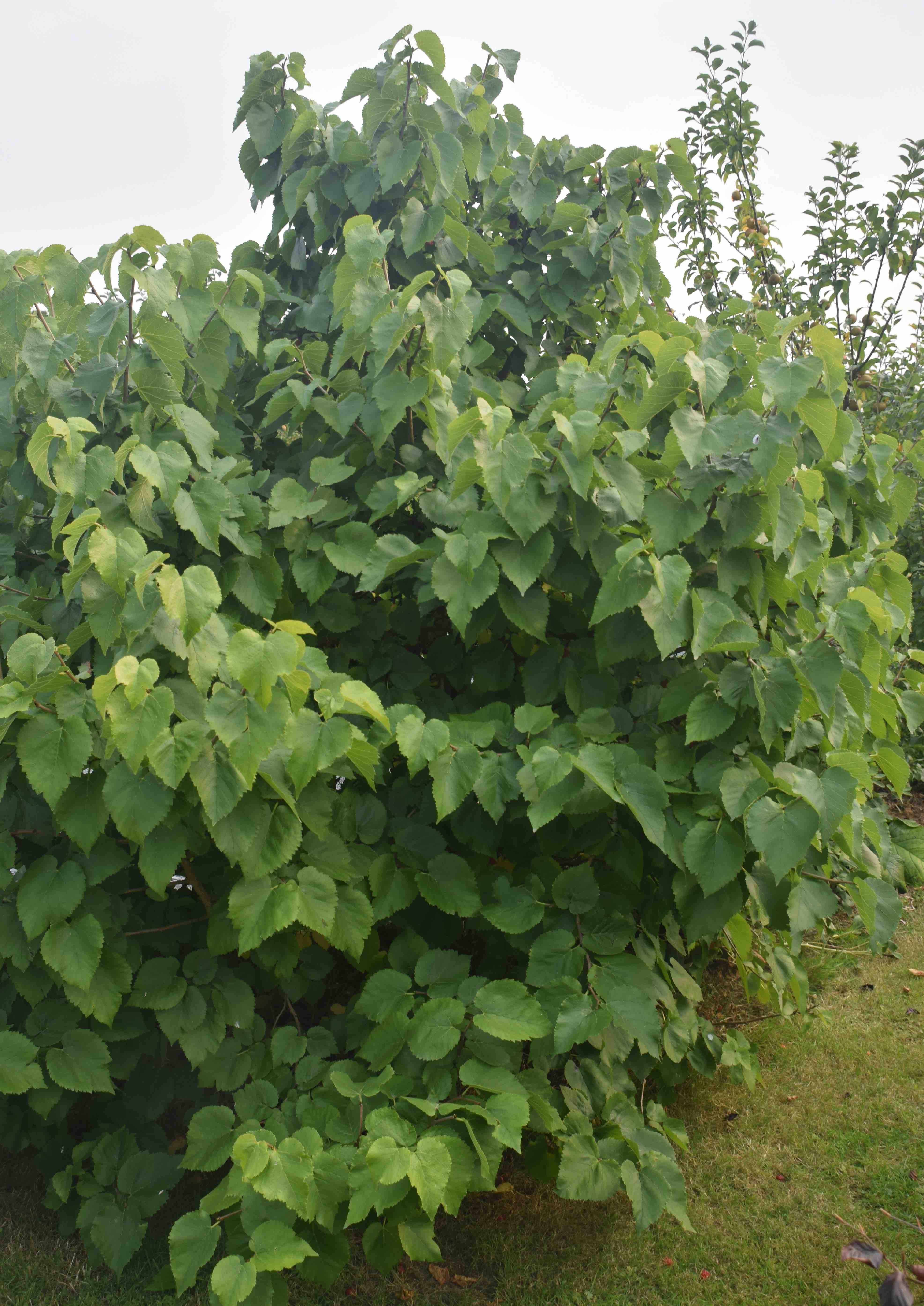
I doubt that you can ever buy mulberry fruits – they are so delicate they are damaged no matter how carefully you pick them. The traditional way to pick them is either from the grass under the tree or to place a net or blanket under them and to shake the tree gently.
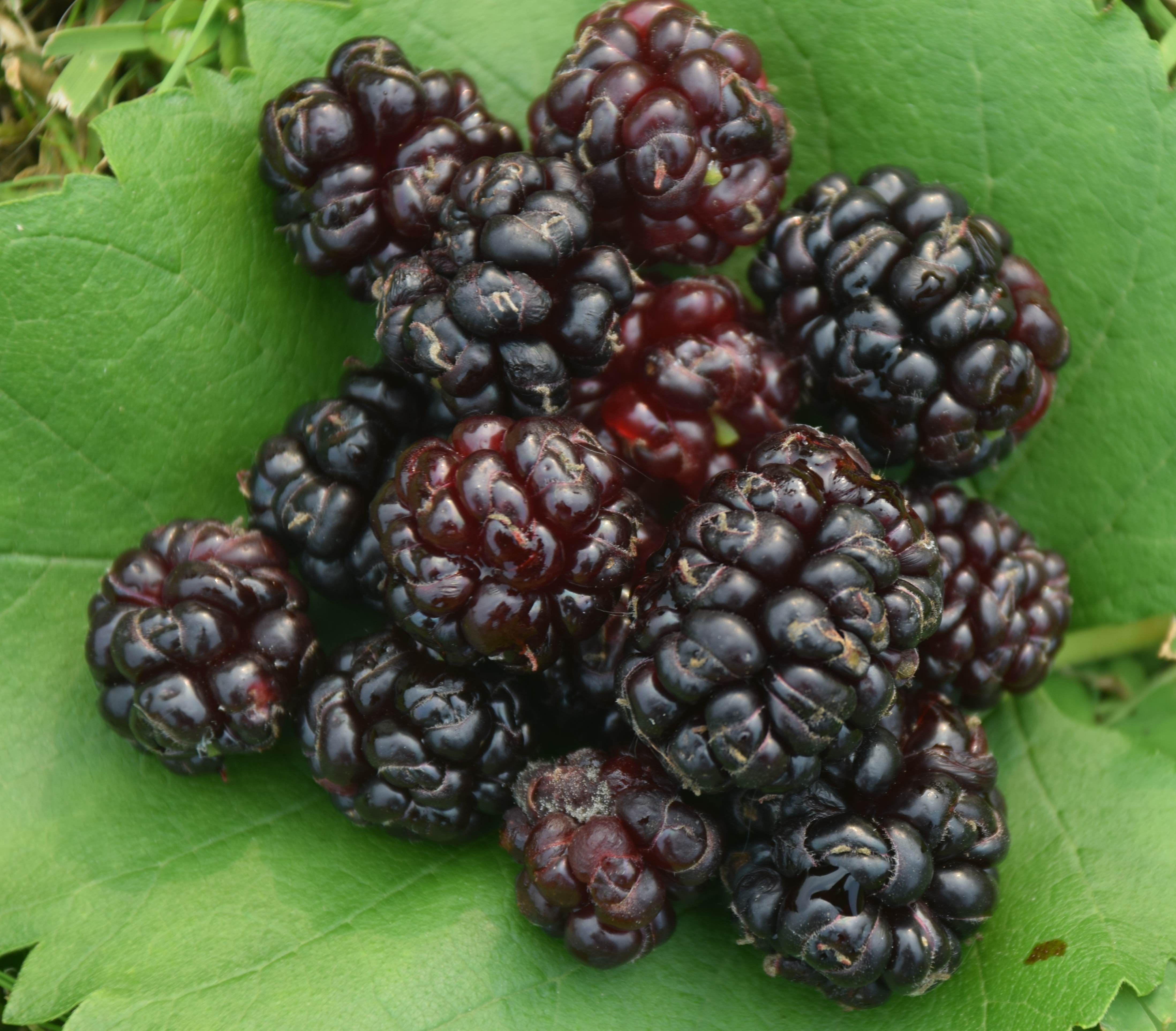
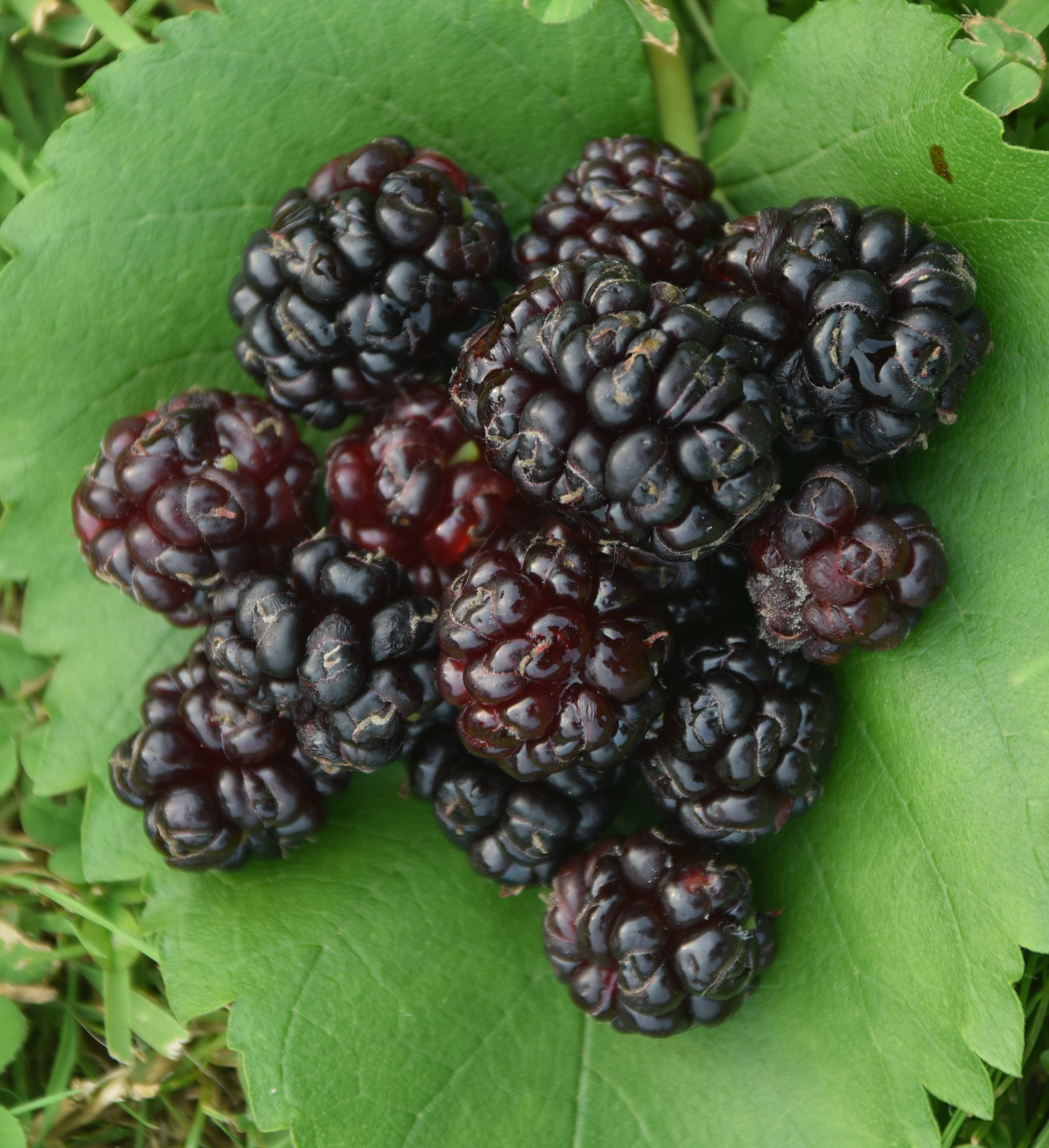
The fruits are creamy coloured at first, changing to scarlet and then through purple to almost black when ripe. At that stage they are so soft they melt in the mouth, apart from the central core. They flood the mouth with zingy, sweet juice. The taste is unlike any other fruit – don’t think these are just fancy blackberries! Ironically, the old English name for mulberry – morbeam – means both mulberry and blackberry and murrey meant purple (and used most often to refer to the colour of cloth), from the French mûre, and that means both blackberry and mulberry in French.
The flavour is rich and almost ‘winey’ or ‘jammy’ with a kick of acid that keeps it refreshing. Because the ‘tartness’ is affected by ripeness, each fruit tastes slightly differently but if you get one that is so ripe it is almost impossible to handle, the reward is sweetness and richness unlike anything else you have tasted.

Picking them is a pain! The fruits ripen over several weeks so you have to pick over the trees every few days. The fruits are hidden among the leaves and the best way to find them is to get ‘into’ the tree and look out so you can see the fruits against the light. From the outside of the tree you may not see any fruit at all! The foliage is rough and like sandpaper (Morus alba has foliage that is shiny on the upper surface) so picking is noisy too. This year I am making some jam so as I collect them each time I am freezing them until I have few Kg – less the fruits that are being eaten fresh, of course.
The mulberry is a strange fruit in many ways. Of course most children have sung ‘here we go round the mulberry bush’ without ever seeing one. The fruit itself is composed of many fruits, each composed of four swollen sepals. It is the type genus in the Moraceae, a family of diverse and extraordinary plants, best known for the figs. The common fig (Ficus carica) is itself a strange fruit and Ficus an incredible genus with huge variation. As a rule, the flowers have no beauty and that is true of the mulberry. The flowers are truly insignificant and the females just green structures with white, protruding stigmas. Trees are said to be dioecious or monoecious but I have to say I have only seen female flowers on my tree and yet fruits form. To complicate matters apparently trees can change sex.
The other extraordinary feature is that the species is a tetratetracontaploid. Most organisms are diploid with two sets of chomosomes. Some apples are triploid with three sets. Some plants are tetraploid with four sets, usually artificially created to make plants that have bigger flowers or have more vigour. But the mulberry has 44 sets of chromosomes. Bonkers!
The black mulberry has been cultivated for so long that the native range is unclear. But it is thought to be native to the area to the south of the Caspian sea (Iran, Azerbaijan, and Turkmenistan). It has long been cultivated in Europe and Linnaeus believed it was native to Italy. Its image features in ancient Roman and Greek mosaics. When it reached Northern Europe is unclear but it was certainly before the 11th century.
The most famous (or infamous) introduction was in the 17th century when, in 1607, King James VI decreed that mulberries be planted to establish a silk industry in the British Isles to avoid the need to import silk from China. Of course it was doomed because silkworms prefer the foliage of the Asian Morus alba. But it led to the establishment of the black mulberry in Britain. Some of these old trees still survive. When he attempted to do the same in the new territories in America he did indeed send the correct species. Morus alba hybridises with the North American native Morus rubra but M. nigra does not.
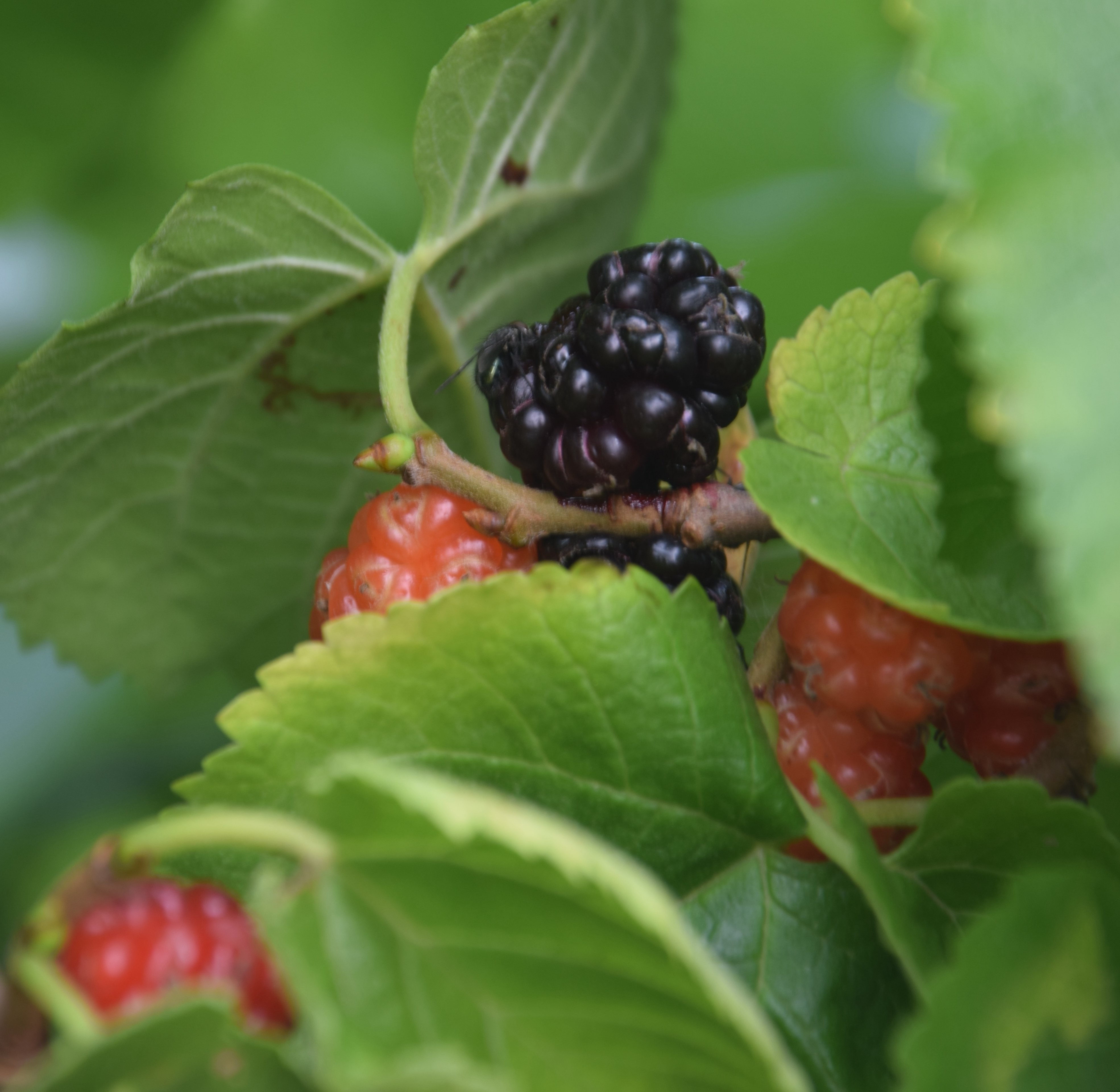
As a garden tree the black mulberry is attractive in a quiet way and assumes a gnarled and ‘old’ appearance that belies the youth of a tree. As such it is a perfect lawn tree, not too big, with a sense of antiquity and the position makes harvest easy. My tree is six years old and has cropped since the second year but it is now producing a decent crop.
In theory it prefers a sheltered spot and a warm, well-drained soil but mine is in my heavy soil that does not drain that well in winter and seems perfectly happy. I do need to do some pruning and shaping to lift the crown so I can get to the fruit more easily. It is easily propagated by hardwood cuttings – even large ones 1m or more in length so I will try that when I prune it.
Despite the long period in cultivation it is believed that there is very little genetic diversity among the plants in cultivation. There are many cultivars offered for sale but they are said to be unlikely to be distinct but just named after their origin. ‘Chelsea’ is the most common, presumably derived from the tree at the Chelsea Physic garden, sometimes said to have been planted by King James himself (unlikely). It is often said to have larger fruits and heavy crops.
A variety called ‘Shakespeare’ comes from the garden of the writer. ‘Plants sold as ‘Shakespeare’ are descendants of a tree that grew in the garden of the famous playwright William Shakespeare in Stratford, England, in the early 17th century. Cuttings were taken in the 1750s when the tree was felled by the owner who was annoyed by tourists coming to see it.’ (‘Bean: Hardy Trees and Shrubs’)
What makes identification of cultivars difficult is that trees have leaves of extraordinary variability. Some leaves are cordate (heart shaped) but often they are lobed.
This is already a long post but I need to mention other mulberries. I am just postulating here but in Cyprus I bought huge, long mulberries in the shops. They were sweet but very bland and I believe they were Morus alba. I have also planted the ‘Mojo berry’ in the garden, a Japanese hybrid that is supposed to fruit for long periods but I read that it was not very hardy. It has not done well and struggles to grow and is almost dead. I am not very worried.
A black mulberry is a wonderful garden tree, ornamental and productive. You will get a crop of a fruit that you just can’t buy in the shops. The fruits are delicious and perfect for jam, ice cream and so much more. Just don’t plant it near washing lines or paving. The fruits stain and birds will spread the stains.
 The Biking Gardener
Fruit was overly abundant for those of us who grew up in the Santa Clara Valley decades ago. However, mulberries were very rare. There were no mulberry orchards that I can remember. Mulberry trees were only grown as decoy trees to distract birds from more important orchard commodities. They grew on the outskirts of orchards. Consequently, they were the first trees to be removed as roads were widened to accommodate the urban sprawl of the Santa Clara Valley at the time. Of course, all the orchards are gone now; but at least I can grow mulberries within my own garden.
I can imagine how effective mulberries would be to distract birds away from other fruit.
I suspect that it must have been effective; otherwise, it would not have been such a common technique. However, I do not remember them ripening at the same time as the apricots, cherries, or whatever the fruit within the associated orchard was. I know that different varieties were used for different orchards, for example, early varieties were used for cherries, but they all seemed to develop fruit either before or after fruit was ripe within the adjacent orchard.