Almost good enough to eat

I am always keen to try new edible crops. In most cases I grow them once. They either take up a lot of work, are eaten by slugs before I get to eat them, they are not really that nice or I forgot to grow them again. Things that are easy to prepare and eat tend to get a second chance if they are palatable. But I keep looking for new, tasty, nutritious plants.
So I was intrigued to read about an edible cosmos. Although the common Cosmos binnatus is not edible, there is an edible species, C. caudatus. The yellow C. sulphureus, is supposed to be edible too. But back to C. caudatus. I had read that the leaves have a fruity taste, like mango. It sounded intriguing.
Of course it is not that surprising that there are edible cosmos. Cosmos is closely related to dahlia and some seed companies sell seeds of dahlias with edible tubers – the same as any other hybrid as far as I can tell. My issue with eating dahlias is the smell of the plants and, I am sure, the taste of the roots. And then there is the problem with eating tubers of these and sunflowers with oligosaccharides – that give you (me) wind.
Cosmos caudatus is an annual in my climate and you are supposed to eat the leaves. It is native to a large area from south Brazil to Mexico and the West Indies but has been introduced to countries around the world. It is commonly called king’s salad or ulam raja. It can grow to 2m and once it starts to produce the pink flowers it is not as productive with leaves so flowers are usually pinched off. My plants are very sturdy and show no inclination to bloom but perhaps it is a ‘short day’ plant. In addition, it has not been affected by the cosmos smut that affected the ornamental cosmos and led to me ripping them all out.
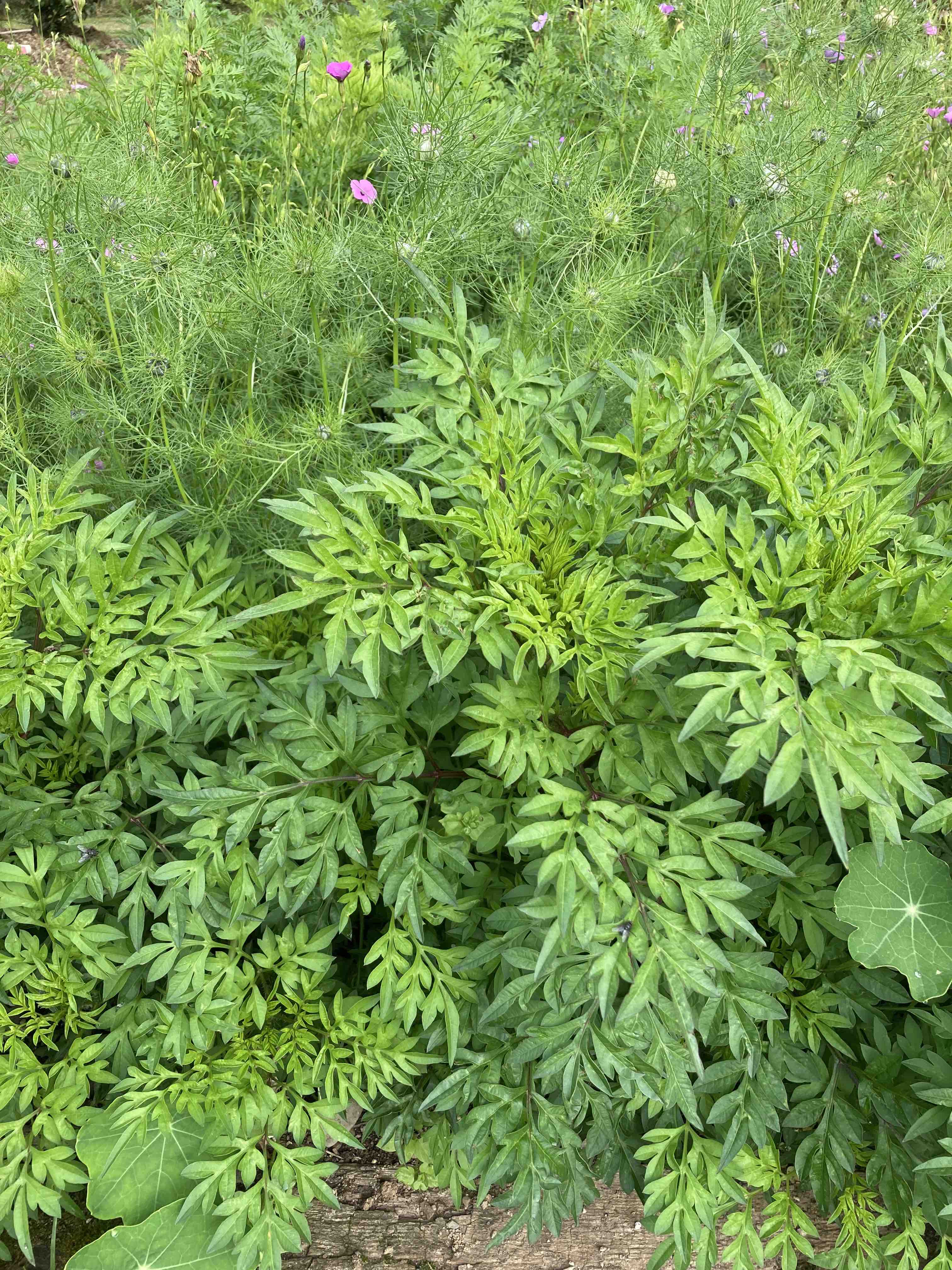
The foliage has many purported health benefits so adding some to salads can do no harm (I hope). So, what does it taste like? Well, I am not completely convinced I like it. The leaf stalks seem to have the strongest taste and are juicy and the leaves are a bit tougher. The taste, like so many of these South American ‘leaves’ I have grown (like papalo), taste rather as though the leaves have been rinsed in floor cleaner. I think the palatability of this and others lay in their use. I am sure that it would be fine sprinkled on burritos or other spicy Latin or Asian dishes but tasting it alone or in a traditional Northern Hemisphere salad does not really work. I will keep on experimenting because it is not awful. But it is not a replacement for lettuce.
 The Biking Gardener
I think that while you may eat it, you won’t gain much by way of nourishment.