What happened to my rose?
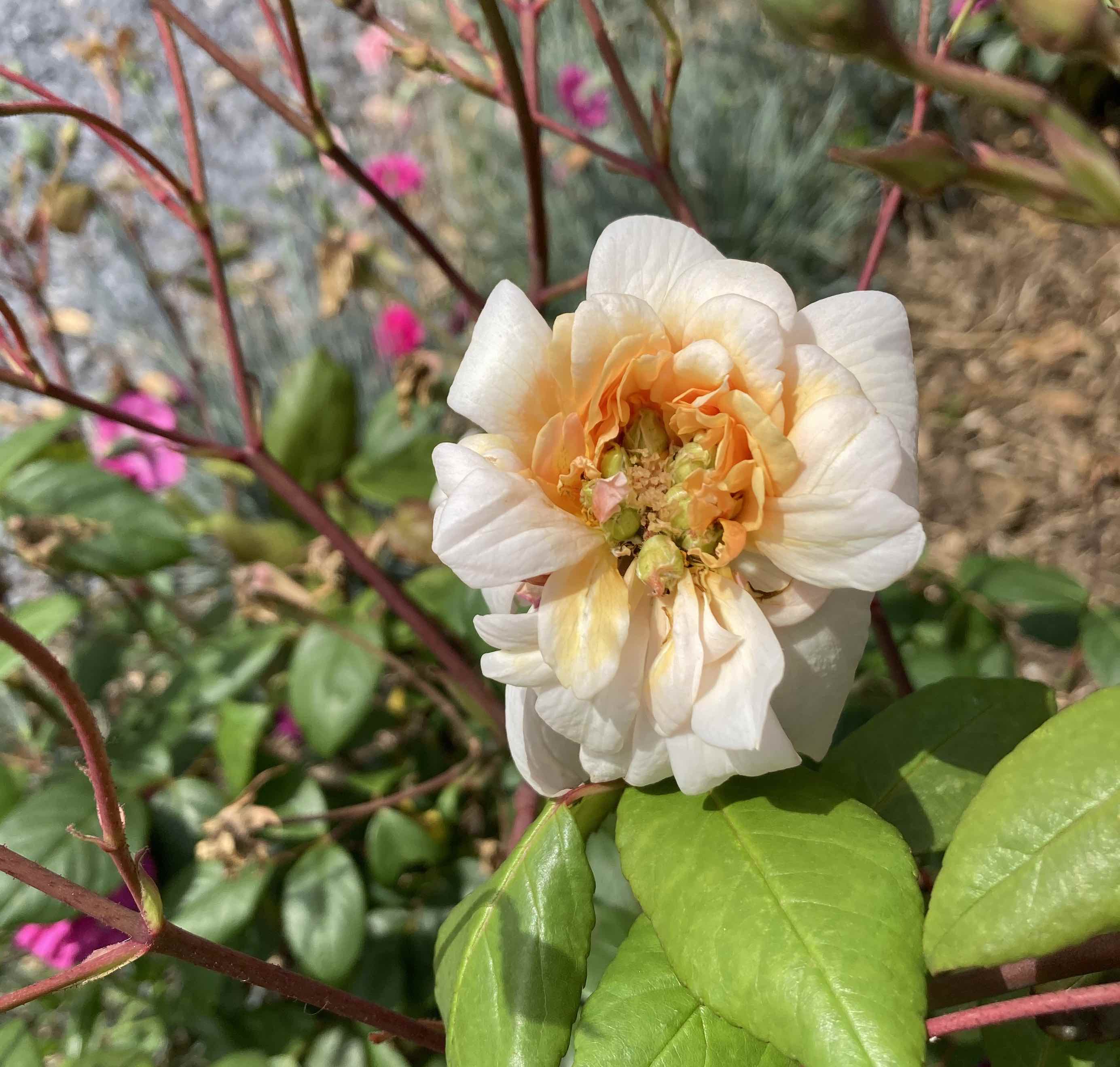
One of the most common questions I get asked is to do with abnormal rose flowers. Probably the most common, apart from the usual disease questions, is to do with ‘balling’ where the flowers do not open because the outer petals stick together, become brown and prevent the buds from opening. It is usually weather-related and is more common in some varieties than others.
But the most curious phenomenon is where the centre of the rose does not have the usual petals but strange leaflike growths, often as though a new stem is growing through the flower. It is called phyllody. It can be rather worrying but usually only one or a few flowers are affected. The exact origins are not clear and it may be related to weather – extreme heat or drought affecting the balance of plant hormones. It may be caused by insect damage too or it may be caused by ‘phytoplasmas’ – bacteria-like organisms that do not have cell walls – don’t ask me more about that!
I noticed this flower the other day on my ‘Perle d’Or’, an old polyanthus rose introduced in 1883 in France. It was bred from a China rose and has a similar ancestry to ‘Cécile Brünner’, the pink rose i mentioned a few posts ago. ‘Perle d’Or’ is a neat, sparsely branched rose with loose clusters of dainty, lightly scented flowers. It is a much more compact plant than ‘Cécile Brünner’ and, because of the ‘China’ ancestry, needs a bright, sheltered spot to do well. That said, mine are both in sunny but average conditions and doing OK without wall protection.
Phyllody was first observed and documented, on roses, in the late 18th by Johann Wolfgang von Goethe. He concluded that all the floral parts are modifications of leaves on the stem and where phyllody was seen, the petals, carpels or stamens had ‘regressed’ to the basic leaf shape. Not everyone agreed with him but I think he has been proved more or less correct.
I do not know how botany is taught these days, if at all, but that is basically what I was taught.
From my own observations it seems that the carpels (the ovules) are the most likely to be converted and the petals are usually normal. Many ‘old’ and moss roses have button centres with green growths (not to be confused with the actual ‘moss’ on the sepals) and the ‘green rose’ which I have mentioned many times, is supposed to be a stable phyllode mutation, but who knows!

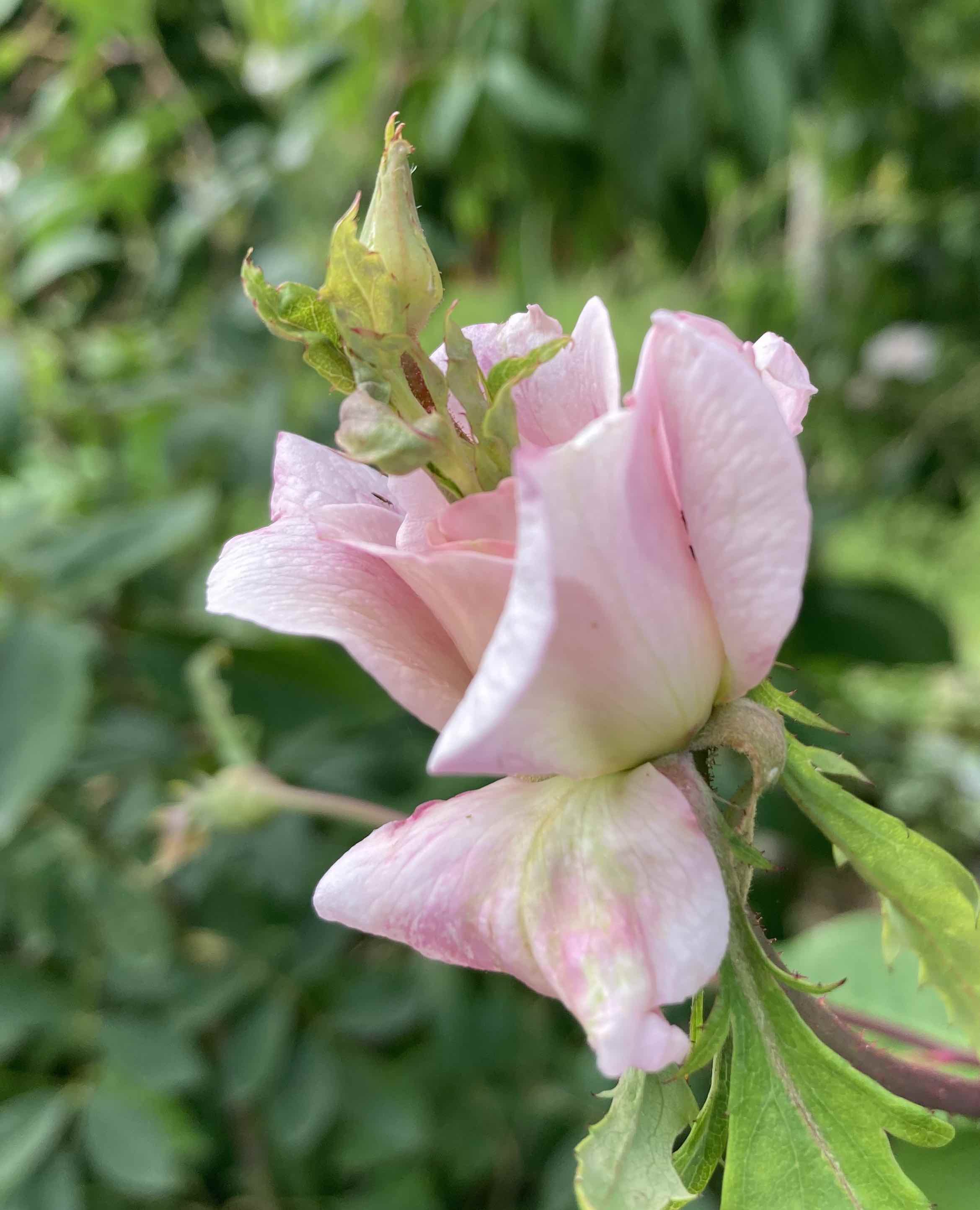
Well, what do you know! I had just finished this post and was wandering past ‘Cécile Brünner’ when I noticed something odd. There was a flower that not only had green ‘bits’ in the centre but a fresh flower bud and leaves growing through the centre. Goethe would have been delighted that every day there is evidence of his belief that flowers are just shoots where the leaves and other parts are just are modified into sepals, petals, carpels, stamens and more. I think it is the most perfect example of this ‘imperfection’ I have ever seen. For the sceptical, I can assure you that this photo is ‘real’. I don’t have the skills to mess around with images and there is no AI here despite how it looks.
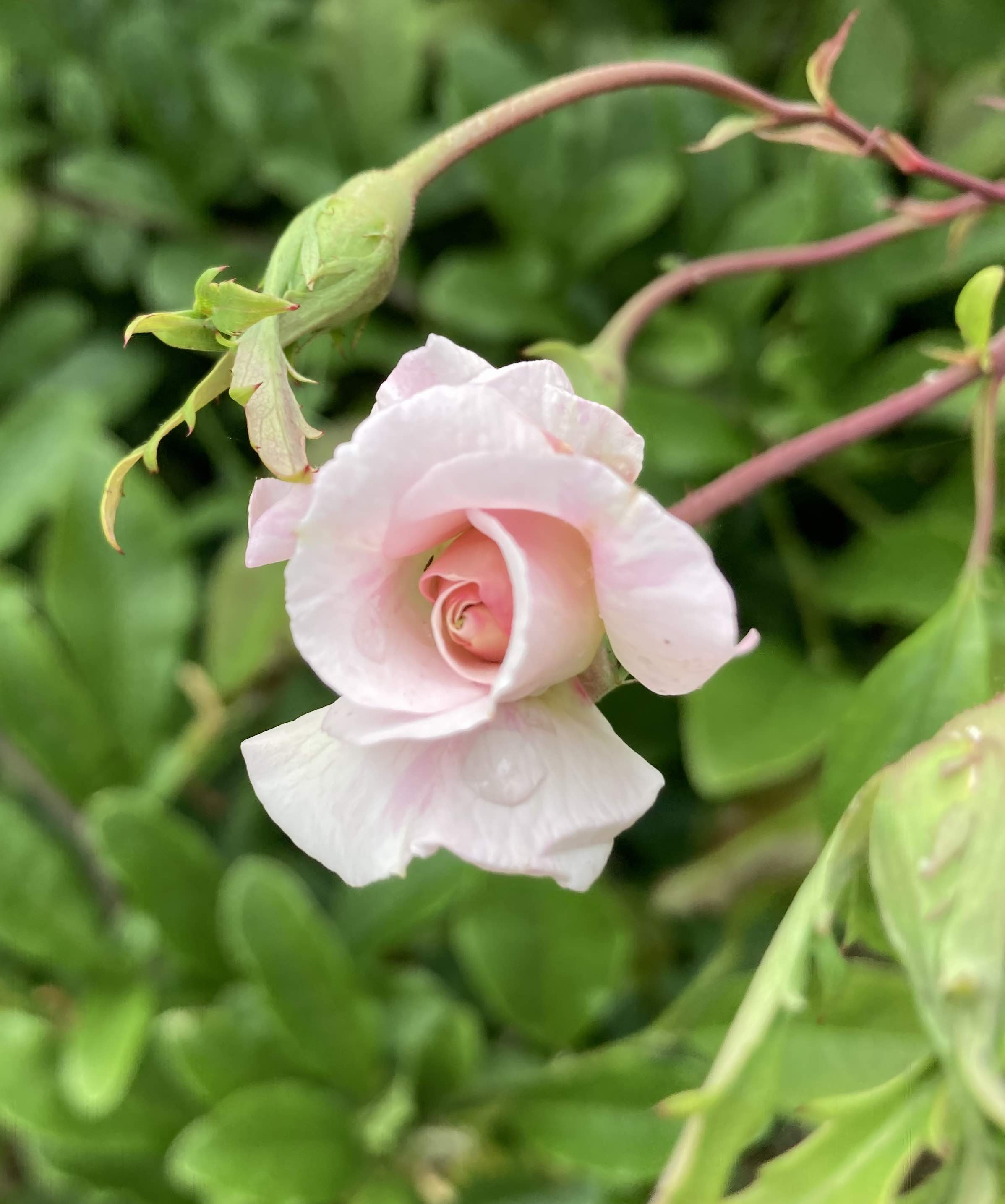
And in case this freaks you out , here is what the rest of the flowers look like – quite normal.
 The Biking Gardener
Interesting! Thanks!