Go forth and multiply

I love propagating plants. Whether it is sowing seeds or taking cuttings, making new plants is part of the magic of gardening. So when I find a plant I like I quickly take cuttings so I can have three rather than one. Sometimes it can be useful too.
A while ago I managed to buy a plant of something I have not had for many years and which I adore – Salvia dombeyi. It has the largest flowers of any salvia and I have been trying to get it for ages. And there it was in a garden centre, looking very dull, without any blooms, as straggly as it could be. As lovely as the flowers are, the plant is awful – straggly and a real ugly ducking, but I love it. What I didn’t realise was that the plant was covered in aphids on the undersides of the leaves. This is not that surprising because salvias do have a few pest issues. The plant looked OK and I took a cutting immediately. The plant is naturally ‘lanky’ and does not always produce much cutting material but there was one obvious candidate for a cutting. It is just as well I did because soon after the plant started to wilt on warm days and there was obviously something wrong with the roots. The problem got worse until it finally stopped picking up overnight and it is now dead. But the youngster is fine and healthy and the terminal is now a pendant cluster of flower buds. Phew.

Diascias are very useful little plants and there are lots of different varieties now. I remember that when I was a student at Kew and worked in the bedding department Brian Halliwell’s bedding schemes were known for their ground-breaking use of unusual plants and one season I planted Diascia ‘Ruby Fields’ in large flower beds along the Broad walk. It was planted interspersed with Festuca glauca. At the time this was the only well known diascia and was used as a rock garden plant. He was well ahead of his time with diascias which are now sold as summer patio plants after intensive breeding by many multinational companies. They are also quite hardy. I overwinter large (old) plants under cover and strip them for cuttings in early spring when I wake them up, and produce dozens of plants for bedding. I have just got four new colours and will use a lot more next year.

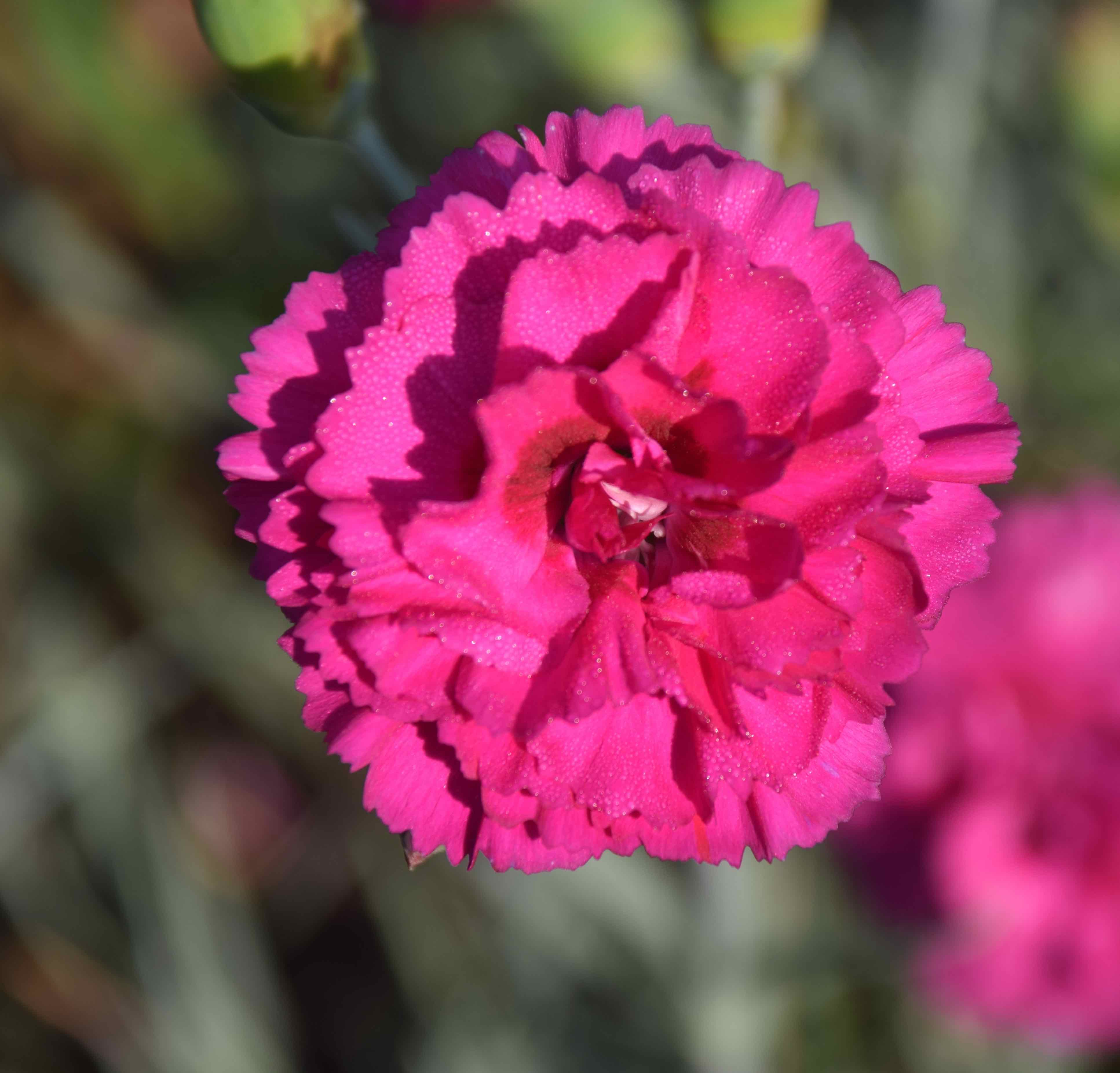
I also grow lots of dianthus, mainly for cut flowers and although I will always be faithful to ‘Doris’, my favourite is ‘Devon Wizard’. The stems are long enough for cutting and the intensely purple flowers have a strong clove fragrance. Just walking past a plant in bloom rewards you with a waft of perfume. I like it even more because the leaves are a good silvery blue and the stems are strong and generally hold up the flowers well – unlike ‘Doris’.
I have propagated many dozens, probably hundreds, of plants over the years. So last year I was intrigued to see that one flower was partly coloured in a different shade (sectorial chimera). I noted the part of the plant, which was a fairly old specimen at about three years, and when the shoots were large enough on side of the shoot that showed the mutation, took two cuttings. In the meantime I noticed that a younger two year plant, had produced two flower stems with blooms of another different colour. I will take cuttings of these when they are large enough.

But back to my two original cuttings. Both have flower shoots, as well as some basal shoots, and the first bloom has opened. And the streak of odd colour on that first flower is the colour of whole bloom. The foliage is the same and the fragrance seems to be just as good, though it is a bit early to say. But the flower is quite different. Plants ‘sport’ all the time and many new varieties arise as sports. So I am hoping that this is unique and stable. And now I have to start taking cuttings in earnest. I have been pondering names and for fun we have come up with Wexford Wizard to identify it to ourselves. If the other mutation is stable too I am thinking about Wexford Witch.
 The Biking Gardener
I also love diascias and take loads of cuttings, using the new plants in pots on the patio. Thanks to you, last year I tracked down perennial diascia in Camolin Nursery. Planted in front of purple fennel it is looking beautiful.
Is that D. personata? It is a remarkable plant and seems reliably hardy. It goes on blooming and blooming here. I bet it looks lovely with the purple fennel! I have planted some with sorbaria ‘See’ which is almost a weed and they look good together too. It is a great ‘mixer’.
Propagation can get to be a bad habit. We sometimes grow plants that we not only have no use for, but can not give away (such as Agave americana). Well, at least it is fun for the useful plants.
It is easy to get carried away and it is as easy to take 20 cuttings as ten! I know what you mean about not being able to give plants away – people dont want them unless they are in bloom or bright pink pots with huge plastic coloured labels these days
Because I lack the infrastructure for efficient propagation, I tend to plug many more cuttings of some species than I want, knowing that only a few will survive. For example, I plugged twenty or so cuttings of female kiwi vine, and got one. However, as you likely know, this does not always work out so well. I plugged three dozen or so cuttings of ‘Pele’s Smoke’ sugarcane, and all but one or two grew! Oh my!