Callistemon pallidus – I think

This garden is curiously unpredictable. Partly because of the ‘raw’ soil, and partly through my impatience, I have lost more plants that I care to thin about. At times I feel like giving up my desire for rarities and ‘interesting’ plants and just plant bog-standard, easy shrubs. But then, quite often, these turn up their toes to baffle me, and something ‘special’ thrives.
It all goes back to ‘what is easy’? There is no answer to that because what is ‘easy’ is usually what is adapted to your own conditions. In a hot, sunny garden caryopteris and hibiscus will thrive but blue meconopsis will be almost impossible. It really is ‘horses for courses’!
But I plod on, relentlessly pushing the boundaries of what I think I can grow and sometimes I win. Three years ago I optimistically planted two callistemon (bottlebrush) in the garden. These Australian shrubs are mostly borderline hardy but, although I am not in the mildest part of Ireland some of the toughest should be OK. One feature they do have which is helpful here, is that they do not come into growth too early in spring but wait for late April. The biggest problem for many shrubs here is that late frosts damage soft new, precocious growth. Because of this, my calycanthus and corylopsis slowly gave up the ghost and my Japanese acers and pieris struggle to actually get bigger – except a couple that I placed with some overhead protection – something that was lacking when the garden was new.

Which is a long preamble for the fact that my two callistemon have done surprisingly well. The plant I bought as Callistemon salignus was planted in a large raised bed in the ‘seaside’ garden and has grown well and has been a fairly handsome foliage plant, of neatly upright habit and, now about 1.5m high, is finally in bloom. The sheer size and fatness of the swelling buds this spring filled me with hope because the flowers are produced on the new growth and as soon as the new shoots swell you can tell whether there will be flowers of not. My plant has wonderfully silvery, silky leaves which makes me believe that it is probably Callistemon pallidus. The flowers of both are usually cream though C. salignus can be pink-ish. Both are native to east New South Wales and C. salignus is generally regarded as the hardiest of the genus, tolerant of -10c. But sun is necessary and well-drained soil. Even so, most callistemon grow along rivers and they are not cacti so do need moisture in summer – just don’t plant them in soil that is soggy in winter.
Having said that, I had a friend who had them regularly self-seeding in their pots of carnivorous plants in the greenhouse so perhaps it is cold AND wet feet that are fatal; his plants were growing in soggy sphagnum.
Anyway, I am pleased with the flowers even though it is possible that callistemons are now lumped in with melaleuca just to spoil my fun. Now the plant is large enough to bloom I am expecting flowers every year.
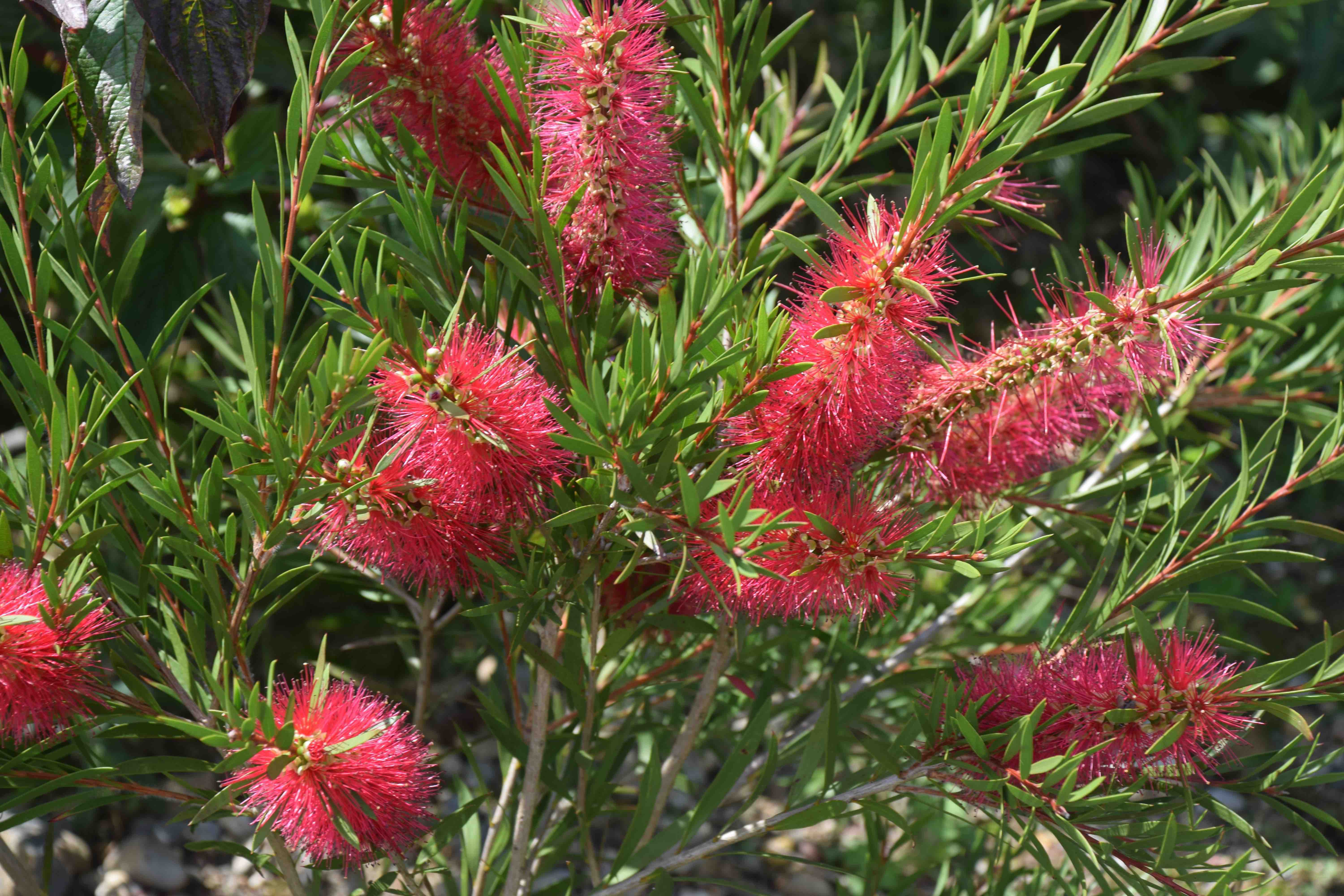
The red Callistemon citrinus (named for the scent of the crushed leaves – C. salignus is sometimes called the lemon bottlebrush because of the colour of the flowers) is much more common and, in milder parts of the world there are lots of hybrids too. Mine is the common red and it settled into blooming very quickly. It is as typical as it could be with arching stems, now making an elegant (or sprawling) bush. It usually blooms in late June to July. I have not done any pruning yet but it can be lightly pruned immediately after blooming. If things get out of hand you can prune hard in spring but you will not get flowers for a few years. Ultimate height is probably 3m but, free-standing it is likely to be wider than tall. All callistemon are frequently grown as wall shrubs which works well if they have horizontal wires to which they can be tied.
Callistemon are largely pollinated by birds in the wild but our bees are clever and they enjoy the flowers. I thought bees would be attracted to the pale yellow flowers of C. pallidus but I have not noticed them on the flowers yet. Many flowers in the garden that are reputedly not helpful to bees actually are frequented by bumblebees here and they bite through the backs of long flowers like salvias that are bird-pollinated in their native ranges. The bees love my grevilleas and salvias but so far have ignored this exotic. It may be because I have so much comfrey in bloom – one clump under each of the 23 apples plus more – that they are content with those.
 The Biking Gardener
My interesting story about Callistemon pallidus. First of all, I have two in the garden. One is 25+ years old and the second a seedling from that and now about 10 years old and with a very tidy upright habit. The original is a very large plant which flowers profusely but on the side which faces out onto our neighbour’s field and so is of little interest to me. The original was grown from seed sent by an online contact in Tasmania. I suggested I send back something of interest and had an email from somebody in the Australian Department of Agriculture advising me that I and my friend in Tasmania would be breaking Australian regulations in doing this and would I please desist! I did!
I knew Australia were pretty draconian when it came to plant imports but I did not know they monitored correspondence like that. It is strange that your original only flowers on the (presumably) sunny side. I wonder how long it will be before I get seedlings? It is interesting that your plant has got to such an age.
Your common Callistemon citrinus does not seem so common. It was formerly one of the most common species of shrubbery here, and still survives out in freeway medians with oleander. The floral color is more of an obnoxiously bright ketchup red, though.
Perhaps it seeded and fell from favour. I guess that it has a short flowering season compared to the oleander too
I have never seen it grow from seed. It just lost popularity because it was too common for too long. It blooms almost as continuously as oleander here. It rarely lacks bloom completely.