Just because you can – should you?
Posts have been a bit tin on the ground lately because work work and garden work have been taking a lot of time. I have just been to the UK to do some talks and some staff training at garden centres in Surrey – it happens twice a year. It is good to catch up with old friends. But the strange title of this post is due to a plant I met there which was shocking. I was first sent a photo of it a month ago. I have a feature on hardy cyclamen being published in The English Garden this month (I think) and the editor sent me a photo of a strange, new cyclamen a few weeks ago, saying that she thought I would be interested in it. I was, and fortunately I was sitting down with caffeine in my hand when I saw it. I was shocked. A few conversations with the garden centre manager in the past few days and the pieces of the puzzle fell into place.
Although bred in The Netherlands and first commercially revealed in Japan this summer, it was also put forward, along with 100 other new plants, at the 2024 Horticultural Trade Association New Plants Show in the UK earlier this month. Of course, new plants can often be controversial and will not appeal to everyone. But we need new plants to stimulate interest and keep us all on our toes as well as to generate income for the breeders, nurseries and garden centres. I am deliberately stalling here before you get to the photo either to build up the anticipation or to protect you from the grizzly truth. So here is the plant that won the Best New Flowering Houseplant category, Cyclamen Illusia.
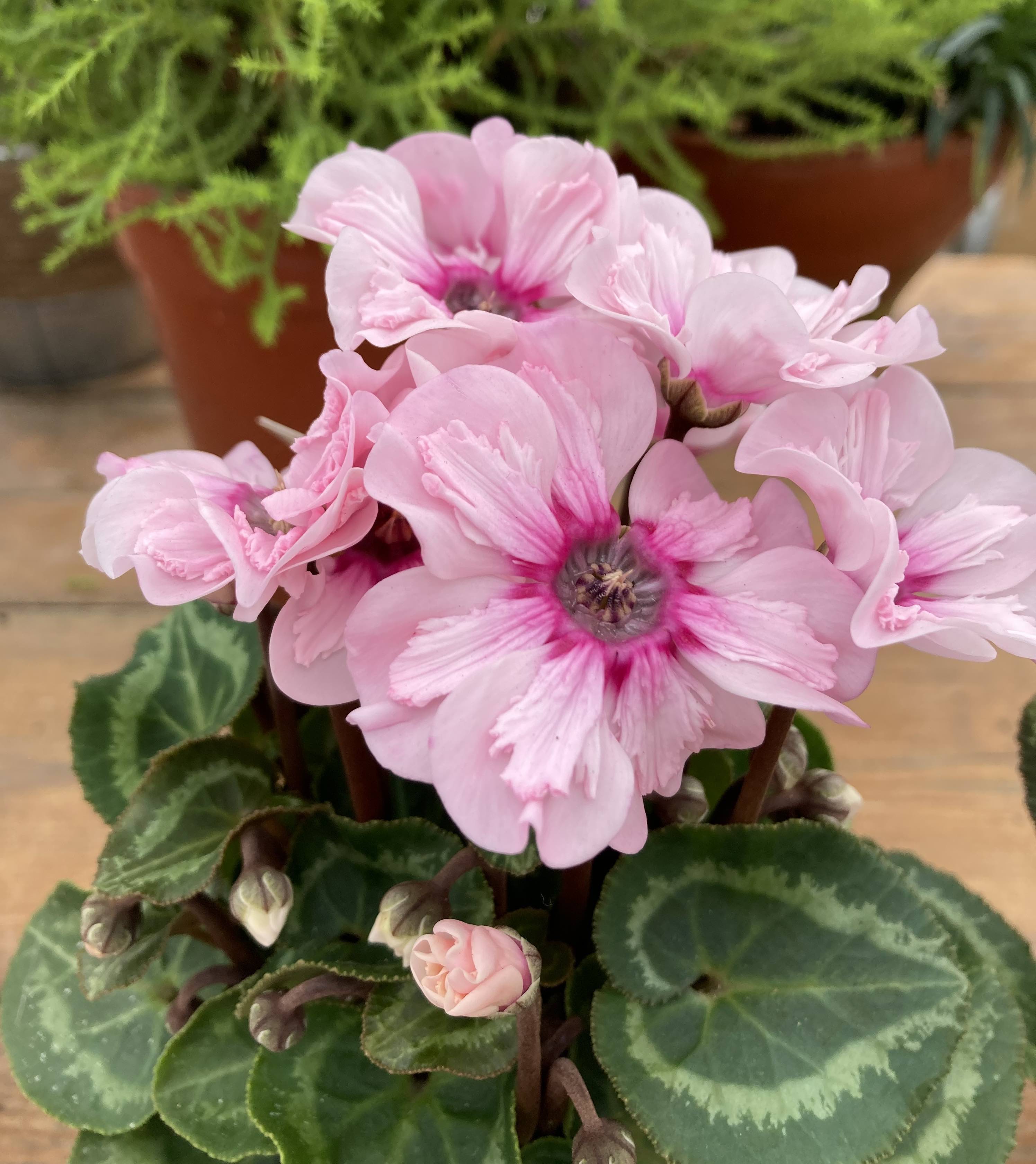
They had some in stock at the garden centre so I could see it in person.
I was not looking for it and they only had a few dozen plants but they did catch my eye!
It was created by Schoneveld, by the breeder Sadrach Talahatu who worked for seven years to create a stable F1 hybrid race. At present there is only one colour but more are on the way. It is officially ‘not scented’ but I did detect a light, ‘cyclamen’ fragrance. At the show Sadrach said ‘When developing Illusia, we focused on preserving the special characteristics offered by nature.’
I think that she has created a truly amazing feat of breeding but I am not sure that nature has been preserved. But I am obviously as much of a freak as the poor plant is because when I look into those flowers my overwhelming emotion is not wonder but pity!
According to the RHS website, Emma Allen, show judge and RHS Head of Horticultural Relations (I am not sure what that job title refers to) is quoted as saying ‘I’ve never seen a plant like it’ and Pippa Greenwood, for whom I have a lot of respect said, rather more diplomatically ‘An extraordinary little cyclamen’.
At the garden centre I was working at they were £8.99 each.

The plant seems to combine many of the freakishness of past cyclamen with the ‘beards’ on the petals, which have, admittedly, been seen for at least a century, but with a very compact habit and upward-facing flowers. There have been upward-facing blooms on cyclamen for a long time too. As my article actually stated, there have been forms of Cyclamen hederifolium, such as ‘Stargazer’ with blooms that face the sky, but they have typical, reflexed petals and, I readily confess, they look very, VERY peculiar. Despite my huge reservations, I have to say that Illusia does look ‘better’.
This breeding company had already produced cyclamen with petaloid sepals and cyclamen with ‘hanging’ petals to produce ‘lampshade-like’ flowers so by combining all these abnormal genes they managed to create Illusia.
I don’t necessarily blame Frankenstein but I have a gut-wrenching pity for the monster.
Oddly, the ‘Visitor’s choice at the show was Spiraea Walberton’s (R) Plum Carpet which has dark new foliage and the typical, dullish, deep pink flowers. I hope it is resistant to mildew or has some other redeeming feature and is not just another very compact plant that performs well in pots and then looks miserable in the garden, like so many other new shrubs. It may have been what people liked most simply because it was ‘normal’ a a relief from the long parade of freaks on display!
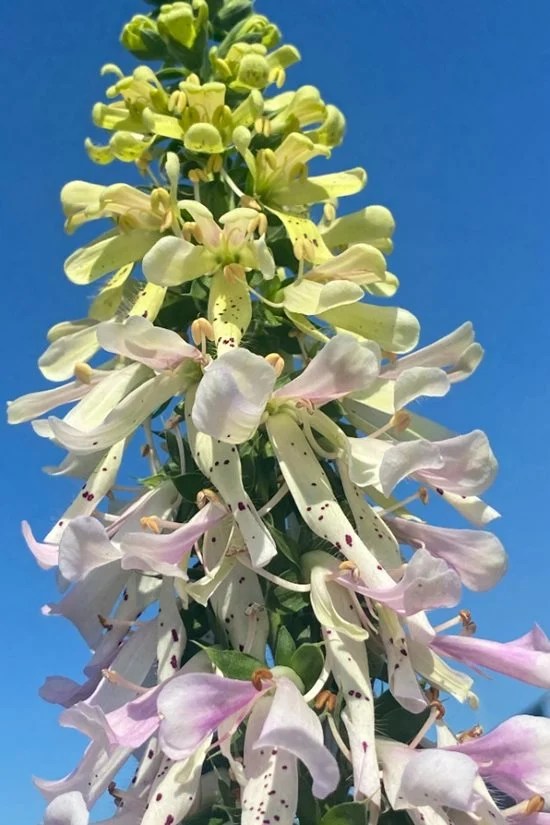
Because the winner of the best new Herbaceous Perennial was Digitalis ‘Apple Blossom’ shown by The Bransford Webbs Plant Company and bred by Maarten van der Sar in the Netherlands where the company first saw the plant in bloom. I am not sure whether this is grown from seed or ‘micropropped’. It is said to be compact – about 60cm high but looks taller in photos – and it produces many lower stems on a compact, bushy plant. Although perennial time will tell just how perennial it is since most digitalis are short-lived perennials at best.
The ‘point’ of this foxglove is that the tubular flowers are ‘split’ into ribbons. It is not a new look because ‘Pam’s Split’ and others have been around for years. But it looks as though the effect is taken further with this one and the flowers open greenish cream and mature to pink. The same effect is also seen in campanula ‘Octopus’ though there, the more regular division of the long, pink, campanulate flowers into regular ‘streamers’ is, in my eyes, somehow more satisfactory.
The RHS’ Emma Allen says, “I’ve never seen foxglove flowers quite like this’. Michael Perry said it should be called ‘Orchid Blossom’ rather than ‘Apple Blossom’.” Geoff Stebbings said it should be composted. Pity the poor bees, though it is said that bees do visit the blooms.
I have not seen it in person and this is a stock photo – credited.
I am not sure of retail prices or availability but I assume it will be widely available in late spring next year.
If you love these plants and want them, great – and good for the horticultural industry since they are relying on you loving them enough to buy them.
But just because you can do this to plants it does not mean that you should!
 The Biking Gardener
In my view the cyclamen is absolutely ghastly. Looked up Stargazer, and it looks preferable. The digitalis is pretty unpleasant too.
I know what you mean about stimulating interest (and sales), but I wonder how many of these poor creatures actually perform well in the garden.
Truly horrible.
Thank you for commenting. I confess that the cyclamen does look ‘pretty’ in the same way as plastic flowers. But I don’t like it in the same way that plastic plants and flowers will never have a place in my home.
Yes, it really is GHASTLY! What is worse is that it is so contrary to what some believe they enjoy gardening for. Some of us want to bring ‘nature’ closer to our homes, but this is so ridiculously unnatural. Some want to attract pollinators, but if this does attract them with its floral color and perhaps fragrance, many pollinators do not know what to do with it, and some insects die of exhaustion while trying to figure it out. After such extensive breeding, it is undoubtedly less vigorous than less bred varieties, which is contrary to the sustainability fad.
Phew – I was beginning to think I was alone in disliking it!
There are so many modern cultivars that I dislike that it is rare that I find one that I actually like. These and many other modern cultivars look like they are in drag.
Both the cyclamen and the foxglove provide good splashes of colour but lack the refinement of the species. They will appeal to some, I expect, but not to me.
I don’t like it either, but it’s no more horrible than many other flowering house plants I’ve seen!