Farewell fuchsias
I have mentioned fuchsias a few times on this blog but not as often as I should. This is largely because I have not planted many. I needed to address this deficiency but was then filled with terror at the prospect of fuchsia gall mite. I posted about this last year. I did finally order some but treated them as though they were carrying Mpox and isolated them and watched every new leaf that grew with fear. But all was OK, as the nursery had promised.
The reason why I am so terrified about this pest is that, because I answer a lot of ‘reader’ questions from the UK, I get a lot of questions about ‘what has happened to my fushias?’ (sic) with an accompanying photo. I had never seen it in real life until this week. I was in the UK visiting relatives in Lowestoft, Suffolk, the most easterly point of the British Isles and, having to use ‘shanks’s pony’, had the chance to see lots of front gardens. I am sad to say that a lot of the fuchsias I saw in gardens were infested.

I think this is especially sad and important because fuchsias are one of those ‘friendly’ plants that is easy to grow and so often given from one gardener to another. I know they are not without problems; they can get rust, often get aphids, used to be often covered in whitefly in the greenhouse and they sometimes flower in flushes rather than continuously if they are not deadheaded and produce their (edible) fruits. They can be a colourful component of hedges in the west of Scotland, England and Ireland, so much so that, along with montbretia they are often considered native even though they are South American.
The worst affected plants I saw were Fuchsia magellanica. The RHS confirm that this species is vulnerable, though not all fuchsias are. The mite is almost impossible to kill with pesticides but it is said to be unable to tolerate temperatures below 5c. But this plant was established and outside. Being near the coast, Lowestoft is not prone to very harsh winters in most years but I am sure there must have been frosts last December at least so perhaps the mites are tougher than thought. I know that I deliberately kept my fuchsias cold last year in the greenhouse, so much so that they mostly died to the ground, but most sent up shoots from below the compost surface. But if the mite gets to mild areas, where fuchsias make large hedges, things will be very serious indeed.

The effect of the mite is horrible, transforming the shoot tips from leaves and flowers into distorted clusters of distorted ‘fuzz’ with the odd flower or leaf poking out. Not every shoot on the plants seemed badly affected but the affected shoots seem to be heavy and were drooping under the weight of the distorted growth.
If you have an affected plant the best thing to do is to cut it right down and dispose of the growth. There is a chance the mites will not be at the base of the plant. But the mites are tiny and are carried on the wind and clothing and gloves, though they can’t survive long on clothes. Keep an eye out for this nasty problem that seems to be spreading fast.

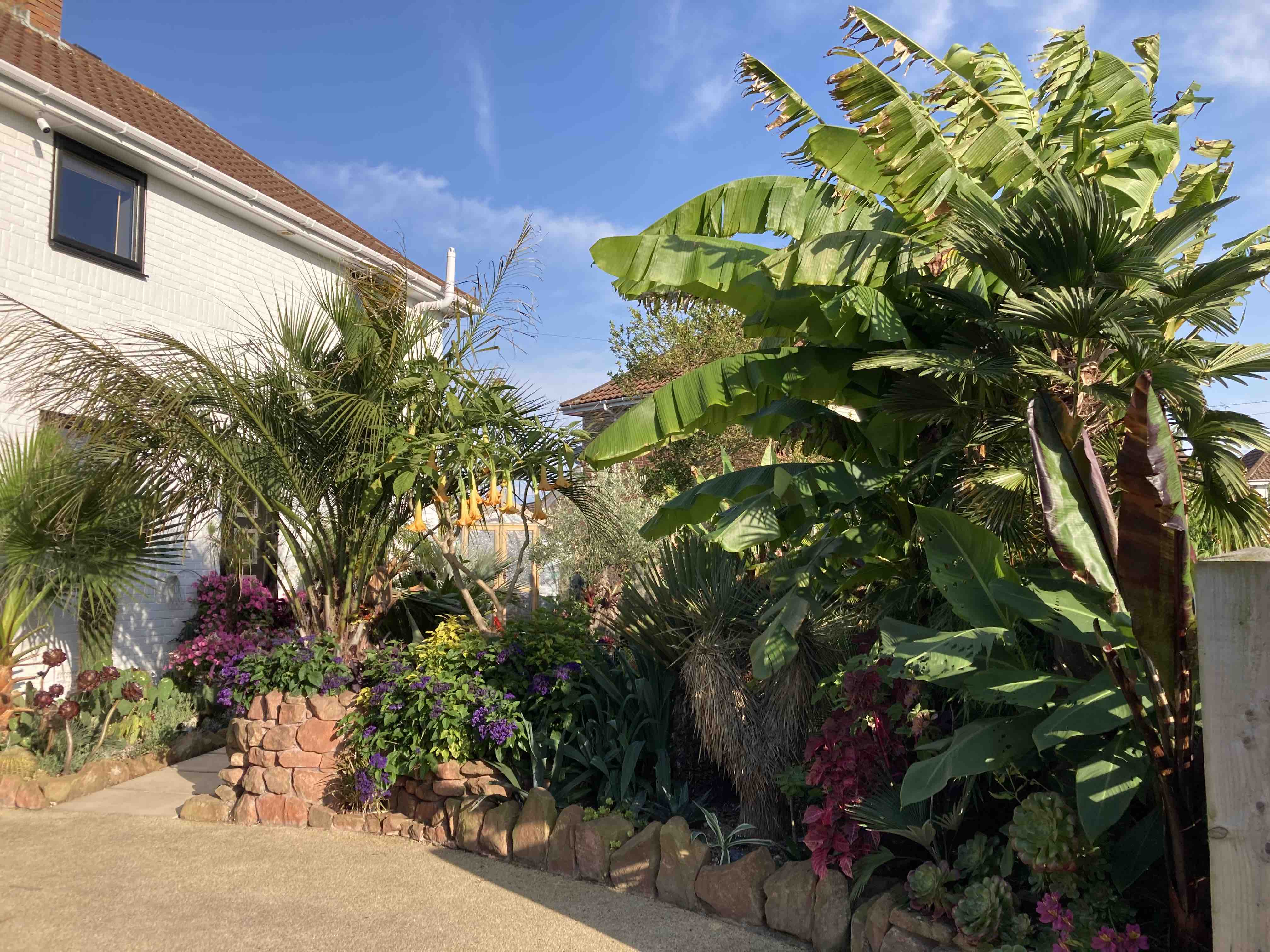
On a more positive note, since this post is a bit scary so far, my wanderings revealed a wide range of front gardens and although most were the usual weeds, wheely bins and hydrangeas surrounded by crazy paving, there were exceptions and one that I walk past every time I go stands out as exceptional. It s a small garden and a front, corner plot but amazing. The use of the word oasis is rarely as appropriate as for this garden which is packed with subtropical plants. It shows that nothing succeeds like excess and that if you are going to go for the tropical look you need to go all out! As well as musa, there are Phoenix canariensis and washingtonia and butia palms, bamboos, agave, aeonium, brugmansia and heliotrope and even some bromeliads strapped to trees. The garden is largely paved, for parking, but the planting is effusive and even the rockwork enhances the planting. I think the owners have done an amazing job.
 The Biking Gardener
thanks for all the info on the mite which has fairly ruined fuchsia growing for many of us – I brought my hardy fuchsias from London to NE when I moved and they have escaped the mite so far but the other ‘blighter’ that I did experience ‘down south’ was capsid bug which was almost equally unsightly on foliage and buds, ultimately delaying flowering till much later in the season. Here it has not been a problem – something to be said for the colder climes except I could never grow such a tropical oasis as you showed at the end there!
I am glad that you are free of the mite where you are. I had only seen it in photos until this week and was pretty horrified at how bad it was. Yes I almost mentioned capsid bugs! I do get it here now and then but it maybe my own fault for not completely controlling the willow herb which they also like. It is hard to know if the willow herb keeps them off the fuchsias or if it brings more into the garden. But I do know that it also gets fuchsia rust and, of course, seeds madly if you let it! We are mild here so musa does OK but we don’t get summer heat. Thank you for commenting – and it is good to know you are mite-free so far. I hope it stays that way.
The roadside fuchsias of the southwest of Ireland could suffer a terrible fate if the mite arrives. Re the crazy paving: I have a greater appreciation of it since reading a recently published book about Richard Sudell.
I agree that the fuchsia hedges could be badly affected. I do not know that book. I have nothing against crazy paving as such though.
The book is Behind the Privet Hedge by Michael Gilson.
thank you
It seems to me that (fuchsia) gall mites would be less of a problem there than they are here, and they are mostly tolerable here. I prefer to cut fuchsias back at the end of winter because they get grungy by that time anyway. Afterward, it takes a while for any pathogen to proliferate within fresh new fuchsia growth. By the time they do so, it is already winter again. I would expect pathogens to proliferate less in the cooler climate there, and particularly since fuchsias are more likely to get cut back annually.
I think you are right about the cold winters being an advantage. If hardy fuchsias are treated as herbaceous and cut back in winter they may not be affected much. But those ‘hardy’ types that are used as hedges, as with the plant I showed, and as they are often seen in milder climatic areas of the UK, the mites could be a big problem. Lowestoft, being coastal, has an average winter min of 2c and frosts in winter can be rare, so although the mites are supposed to be intolerant of temps lower than -5c, they probably will survive. Greenhouse fuchsias that are trained or need frostfree conditions are going to be a problem.
San Francisco has historic collections of fuchsias, but many of of the old hybrids were hit hard by the mite and have been replaced with mite resistant species and hybrids. The botanical garden in Golden Gate Park (Strybing Arboretum) has focused on breeding mite resistant varieties–and there are some gorgeous ones. My favorite is “Fanfare,” thought “Hawkshead” comes in as a close second.
That is worrying about how hard the mite has hit the collection there. There may be some hope that selection will help us grow fuchsias in the future but certainly in the UK fuchsias in gardens everywhere are full of it and people don’t seem to know. Fortunately I do not think it is in Ireland but it is only a mater of time