Do another day
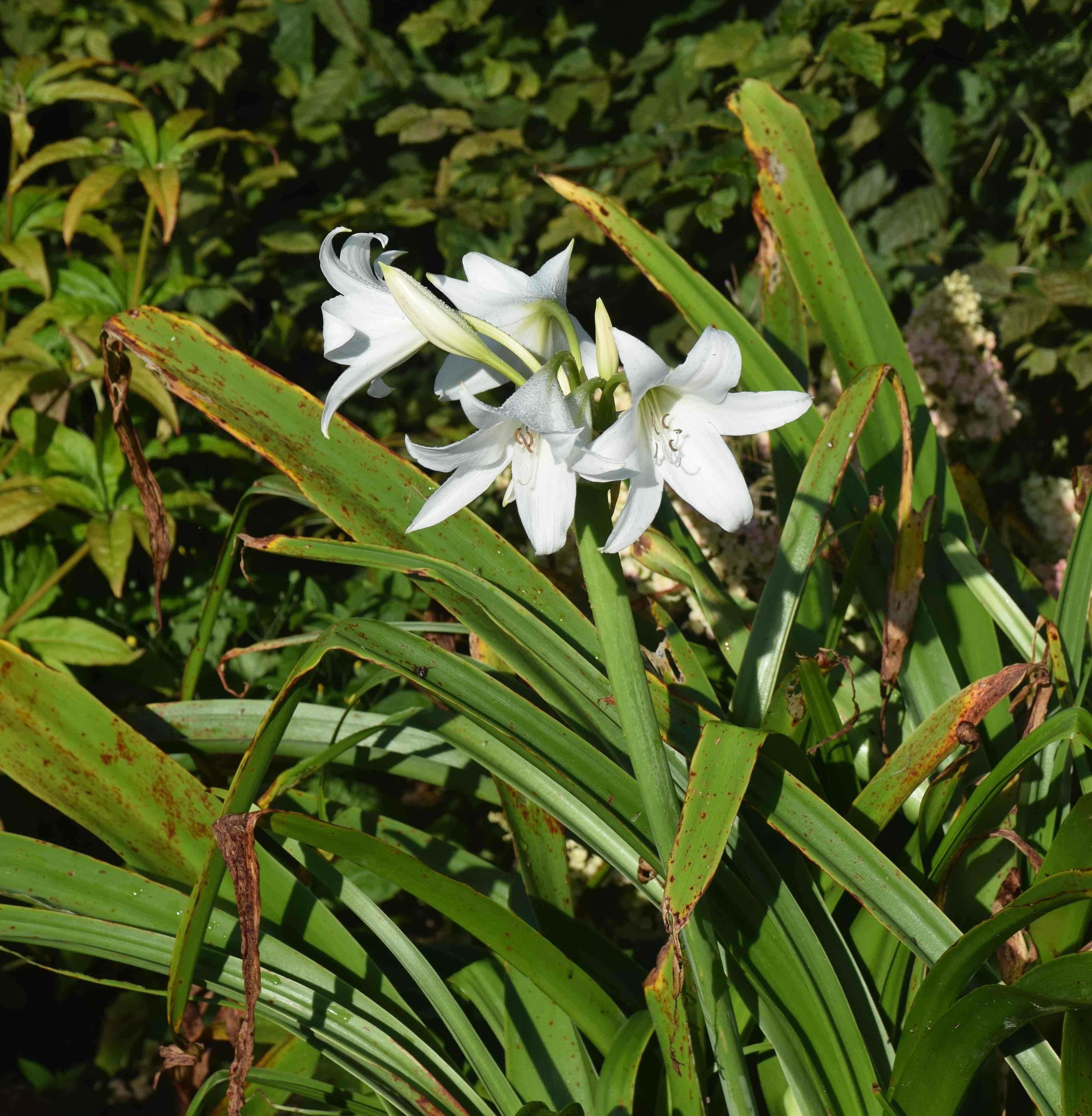
My crinum has finally bloomed. I noticed a scape growing from the base about three weeks ago and I was actually quite annoyed. Let me explain. I bought a potful of bulbs about five years ago and was very pleased with myself. It was a large pot with at least five bulbs in it and it only cost €10. Because you can easily pay that for one bulb I came away very happy. And since the bulbs have permanent roots and do not like being dried out for long periods my potful was not going to have a check to growth and should have romped away. It was planted in a border that faces east (not really ideal) but it gets sun for most of the day and in the early years the hedge was too small to cast shade so I expected it to be happy. But I got nothing but leaves.
Last winter a sharp frost in December, in fact the hardest frost of the whole winter, turned the plant to mush but that is not an issue because the bulbs are deep and they usually grow away in spring without a hitch. But I had decided that five years was long enough to wait and I was going to tackle the considerable task of digging up the clump and moving it to a better spot or, more likely, divide it and try it in a couple of spots. Now it has flowered I am in a quandary. Should I leave well alone?

I bought this as Crinum x powellii. There are dozens of crinum species and hundreds of cultivars but this is the only one that is at all common in Ireland (and the UK). Crinums are sometimes called swamp lilies which gives a clue that they want moisture. Most are potentially evergreen and of the many species, found wild in Asia, Africa, Australia and the Americas, many are tropical. The have broad, often impressive foliage and scapes (leafless stems) of large, often fragrant, blooms in shades of white, pink or red, the flower shape ranging from spidery to trumpet-shaped but always wonderful.
Crinum x powellii is hardy in most places and is a hybrid of Crinum bulbispermum, which is hardy but has rather small flowers compared to the plant and the seed pods, and C. moorei which is not really hardy but has the most wonderful, large, open chalices of pink and highly fragrant. There is a white form too. Both are South African species.
Crinum x powellii is sometimes sold as the elephant lily because of the huge bulbs that can be 30cm from top to bottom. They need to be planted with the neck of the bulb at ground level so considerable excavation is needed to plant them. Like all crinums, they can be grown in pots but large, deep pots are necessary to give the roots room to grow.
In general, crinums need sun, warmth and plenty of water and feeding. The only other crinum I have is a purple-leaved form of what I believe is Crinum asiaticum. I have had this just as long but have never really made it happy. It has been in a pot, kept frost free in winter, but although it offsets readily it has only tried to bloom once, the spidery, highly fragrant flowers quickly munched by snails. I decided to divide the, by now crowded, clump this spring, keeping one clump in a pot in the polytunnel and the others planted in a raised bed with cannas. Each clump was of three or four bulbs. None seem very happy but they are growing. I don’t think any will reach flowering size this summer.
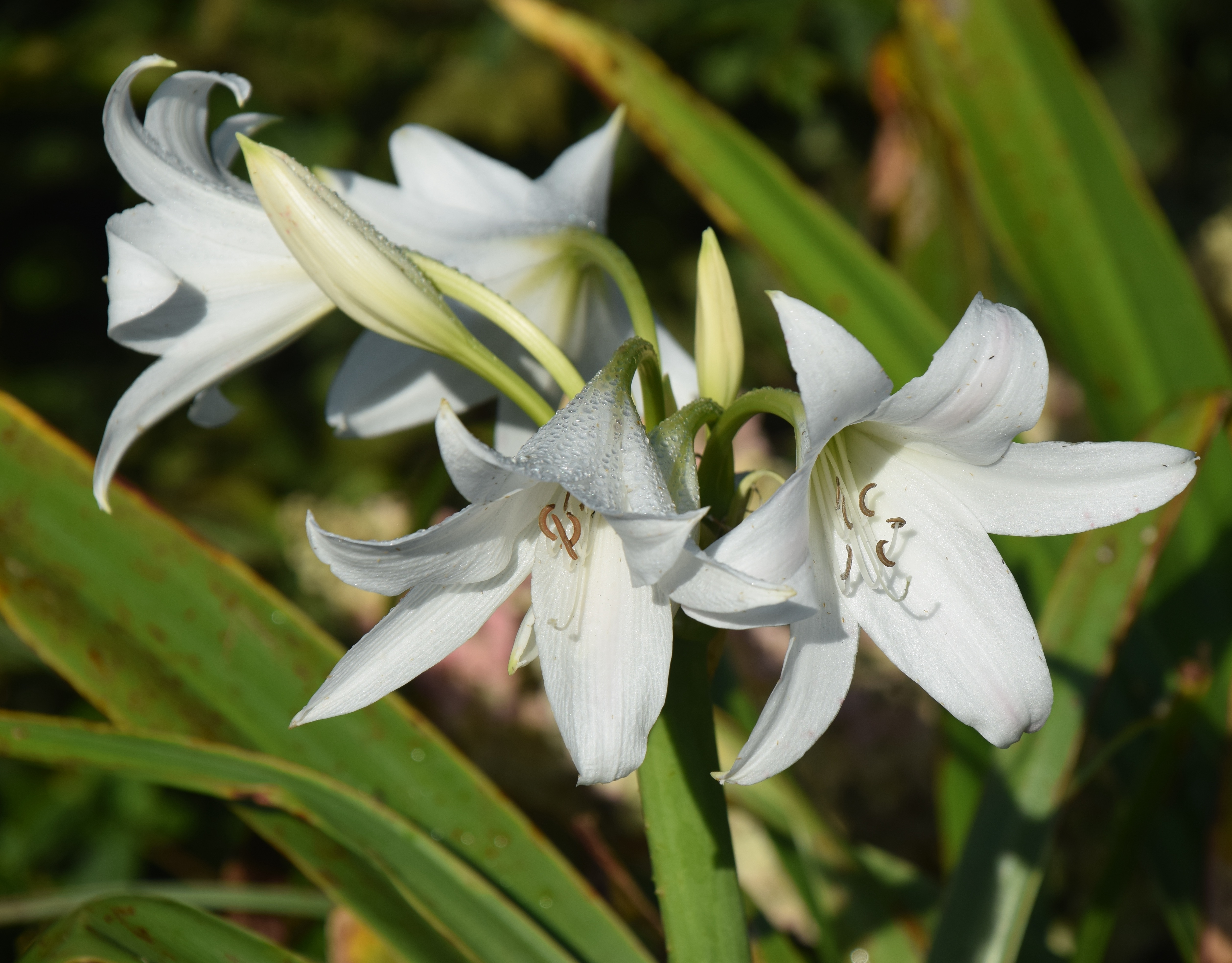
As it turns out, my Crinum x powellii is ‘Album’ with white rather than the usual pink flowers. Some crinums have fugacious flowers, lasting only a day, but this one has blooms that last four or five days. It is very beautiful and is fragrant though being in the middle of the border it is not easy to get to. There is some talk of the flowers being larger than the usual stocks of the pink form. It is likely that the hybrid was created many times.
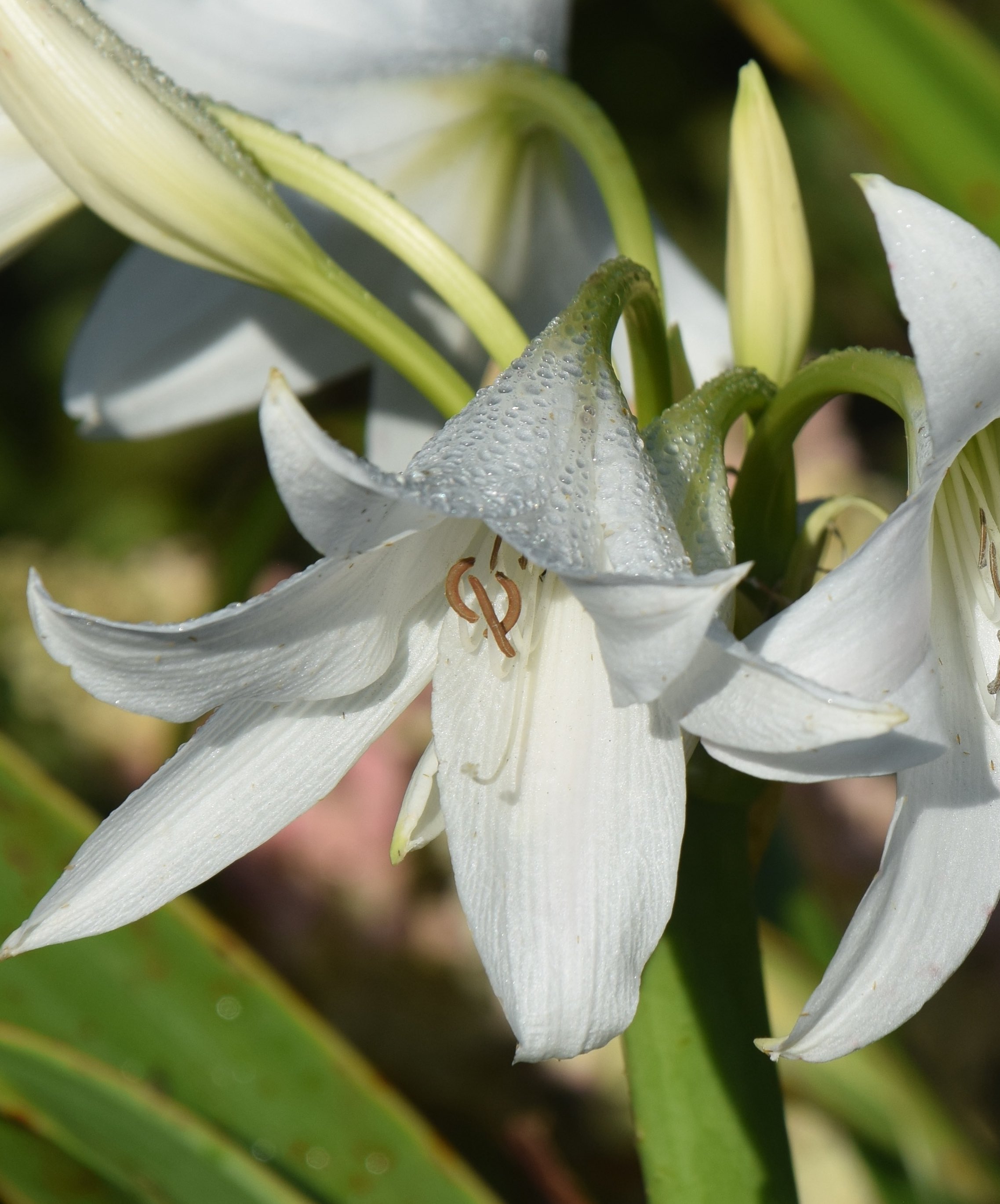
For now I can just enjoy the large and elegant blooms and leave the decision of whether moving it is something to do another day.
 The Biking Gardener
There are too many to keep track of! Amaryllis belladonna naturalizes here, and seems simple enough, but even it supposedly includes a few cultivars (or varieties). Because Crinums do not naturalize, I see them only in a few home gardens. Some get my attention near here because they look like red Amaryllis belladonna.
A good plant which has flowered reliably here over many years but is now too deep that I cannot move it nor even pry a bulb from the clump – they go down and down and down.
Yes I think it will be a big job if I do decide to move it.