The joy of F1 hybrids
The term ‘F1’ crops up if you read anything about gardening and it can be seen frequently if you browse seed catalogues. It means that the seeds are F1 hybrids. Some people think that these are ‘hybrids’ and anything else is not a hybrid which is not true. Most plants we grow from seed are hybrids of some sort. F1 hybrids are rather special. And their price reinforces that in the way that a certain lager was always marketed as being ‘reassuringly expensive’, though in these tough times I see their adverts feature a rather enigmatic David Beckham waiting patiently for a glass of lager to be poured – I don’t understand it at all, in common with most adverts.
I want to get one thing out of the way from the start. These are not genetically modified.
Some people do not like them because they tend to be bred and maintained by big seed (and therefore often chemical) companies simply because they are expensive to produce. They are also very good for farmers and growers so there is a danger that older kinds are eclipsed. It is a huge subject that could quickly get political so I will stick with tomatoes for this post.
To create some seeds of an F1 hybrid the seed company has to maintain two inbred lines. Say you want to breed a red cherry tomato. You could cross a red beefsteak with a yellow cherry. The trouble is that the parents are not necessarily genetically stabilised and they don’t breed quite true. So you will get some plants that produce fruit like either of the parents, you may get some plants with small red fruits and some with large yellow fruits. You will then collect seeds from the fruit from the plants you like and grow these and you select the best, the most that resemble what you want, till they are stabilised. You might then name them. You might call them ‘Gardeners’ Delight’ (except that someone already has). The problem is that every generation will throw up plants that are not quite the same, as hidden genes show up. So you need to maintain the plants and rogue out ‘off’ plants. Tomatoes are quite easy to breed because the flowers are generally self fertile and you can easily save seeds from a plant you grow.
I bought two ‘Gardeners’ Delight’ plants this spring. I need to ‘do’ my jobs for Garden News several weeks in advance and my seedling tomato plants were not big enough so I had to cheat and buy some for photos. They have produced plants that are certainly not ‘Gardeners’ Delight’ . Cheap tomato seeds often give bad results because the growers do not ‘rougue out’ the ‘off’ types. It is just not worth it because the price they get for the seeds is so little. In the same way, if you save your own seeds, you might select from the biggest fruits each year and so gradually select plants that are not the same as the original ‘Gardeners’ Delight’.
This is not to say that open-pollinated tomatoes or any other plant are bad. In fact you can select the best of what you buy and keep your own special strain. This is how heritage or heirloom tomatoes start. A person or community find a tomato that does well with them and they keep it and select from it for generations until it is distinct . It is part of our gardening heritage.
To create an F1 hybrid the two parents – the plant that will produce the fruit and thus seed and the plant that will provide the pollen – have to be selected and reselected for many generations. This is inbreeding or linebreeding . It is usually a bad thing because although it stabilises certain traits, the lack of genetic diversity leads to reduced vigour and often undesirable side effects.
But it does mean that when two inbred lines are ‘crossed’ the first generation of plants is uniform and very vigorous. This is the F1 generation.
Unfortunately, the next generation produces plants that are different. So you can’t save seeds of F1 hybrids at home – well you can but the plants will not be the same. You might be thinking ‘what a faff!’. But imagine you are the seed producer. You sell seeds of a great tomato – let’s say ‘Sungold’ – and only you sell them because you maintain the parents. It does make the seed relatively expensive though.
Some people don’t like F1 hybrids because of the power of big companies and the fact that you have to buy the seeds every year. But they will bend their own rules when it comes to ‘Sungold’ – everyone loves it and many people claim to have bred an open-pollinated version. It is odd really because I am sure ‘Sungold’ would have been dropped from seed production if it were not for home gardeners because the fruits split and they can’t be good for commercial production. But the taste 🙂 Most F1 hybrid vegetables are created solely for commercial production and not for home gardeners.
F1 hybrid have many advantages. They are uniform, so all your onions, or cauliflowers will be ready to harvest on the same day great for farmers selling to Walmart but not the home gardener. F1 hybrids tend to be vigorous, or resistant to disease, or crop heavily or have some other useful trait, which may also be that they are hard and travel well.
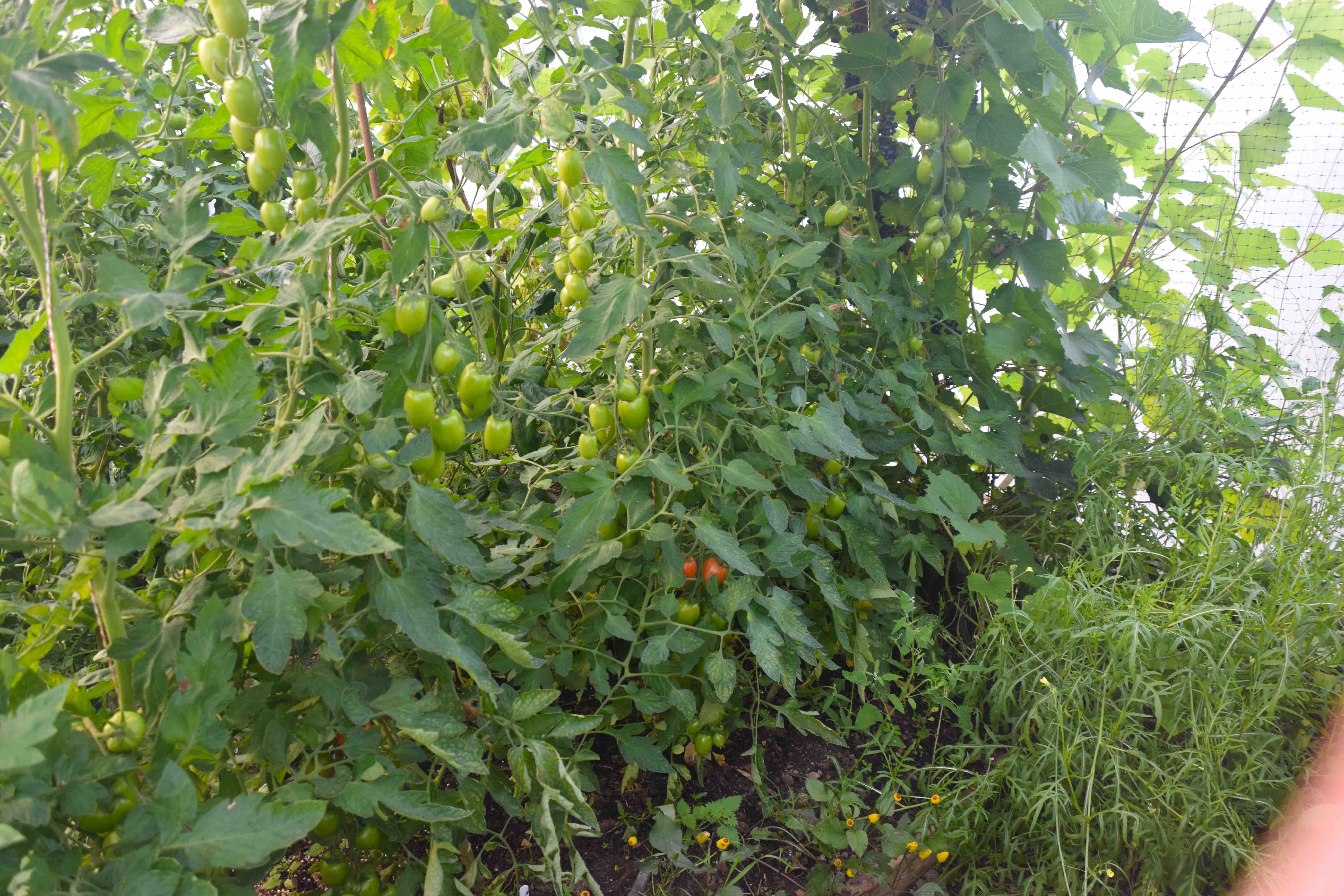
I was inspired (if that is not too pretentious a word) to write this because of my ‘Bolstar Sensatica’ F1 tomatoes. (pic at top of post) They are a ‘paste’ plum tomato. The plum tomatoes weigh about 80g and are supposed to be in trusses of about ten. The plants are resistant to disease and they should have good flavour. This summer it has been a long wait for ripe tomatoes but in the last week we have finally been tucking in. I was watering and I saw a hint of red on one of the lower fruits. I looked at the other four plants and sure enough, on the same day, one fruit on each of the plants was showing colour. Talk about uniform!

They are not the first to ripen and they will not be ready for another week I suspect. First to ripen were ‘Tropical Sun’, that I grew last year and like, and ‘Honeycomb’ which is a new version of ‘Sungold’. It is early, very sweet with thin skins and, so far, has not split which is a big improvement.
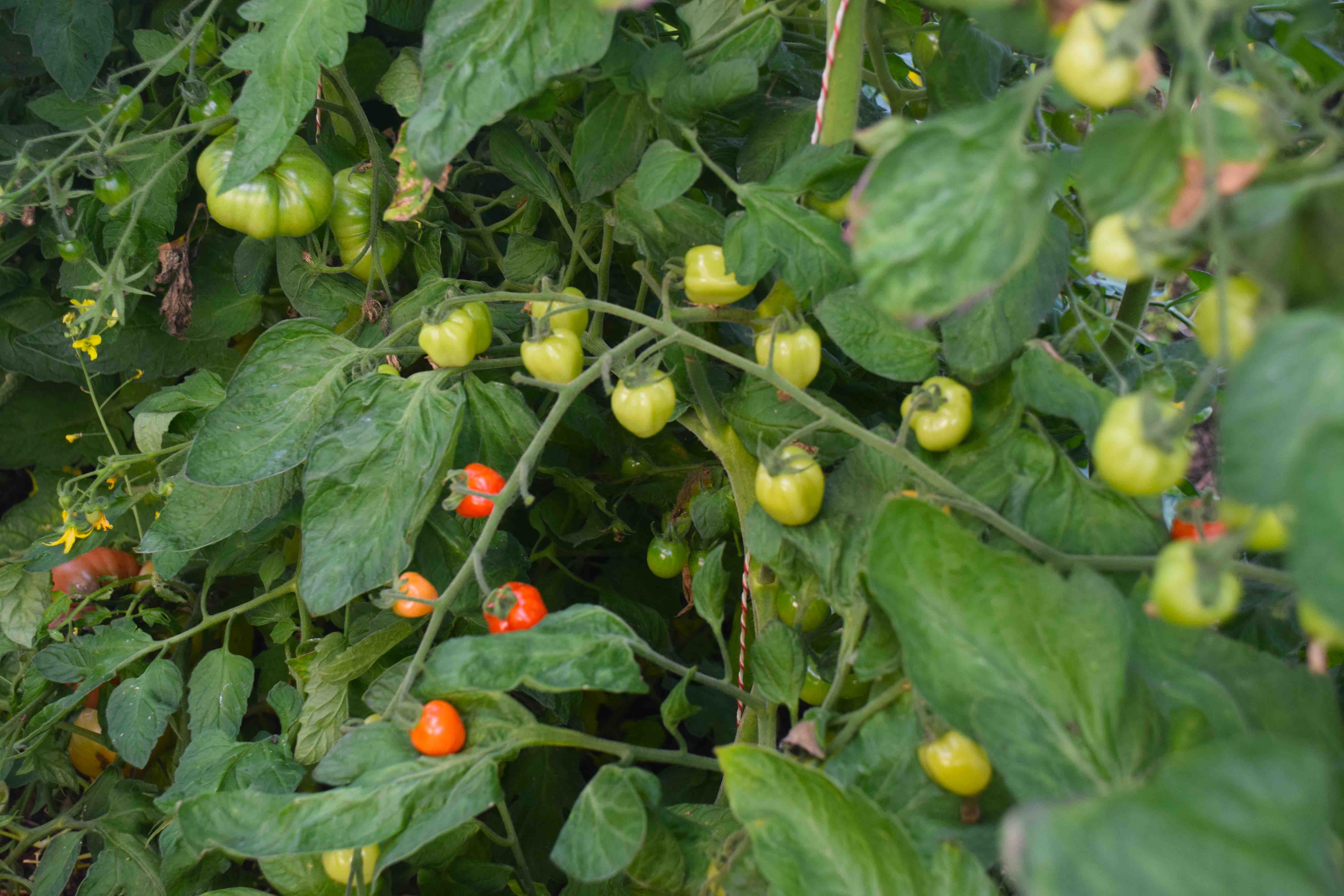
Another to ripen early is ‘Jahodo’. I believe that the word is Polish for ‘strawberry’. The fruits are very like a variety called ‘Tomatoberry Garden’ F1 which I grew a few years ago. I think this one is open-pollinated and, in many ways, it is not as good as ‘Tomatoberry Garden’ F1. The trusses are loooong. They go on for ever. The fruits are small and although they have a cute strawberry shape they are rather firm (well quite hard). Their taste is OK but because it is early in the season and each picking is a few ripe fruits from all the plants they just can’t compare to the other cherry toms. I won’t judge them harshly yet but I don’t love them. On the other hand they are growing really well and cropping heavily with every flower setting a fruit.
Some of the other tomatoes, in particular some of the old, large heirloom kinds, are struggling. They don’t set well and they are slow to ripen. As always I have some plants of ‘Brandywine’ and picking each ripe fruit is worthy of a celebration.
So are F1 hybrids worth the money when a cucumber seed can cost €1 and tomato seeds 50c or more each? It is a matter of opinion but I think yes. A packet of ‘Moneymaker’ seeds will contain 200 seeds for the price of five F1 hybrid seeds but do you need 200 seeds, even if you keep some for next year? In the end, the cost of the seed is not the biggest cost when you consider the heating, pots, compost and all that time and watering and fertiliser. And the results are known. The plants are often easier to grow. I will always grow some odd, old variety for fun but I will also grow some F1s.
Gardening seems to get more difficult every year. It is important that new gardeners have success. If that means growing an F1 hybrid then let them do it.
I know some will say that F1 hybrid tomatoes do not have the taste of the ‘old kinds’. I think a lot of the taste of tomatoes comes from how they are grown and if they are picked when perfectly ripe and NOT refrigerated. – please!
Although some F1 hybrids are bred for a lot of attributes rather than for taste, the tomato that most people grow – ‘Moneymaker’ is no great shakes when it comes to taste. And I defy anyone not to be impressed with the sweet taste of ‘Sungold’, ‘Tropical Sun’, ‘Sweet Million’ or ‘Honeycomb’.
 The Biking Gardener
We bought plants of ‘Gardener’s Delight’ this year and we reckon they are not the real deal.
That is interesting to know. I doubt it if Gardeners’ Delight actually exists any more. I hope they are ripening well and tasty whatever they are!
Ripening well but small fruits.
My primary reason for avoiding F1 hybrids is that they are not the varieties that I want. I mean that my favorite varieties simply are not F1 hybrids. Otherwise I have nothing against them, and I know that they are quite popular with some who enjoy growing vegetables that are more impressive than mine. Instead, I have issue with some modern cultivars (which are not grown from seed) of horticultural commodities because they are marketed as so much superior to older cultivars. I do not doubt that many of them are. (I was recently impressed by ‘Cannova Mango’ Canna, which I really did not want to grow.) However, MANY are weak from their extensive breeding. Yet, they are marketed as sustainable, because ‘sustainable’ was a buzzword for so long. The weakest are the most profitable to growers, who grow more to replace what does not survive.
It does seem to me that many ‘novelties’ are bred to be grown in pots for sale and just don’t cut it in the garden. ~Don’t get me started on the ‘sustainable’ nonsense!
Oh, I get it. There is no need to get started. I no longer get samples because I was a bit too honest about assessing them.