Not just for the bees
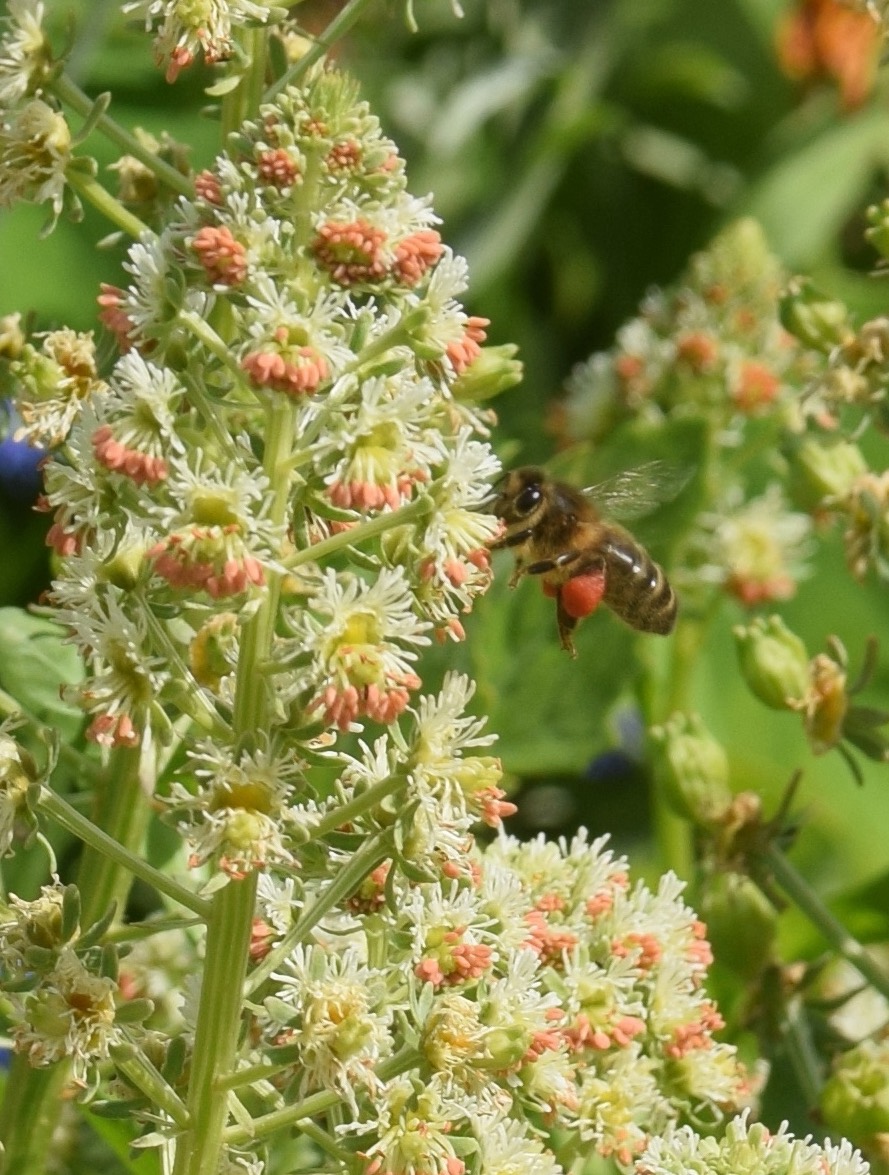
I have mentioned before that there seems to be a general lack of bees in the garden this year. I think it might be result of the poor weather since I will only have seen them when they were visiting flowers and if the weather is cold and wet I can’t blame them for not flying around – I am not even walking around. The same is possibly true of butterflies which are notable by their absence.
Some of my plans for the bees have been thwarted by those helpful garden residents (they are no longer pests of course) the slugs and snails. So there will be no zinnias, sunflowers and many more and vey few tagetes, all consumed as small seedlings. But I want to talk about bees and not get bogged down in moaning about molluscs.

I have two raised beds that are filled with bulbs in spring but these are replaced with annuals in summer, both for cutting and for pollinators. I stupidly put in some nasturtiums which have taken over the beds, and grow onto the surrounding lawn and I have had to thin them out a lot. But the bumblebees adore them, particularly, it seems, the golden yellow flowers with reddish splotches. The cornflowers seem to be more popular with honeybees and smaller bumblebees while it is the larger bees that love the nasturtiums.
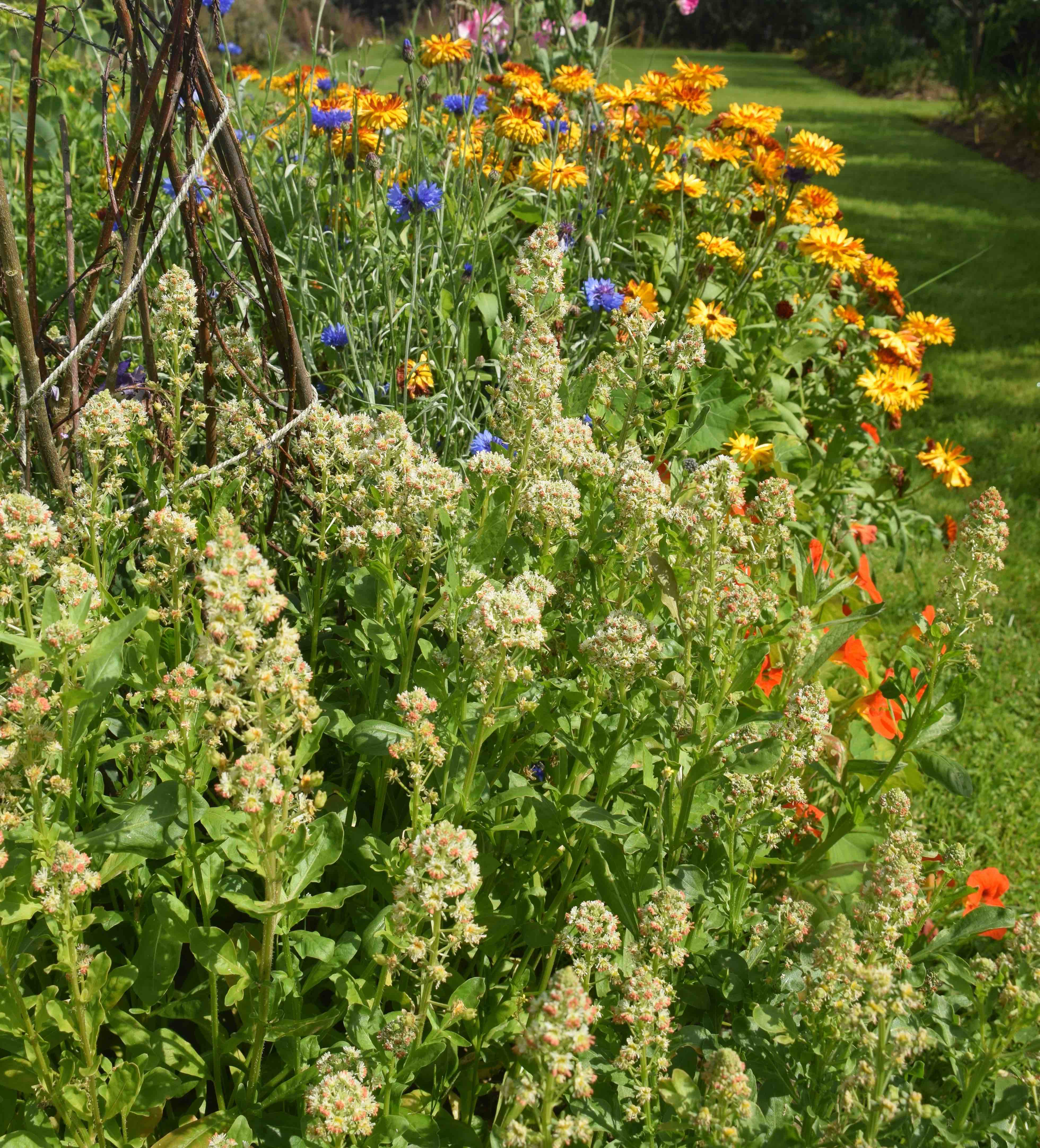
But I want to mention mignonette (Reseda odorata). I grow this most years and I find it a fascinating plant. It is Mediterranean in origin and there are stories about Napoleon returning from Egypt with seed and it was certainly popular in Victorian times when it was frequently grown as a pot plant. A flower of such demure appearance but sweet fragrance was bound to have a meaning in the language of flowers and to present someone with a bunch of mignonette meant ‘your qualities surpass your charms’ which I suspect was faint praise and may have resulted, with some justification, in a slapped face!
I need to warn you that I have been falling down rabbit holes in the past few days and this post and some of the next few will dig deep and meander at strange tangents as I hide from the horseflies in the garden and try to watch a bit of the Olympics while investigating strange subjects to try to avoid the inane and thoroughly irritating ‘commentary’ that the BBC obviously think is highly entertaining. Quite why everyone that wins a medal has to be asked how they are feeling is beyond me. I just wish one of them had the guts to say ‘well what do you think, you idiot?’
And there I go again!
Back to mignonette.
It was probably first grown in the UK in 1752, at Chelsea Physic garden and was quickly popular in pots on windowsills to protect the house from awful smells from the street. The common name roughly means ‘little darling’ and it is certainly a reflection of the rather inconspicuous flowers.
But mignonette is a very special plant. It is a hardy annual, though I always grow it by sowing in cell trays and planting out in May. I see it is included on a website devoted to Irish wild flowers so it must have naturalised which is not surprising.
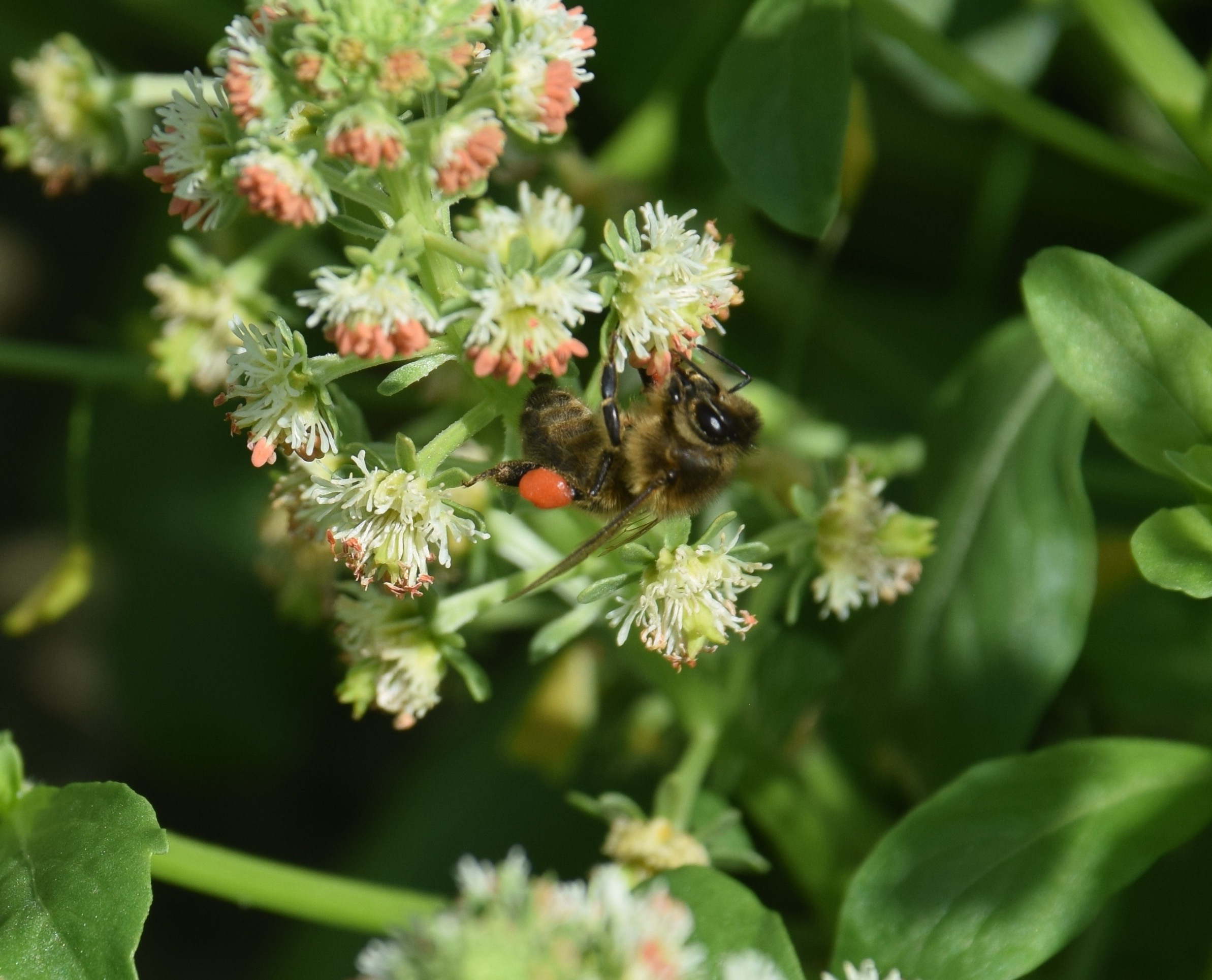
Ever since I first started growing it I have always been a bit puzzled by the fact that catalogue descriptions often refer to ‘red’ flowers and I have never seen any with red flowers. The blooms themselves are very strange with feathery, creamy petals and then a bunch of stamens and I think it is always the stamens that provide the colour to the flowers. Not all flowers produce seed pods but these are large and inflated and considerably larger than the blooms.
The flowers are certainly not colourful, though old catalogue descriptions suggest otherwise. I suppose that without the huge neon F1 hybrid petunias and marigolds we take for granted they had a more level playing field on which to compete. I include some descriptions from old catalogues (or catalogs since they are American) below.
But the perfume of the flowers is impressive. It is difficult to describe apart from saying it is very sweet but descriptions that compare them with violets are, I feel, justified. The scent is profuse and it wafts and is really delightful.
I actually picked some this year and they do hold well in water. I included some in bunches of flowers for sale but they did not sell. I suspect that they look too weedy to be appealing, despite the perfume.

But the honeybees are not put off by the lack of showy petals. I am not sure if there is much nectar in the blooms but the bees must collect a lot of pollen because the busy bees, that quickly visit the blooms, all have pollen sacs packed with rusty brown pollen, obviously collected from the mignonette.
It is intriguing that the beds, just a few metres square, include a range of flowers that attract different bees. And the mignonette will still be in bloom long after the calendulas and cornflowers are just skeletons scattered with seed.
From Samuel Wilson seed catalogue 1889
Mignonette Machet
‘The finest Mignonette yet known. The plant is a strong bushy grower bearing spikes of flowers in great number, which are of gigantic size and perfect pyramidal shape, and of a brick red colour. It is called the New Red Mignonette. It is extremely beautiful and fragrant. Our stock is true and pure. Much inferior stock of this variety is being offered. Everyone should plant this Mignonette, as it forms one of the most attractive features of the garden.’
From Alfred Bridgeman seeds 1894
‘Improved Victoria This novelty, which grows to about 6 inches high will put every lover of flowers in ecstacy by its perfectly regular pyramidal habit, and elegantly formed spikes, which are profusely covered with pretty, brilliant red flowers.’
From Iowa seed company 1896
‘The delicious fragrance of the Mignonette makes it indispensable for bouquets and cutting.
Elmwood Giant A special selection of a famous grower whose mignonette spikes have always excited the wonder and envy of his competitors. The plants are of a robust pyramidal habit: fine healthy growers. They throw up very large spikes of reddish-tinted, deliciously fragrant flowers.
Miles White Spiral
Grows two or three feet high, perfectly erect, spikes of bloom often measure twelve inches long. It is very showy in growth and the grand spikes of bloom can be seen for a long distance, and attracts the attention of everybody
Machet An entirely new and distinct sort of great merit. It is of dwarf and vigorous growth, and throws up numerous stout flower stalks, terminated by massive spikes of deliciously scented red flowers.
Golden Queen A very distinct new variety, with bright golden flowers ‘
From Forrest’s Honest Seeds 1925
‘The good, old-fashioned sweet mignonette that grandmother used to love. Wha is there sweeter than a patch of it, with its thick, healthy foliage and lovely fargrant flower spikes? Plant it in rich soil in a half shady spot, somewhere where it gets just the morning sun and see what wonderful results you will have. ‘
It includes ‘Forrest’s Leviathan’, ‘Golden Queen’ and ‘Selected Machet’ – ‘the greatest abundance of short but very thick flowers spikes, extremely fragrant. Just right for bowls.’
 The Biking Gardener
I am inspired to order some mignonette seeds to sow next spring as I love perfume in the garden.
This year in my Edinburgh garden the perfume from a Daphne transatlantica Eternal Fragrance and Philadelphus Manteau de Hermine have been almost overwhelming, despite the poor weather.
Mignonette sounds like a good choice for later in the season.
That is interesting about the daphne as I find that the smell is not that strong. It does have several flushes of flowers so it does try!