Silver linings

Tomorrow will see the spring equinox and that means, to me, the arrival of spring. But this year I am not totally convinced we’ll see spring any time soon. I certainly won’t be doing any of the ‘spring work’ that was planned. Very few dry days means the garden is still saturated and I am trying not to walk round the garden because I am ruining the grass.
But all this mild, wet weather does suit a (very) few plants.
I am reluctant to be too hopeful – after all I have just come in from the greenhouse and discovered that (probably) a mouse in the greenhouse has bitten off my chilli seedlings over night. But lack of frost has benefitted the plum blossom.
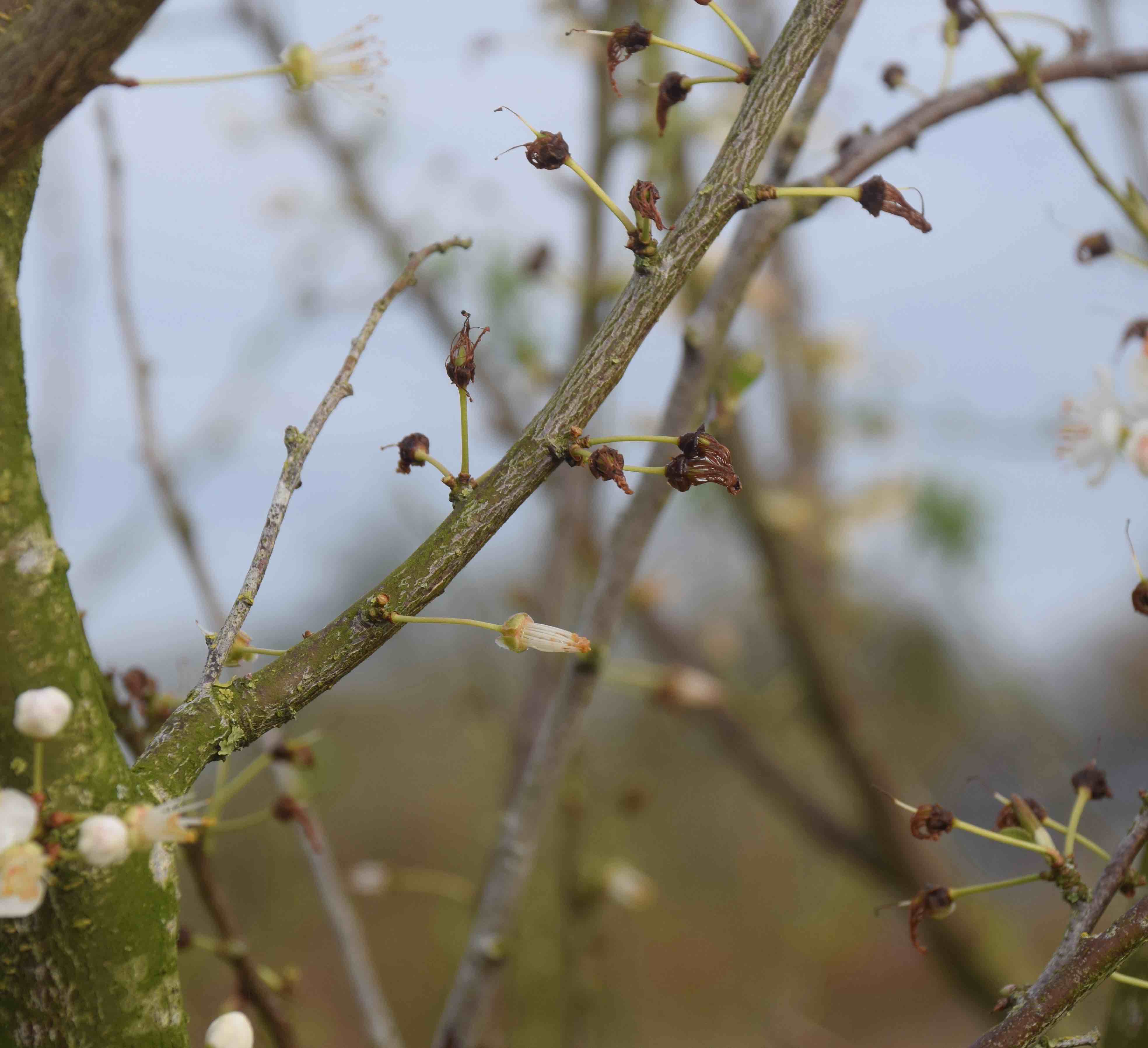
The Japanese plum ‘Lizzy’, which has not ever set a single fruit because it blooms so early, seems to have set fruit this year. Instead of the flowers, complete with stems, dropping off soon after the petals fall, a large number seem to be hanging on and there are tiny green lumps which are potentially fruits. Further along the row of five plums lots more flowers are opening in the mild weather.

And even the damson is starting to bloom. This was planted two years after the other plums to replace one that was snapped off in a gale and this is the first year it has bloomed and I am hopeful for fruit. There are lots of blossom, it is flowering at the same time as the other three plums and it is mild, for now. Cold and frost is the biggest risk with plums here, either killing the flowers or preventing bees from actually visiting the flowers.

The grevillea ‘Canberra Gem’ seems unscathed by cold down to -6c that hit it in January and most of the flower buds were undamaged and are now opening. I am grateful for the vivid colour of the blooms and bumblebees find them irresistible. Being in the Proteaceae, grevilleas worry me because most require soils that are low in phosphorus, replicating their native habitat and you should avoid feeding with ‘regular’ fertilisers. But this one seems very tolerant.
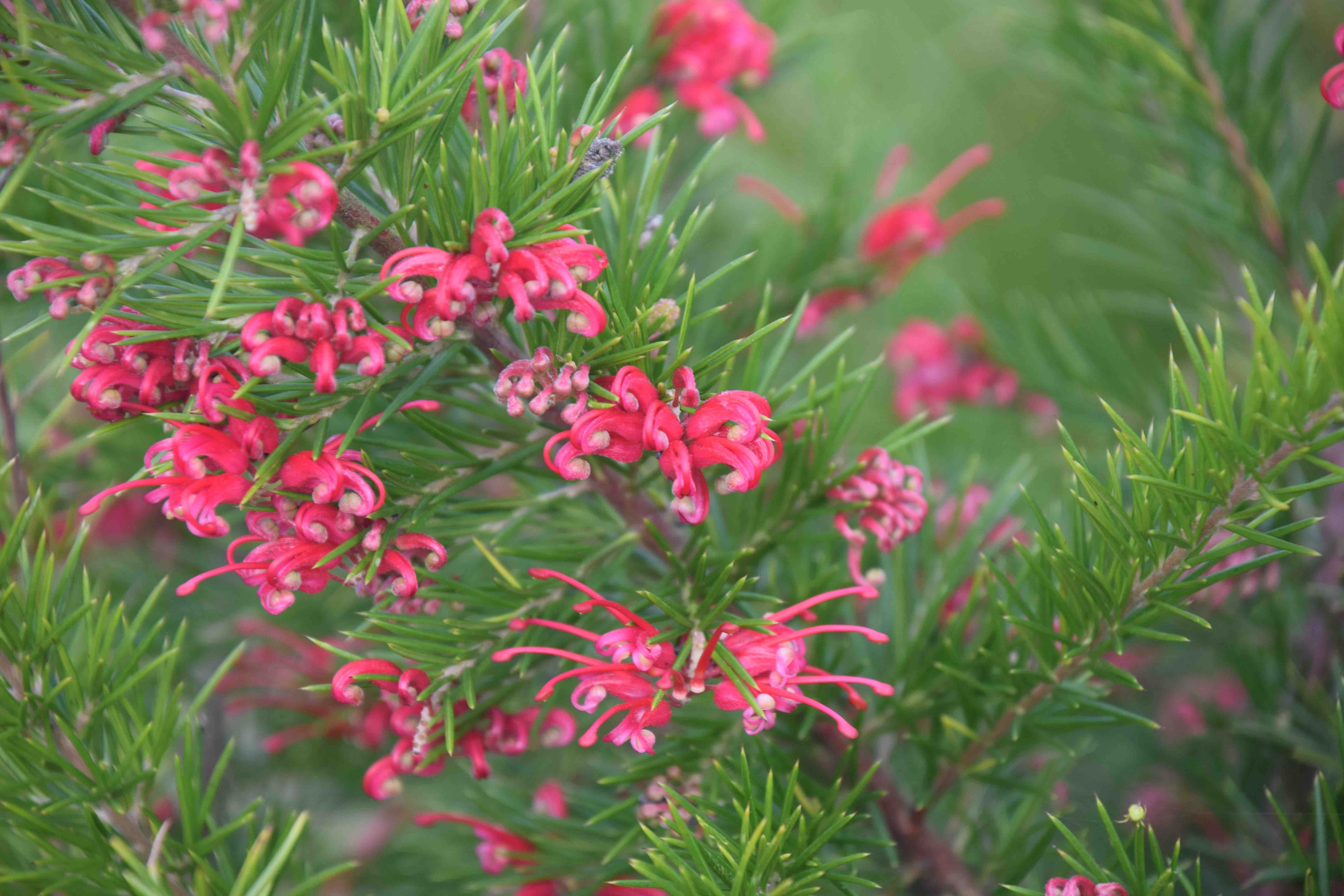
‘Canberra Gem’ is a hybrid of G. juniperana and G. rosmarinifolia. It was created in the 1960s by P. Moore, at the Yarralumla Government Nursery in Canberra, Australia. It is very vigorous and can easily reach 1.5m high and wide and mine gets a light prune every spring, after flowering and even so is getting a bit big for the spot. When I planted it I was not even sure it would survive so I planted it a bit close to other plants, but survive it did! I may have to move some other plants! The foliage is very ‘prickly’ and you should not plant it where that will be an issue. On the other hand it would make a good plant for under a window on the south side of the house, as one of those ‘burglar deterrent’ plants. It has the RHS Award of Merit and fully deserves the praise.
The wet spring has not bothered it, though it is in a large raised bed, and the mild temperatures have suited the flowers. Wind seems to be no issue for it, unlike the poor correa (Australian fuchsia) nearby, that is almost stripped of leaves after all the gales.
The wind and rain has also not been kind to the daffodils. For the past few years the collection of ‘heritage’ daffodils has been a delight and they have increased and bloomed well. But this year the vicious wind and rain has totally flattened them. It looks like someone has driven over them. I planned to dig them up, divide and replant them last year and I really must this May as they start to die down.

But the wet and warmth has proved good for the gunnera by one of the ponds. This area gets dry in summer but I wanted the ‘pond and gunnera’ look. Spring frosts usually blast the young leaves and it does not start to grow with any conviction until too late to get a real head of steam up, but perhaps this year will be the year it makes some real growth. There is still time for some sharp frosts so the battle is not over, but it is a good first step.

And in the raised beds the hyacinths have done well this year. I had a collection of uncommon kinds but lots of things went wrong and they did badly so now they get planted in the raised bed with the tulips. Progress is slow in building up the bulbs to flowering size and I am unsure if the effort is going to be rewarded. But some are doing well including the wild form (blue in the background) and ‘Sunflower’ the double yellow that is not the most beautiful but the one I really want to keep. The flower spikes are a bit larger this year than last season. So there are little triumphs here and there.

 The Biking Gardener
Yes, my garden is still a soggy mess and nothing wants to be the first footer. Hopefully, a few warm and dry days will see more progress…
I hope you get some fine weather and the garden dried up a bit
It must happen soon, shouldn’t it?
I really hope so. More rain forecast for later today and then a colder weekend so maybe next week!
I take my cues from Mother Nature, she’s up for it now so I know things will get better…
I have been reluctant to attribute any benefit to the heavy rains we have experienced but the rhubarb has been fabulous and, with first snouts showing, I am hoping the asparagus will produce as well.
Yes I have covered some rhubarb with upturned pots and it is growing well and will be ready for a first pull at the weekend. But there is not much benefit to this wet weather. I hoped that after a dry Tuesday I might get on the garden but rain over night has put paid to that.
Covered rhubarb did very, very well this year.
I am looking forward to getting the first feed. The mild weather has suited it well
Japanese plum? Is that how it is distinguished from European plums? I have not heard that in quite a while. MANY years ago, prunes were a primary commodity of the formerly vast orchards of the Santa Clara Valley. They were comparable to European plums. Most were dried. Some were canned. I suspect that very few were sent away fresh. French prunes were the most common. Italian prunes were the second most common. Plums, which were comparable to Japanese plums, were rare or non-existent within the orchards, but very popular within home gardens. Now, dried prunes are known as dried plums, merely because they are more marketable as such. Apparently, dried prunes are for the elderly who remember what they are. Only a few decades after the orchards were exterminated from the Santa Clara Valley, no one believes me that prunes and plums are two distinct types of fruit.
Hello – a lot of issues there! Japanese plums (Prunus salicina) are not that common here (N Europe) and are a bit new to home gardeners, which is why I am trying one. They are reported to be self-fertile but they flower very early. I think they are better in warmer climates with longer growing seasons and although mine is ‘Lizzie’ I see a common one if one ‘looks’ is ‘Santa Rosa’. We don’t grow plums for prunes here much, preferring to eat them raw but also probably because we can’t dry them as easily as they can in more southerly areas of Europe. I believe that plums for prunes have drier flesh and more fibre. Prunes suffer from a PR problem. Stewed prunes and custard were a traditional winter pudding, when fresh fruit was not available. These would be soaked and stewed. But with the advent of plastic packs (and sulphur dioxide I suspect) soft prunes are quite popular. I would agree that ‘the elderly’ probably eat more prunes than others but, in fairness, they are really good – I just don’t think to buy them. Maybe in a few years I will get the health visitor to bring some when they come to get me out of bed!
Oh yes, ‘Santa Rosa’ has been the most popular plum here for as long as I can remember. White plums, such as ‘Shiro’ have gained popularity more recently, but are not as popular as ‘Santa Rosa’. I grew ‘Satsuma’ because it is what I remember in conjunction with ‘Santa Rosa’ from my childhood.
I am still unclear on how prunes are distinguished from plums there, but that may be because they are known as plums and Japanese plums respectively. Japanese plums have richer flavor and softer flesh. European plums, which we know as prunes, have milder but sweet flavor, firmer flesh and, very importantly, a higher sugar content that inhibits mold while they dry. Incidentally, the Official Town Flower of Campbell to the north of Los Gatos is the prune blossom (although I doubt that more than a few of the 40,000 residents know what a prune is). The largest retail ‘complex’ there is the Pruneyard because it was a drying yard prior to more urban development. My mother’s home was built where an old French prune orchard had been. Although very few remember it, prunes and apricots are a major component of the history of the Santa Clara Valley, long before the horrid electronics industries ruined it all.
Here ‘plums’ are what you call European plums and prunes are dried plums though not the kind that are usually grown. Japanese plums, I think, prefer warmer climes than here and are what we can buy in shops almost year round imported from Spain etc, though I am not keen on them and prefer to wait for ‘in season’ homegrown plums. We also have damsons which are purple-skinned, green-fleshed small ‘primitive’ plums that are grown for cooking, and then gages which are usually green or yellow with low acidity and soft, sweet, buttery flesh. Our plums are dominated in home gardens by ‘Victoria’ which is not the best-flavoured but is self-fertile and pretty good when picked ripe. How interesting that Campbell has prune blossom as its flower. And a shame that the old Prune Orchard is now a mall. But that is the way of things.
That makes sense; that prunes are dried plums, because your plums are what we know as prunes. Okay, now I am confusing myself. Anyway, if Japanese plums are rare, there is no point in confusing them with the others. It is more confusing here because they are so popular here. The climate is similar to that of Spain, which is why it was historically so popular with the Spanish. Damson and gage plums are the same here, although rare. They were not grown in the orchards, but, a very long time ago, grew within a few home gardens. I have not seen either in many years. The Santa Clara Valley was formerly occupied by the most productive apricot and prune orchards in the World, and even more productive than similar regions in Turkey. Other stone fruits, as well as minor quantities of English walnuts and pears grew here also. It was a tourist destination during bloom, like the autumn color of New England. More than a million people live here now, and almost none are aware of the history.