By the pricking of my thumbs
Something wicked this way comes

Just like last month, March has been relentlessly wet. Even so, seeing a crocodile in the pond may seem something of a shock.

But the fish need not worry, it is actually there to protect them.
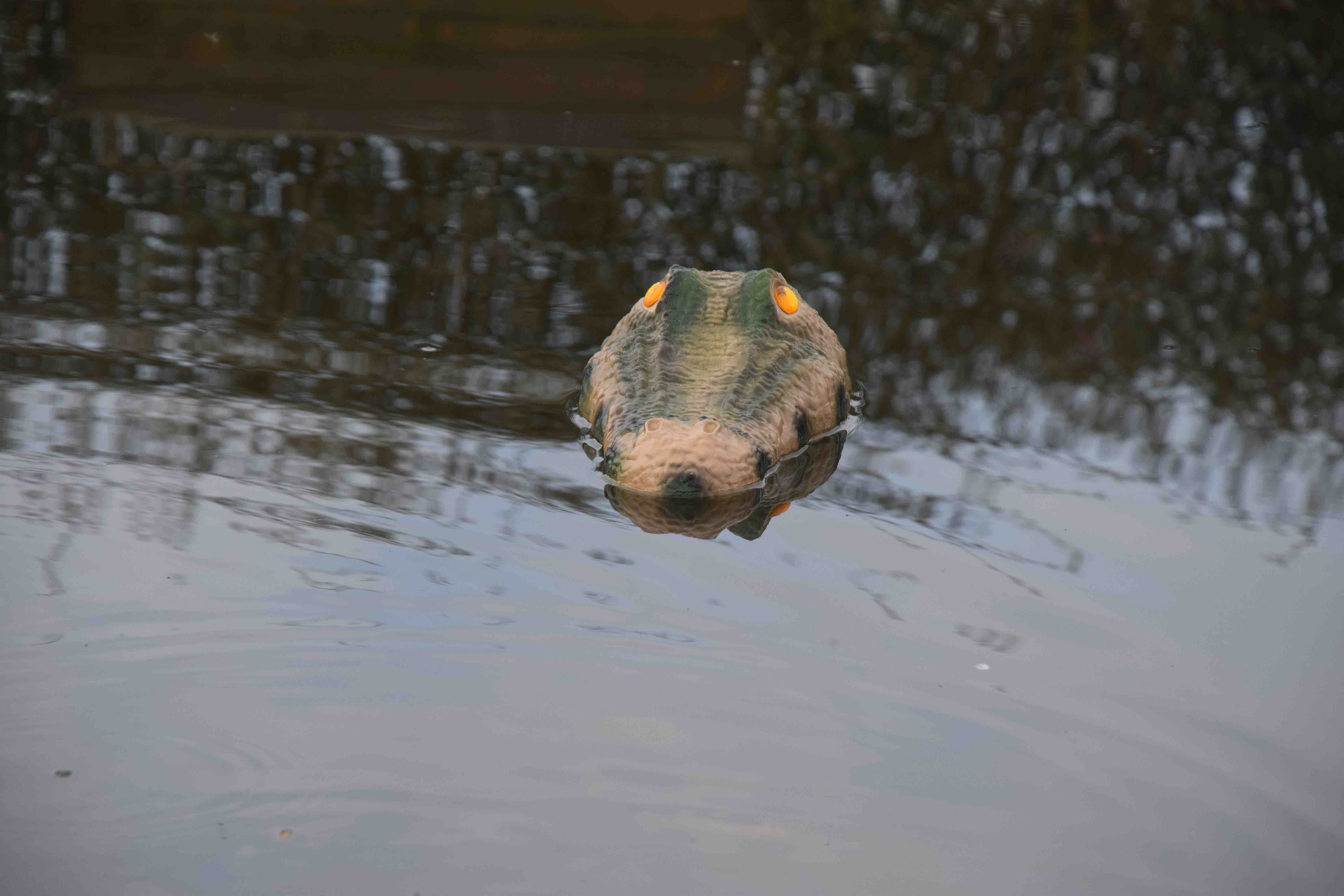
Ever since the fish started doing so well, and breeding prolifically, I have been concerned for their welfare. Now and then a local heron swoops down and lands on the paving round the formal pond and all winter I have had a tripwire beside the pond which yanks over a wooden plank which seems to have worked in scaring it off. But I needed something easier to look after and less of an eyesore. So when I saw a floating plastic crocodile head in a French seed catalogue, from which I get lots of my seeds, and it was half price, I thought I would give it a go.
Now I am not totally convinced that an Irish heron would instinctively know what a crocodile is. Will it work? Well for some reason Mia, the cat, seemed very worried by it and when it floated to the edge (it is now anchored in the centre – the crocodile that is) she would pat it but was very cautious when it moved. But then she is 2% African wild cat so maybe there is something in her DNA that remembers what a crocodile is and to be careful. The fish don’t seem concerned and it does look cool in a very tacky way. I don’t like filling the garden with plastic tat and this will not become a habit but if it works and the fish are safer it can stay. *
But aquatic predators are not the only wicked thing in the garden. The wet weather has brought the devastating tulip fire into the garden with a bang.

To be completely accurate I have to say that I cannot be sure that this is truly tulip fire. Real tulip fire is caused by Botrytis tulipae and as well as spots on the flowers, that coalesce to make larger dead, wet areas, it kills the foliage and plants look ‘burned’. Similar symptoms on the flowers are caused by grey mould Botrytis cinerea. Both are worse in wet springs and this season the flowers have been almost continually wet for the past month, ideal for fungal diseases.
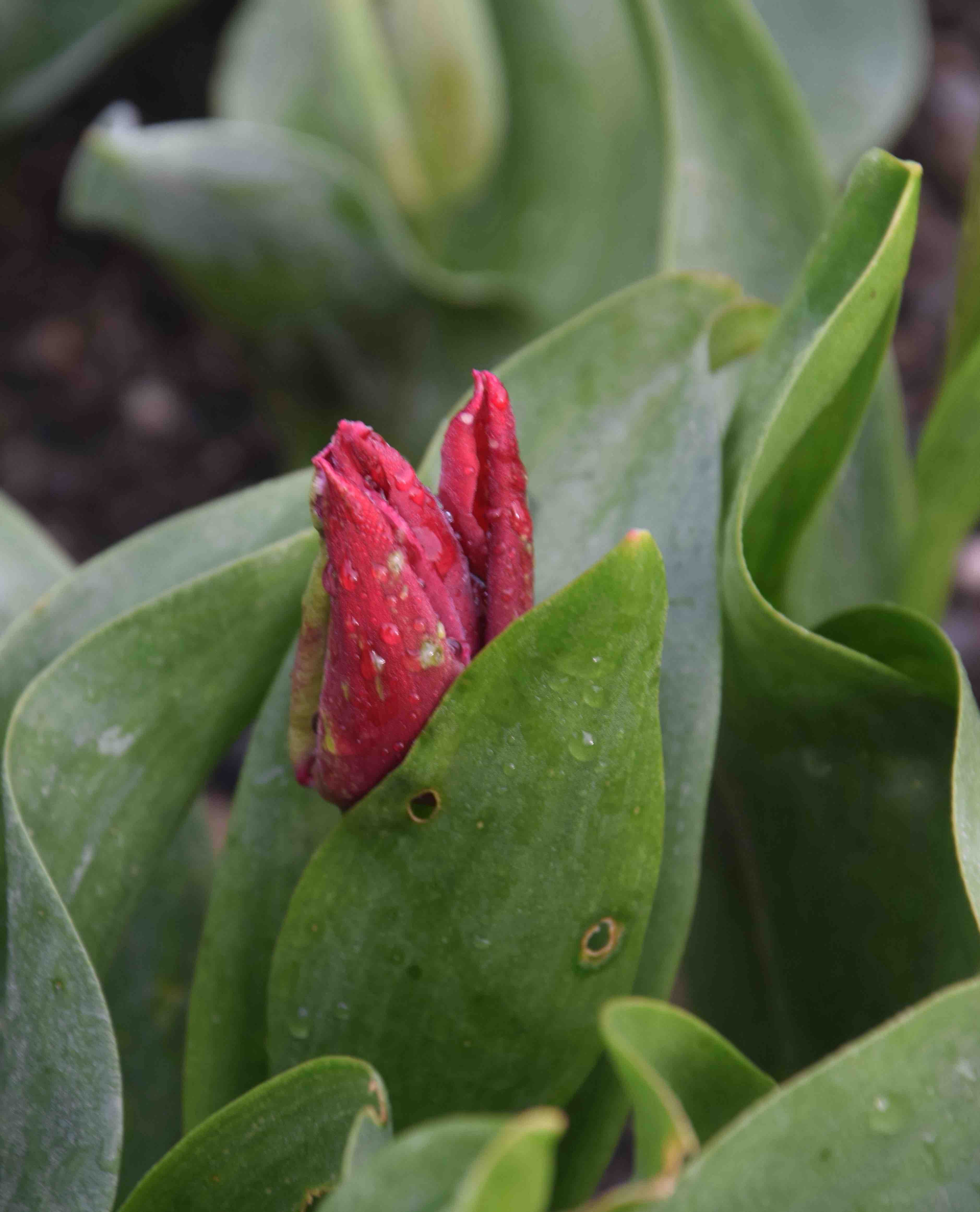
If it is true tulip fire I have a problem because it forms ‘resting spores’ on the ageing foliage and can remain in the soil to reinfect any bulbs planted the following year. As I grow my tulips for cutting in two raised beds I will have a problem. There is no chemical cure and I will have to avoid growing tulips in the beds for a couple of years. So I am hoping that this is just grey mould and not fully blown tulip fire. So far the foliage seems to be less affected and, when picked, the flowers do not deteriorate more.
Many small, species tulips have failed to open their flowers at all. It has been dull and wet ever since the buds have emerged and the petals are dropping without the flowers ever opening.

And daffodils have not fared better either. Generally better adapted to our wet climate than tulips, this year has been awful for slugs and snails. Despite the nonsense news stories peddled by the RHS and BBC last week, snails and slugs are hardly useful in the garden. If the thrushes ate all my slugs they would die of obesity so I am doing the birds a favour by tackling slugs too. But I can’t protect everything even if I wanted to, and this year these slimy little ‘wildlife’ have really taken a toll on the daffodils. In some clumps there is hardly a bloom that has not been either nibbled or totally eaten. The constantly wet and mild conditions have favoured the slugs and they are making hay while the sun doesn’t shine.

And on a much more positive note, our local woodpecker is becoming a regular visitor. It has been coming to the peanut feeder all winter and now makes daily visits, usually several times a day. The tits scarper when it arrives and it is very cautious, hence having to take a photo though the window. It is a Greater Spotted Woodpecker (Dendrocopus major) and they have been in the area for a few years – you can hear their head-banging on trees. Until 2005 there were no woodpeckers in Ireland but they arrived, presumably from Wales, and are established in several areas in the East, especially in Wicklow. I don’t think they are formally known in this area but there is at least one and presumably more. I am very pleased to be able to help it flourish.
*Those who don’t like fish in ponds because they eat invertebrates and larvae can rest in peace because two other pond are fish-free and the wildlife can do as it likes there.
 The Biking Gardener
It is quite a few years ago now but the image remains imprinted on my memory – and that’s quite an achievement – of the visitor to our garden who took off his shoes and socks, pulled up his trouser legs in the style of a Tipperary man visiting Clonea Strand, or a Kilkenny man in Tramore, and dangled his feet in the water of the pond. How I would love to have had a resident crocodile on that occasion! On the matter of diseased tulips: I have seen this in gardens which have featured big tulip displays over the previous years. It may be an example of a mono-culture leading to disease or simply the unfortunate arrival of an unwelcome disease. The woodpecker is a fabulous visitor to have in the garden. The Common Buzzard is my entertainment, whistling overhead and on occasion coming down to tree-top height above my head. Otherwise, it continues wet though we have managed some gardening in recent days.
We have local buzzards that circle around calling and sometimes sit on fenceposts. I am not totally convinced that I do have tulip fire ‘proper’ and it may just be grey mould because of the wet conditions and if it ever dries up we will see if it declines. I have picked some with spotted petals and the spots have not increased. I love the idea of someone dangling their legs in the pond and seeing a crocodile! I am pleased to say that, with the help of a humane trap and some peanut butter, I caught the mouse in the greenhouse that devoured my chilli seedlings and dug up the tomato seeds! I took a walk down the road and let it bound into the hedge.
We had a woodmouse in the glasshouse one year – no damage as it was only for keeping plants overwinter. The mouse would go behind a pot on the staging to hide but would come out to take a peanut from my hand!
Aww. That is sweet. They are so cute and I hate harming them but, having pregerminated the chilli seeds in the hot press on wet paper, carefully transplanted them into individual cells, and seen them pop up and then lose them after three days, I was not feeling very charitable! But I did let it go in the hedge. Ironically I think it got in through a low louvre vent that I had left open to let out a huge bumblebee. As soon as I open the door to go in I can be sure a bee will follow me and then spend hours banging against the glass. I usually forget what I went in to do and spend all my time trying to catch and release them! I have put bumblebee nests in the front bank and then they try to commit suicide in the greenhouse.
Slugs and snails, don’t mention them. Last year my Lilies came up without a problem (except for Lily Beetles) but this year as soon as they put up shoots they get eaten, some of them down to ground level. A lot of them are in pots, elevated on various things but, even then, they don’t escape being eaten. With ‘treasured’ plants in pots the only way is to keep slugs at bay is to elevate them over a tray filled with salt water, like a moat, as long as nothing can make ‘bridge’ around it, like overhanging branches etc.
I grew some Calendula which flowered last year but, surprisingly, they’re still going strong and making new buds. Not bad for an Annual!
Calendulas are amazing and can struggle through winter weather and bloom just when they like