Of cabbages and things
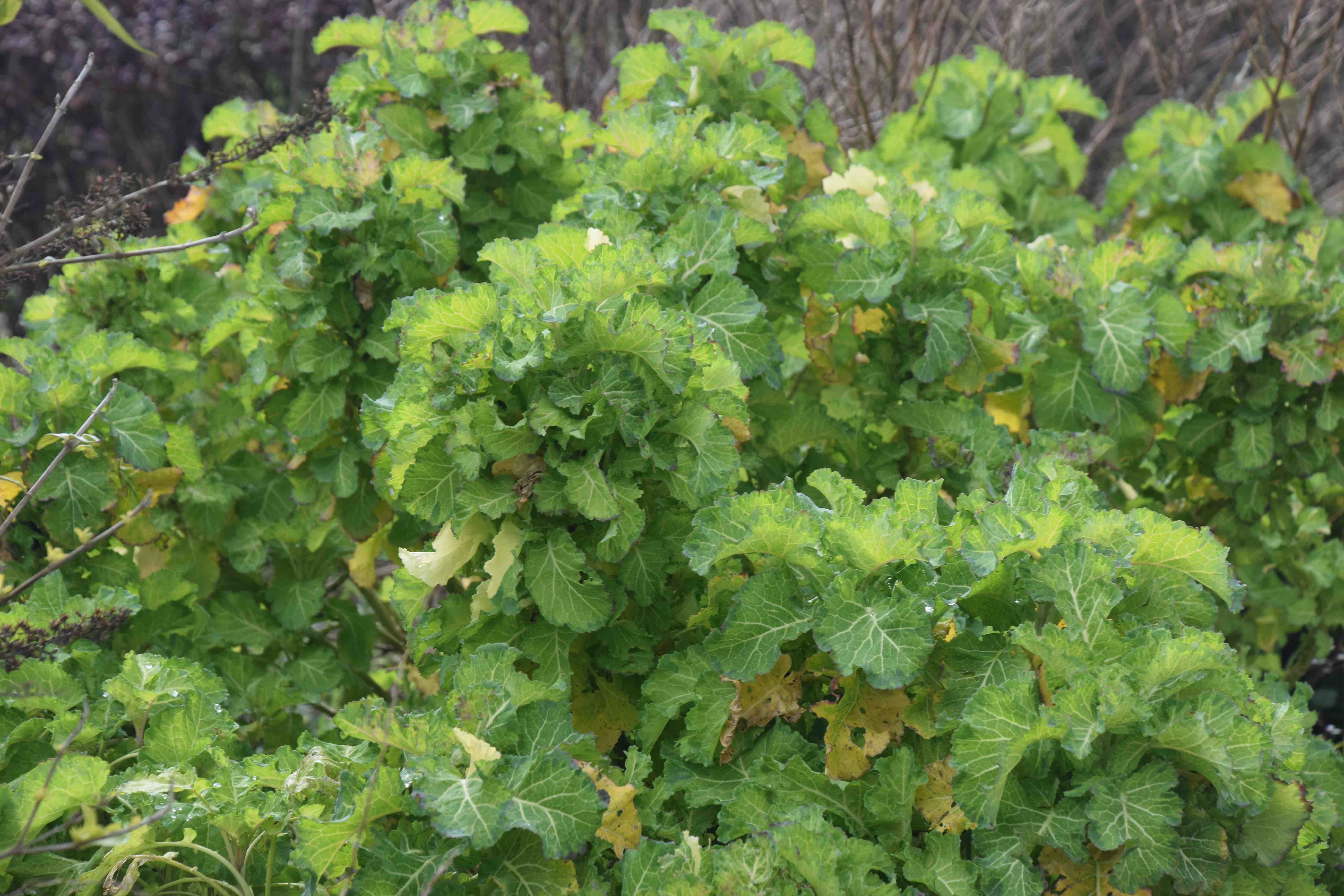
This post is about Brassica oleracea var. ramosa ‘Luigi Leopold’ – but there is a lot of preamble!
Cabbages are hardly the most exciting of vegetables. If any vegetable was truly ‘common or garden’ surely it is the cabbage. Most people regard cabbages with disdain and I confess it is not the vegetable I buy most often. I would buy more, and eat more, if I could think of easy and imaginative ways to cook and eat it. I do like cabbage boiled and slathered in butter and pepper.
But I am always slightly wary of bought cabbage because I know just how difficult it is to grow, or rather how many pests attack it. Pristine, hole-free cabbages must surely be sprayed many times, during their production, with insecticide. I am not against the use of insecticides but I don’t like eating bought veg where I am eating the part that has actually been sprayed. Every year I grow some cabbages, of various types, but almost always I have to clear away 70% of them, leaving me with a blonde, small head, as I pull away leaves munched by caterpillars and slugs. I think cabbages are among the most difficult of veg to grow organically. So I am always looking for alternatives and more of that below.
Firstly, cabbages and their kin are all derived from the wild sea cabbage Brassica oleracea var. oleracea, the genus itself giving its name to the group ‘Brassica’ that gardeners know and to the plant family which is now called Brassicaceae and no longer Cruciferae.
The wild cabbage grows on seaside cliffs and on beaches in west and south Europe, mostly on limestone soils. It is tolerant of wind and salt spray. It is a common plant on both sides of the English Channel. The wild plant is evergreen and, growing in mild, coastal areas, the leaves could be picked for human consumption all year but were especially useful in winter. It was domesticated thousands of years ago and, just as the wolf became innumerable types of domestic dog, it has been manipulated into the huge range of vegetables we know today.
It can be hard to believe but kale, cabbage, cauliflower, Brussels sprouts, kohl rabi and calabrese are all the same species, selected and bred from the wild cabbage.
Brassica oleracea var. botrytis is cauliflower
Brassica oleracea var. italica is calabrese
Brassica oleracea var. gemmifera is Brussels sprouts
Brassica oleracea var. capitata is cabbage
Brassica oleracea var. capitata f. rubra is red cabbage
Brassica oleracea var. capitata f. sabauda is ‘Savoy’ cabbage
Brassica oleracea var. palmifolia is ‘Tuscan’ (‘Cavalo Nero’) kale
Brassica oleracea var. viridis is collards
Brassica oleracea var. acephala is kale
Brassica oleracea var. gongylodes is kohl rabi
and
Brassica oleracea var. ramosa is perpetual kale
Perpetual kale is a relatively primitive form of the species. It has not been manipulated to form a tight head of leaves (cabbage), a dense head of flower buds (cauliflower) or a ‘mini cabbage’ from each leaf bud along the stem (Brussels sprout). There are regional variants of perpetual kale found throughout western Europe and it crops up in the west of England and in Ireland with various names. It is commonly known as ‘Cottager’s kale’ or ‘hungry gap’ kale
But the best documented is that known as Daubenton’s kale. It is named after the French naturalist Louis-Jean-Marie Daubenton (1716-1800). He was best known for his work on animals and especially mammals. His name is remembered in the scientific name of the aye-aye (Daubentonia madagascariensis) and Daubenton’s bat (Myoptis daubentoni). But, as a gardener, I know his name from the kale that was named after him.
He grew the kale in his home town of Montbard in the Bourgogne, in eastern France. He was interested in the farming of sheep and he introduced Merino sheep to France from Spain. In a book about sheep husbandry he wrote about ‘cuttings cabbage’.
‘It is difficult to have a fairly large amount of cabbage for the numerous flocks: one must sow, transplant, watering for several days, and this care must be repeated annually; it would be too time-consuming and expensive for farmers. I would not consider that cabbage was of any advantage for the diet of flocks, had I not met a variety of cabbage that one can have without sowing, transplanting or watering, it is also unknown to naturalists and farmers: it resists frost, like kale and collards, and is better for their livestock because its cultivation is very easy. One can multiply by cuttings; just cut its lateral branches, which are in large numbers and put them in the ground, to soon have a whole field of new plants. The leaves are smaller than other cabbages; but their juice is also abundant; they may serve as food for the shepherds as well as the sheep;…..’
So with Daubenton’s kale we have an old plant, that is propagated by cuttings and that produces leaves all year. But it never (or very rarely) flowers and makes seed. It seems that for the next century perennial kales were quite popular but then seed-raised kales took their place.
The perennial kale is an odd thing. Because it rarely flowers there is no chance of improvement through traditional breeding techniques. It is what it is. The only way it can be changed is through spontaneous mutations and these are most likely to be variegated forms. Apart from the plain green, there is also ‘Panache’ which has cream/white-edges leaves. Much less common is ‘Luigi Leopold’ which has pale leaf centres and darker edges.
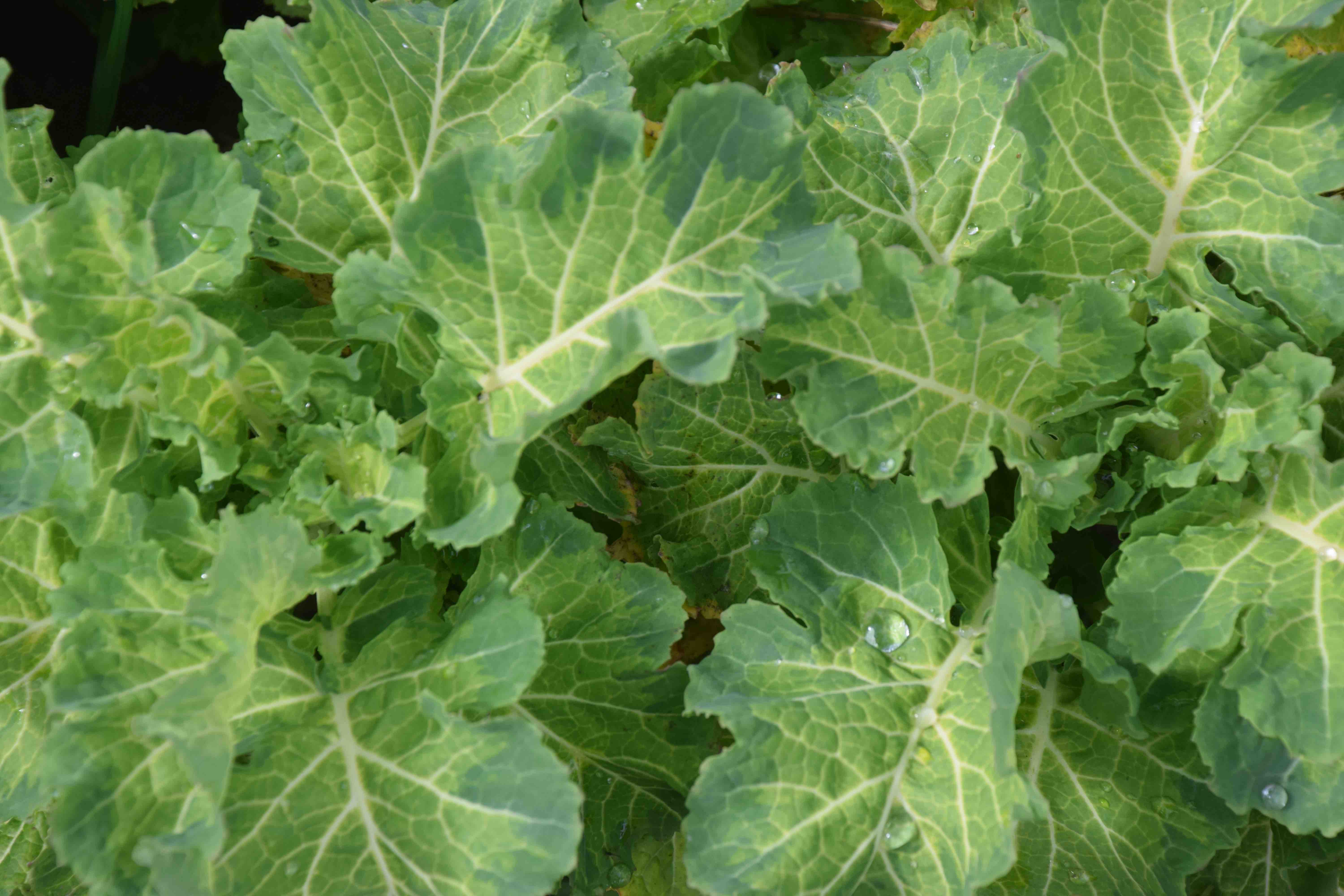
None flower very often and that is a good thing in the garden because once planted the plant keeps on growing for many years. Perennial vegetables always sound a great idea but a lot of them are not in reality. Globe artichokes are easy but don’t actually produce much food (though I do like them) and Jerusalem artichokes are very easy to grow but hard to digest (I love the taste but they really don’t like me, despite my continued enthusiasm for them). But this one really is good. The trouble is that you can’t just start with a packet of seeds – you have to buy a plant.
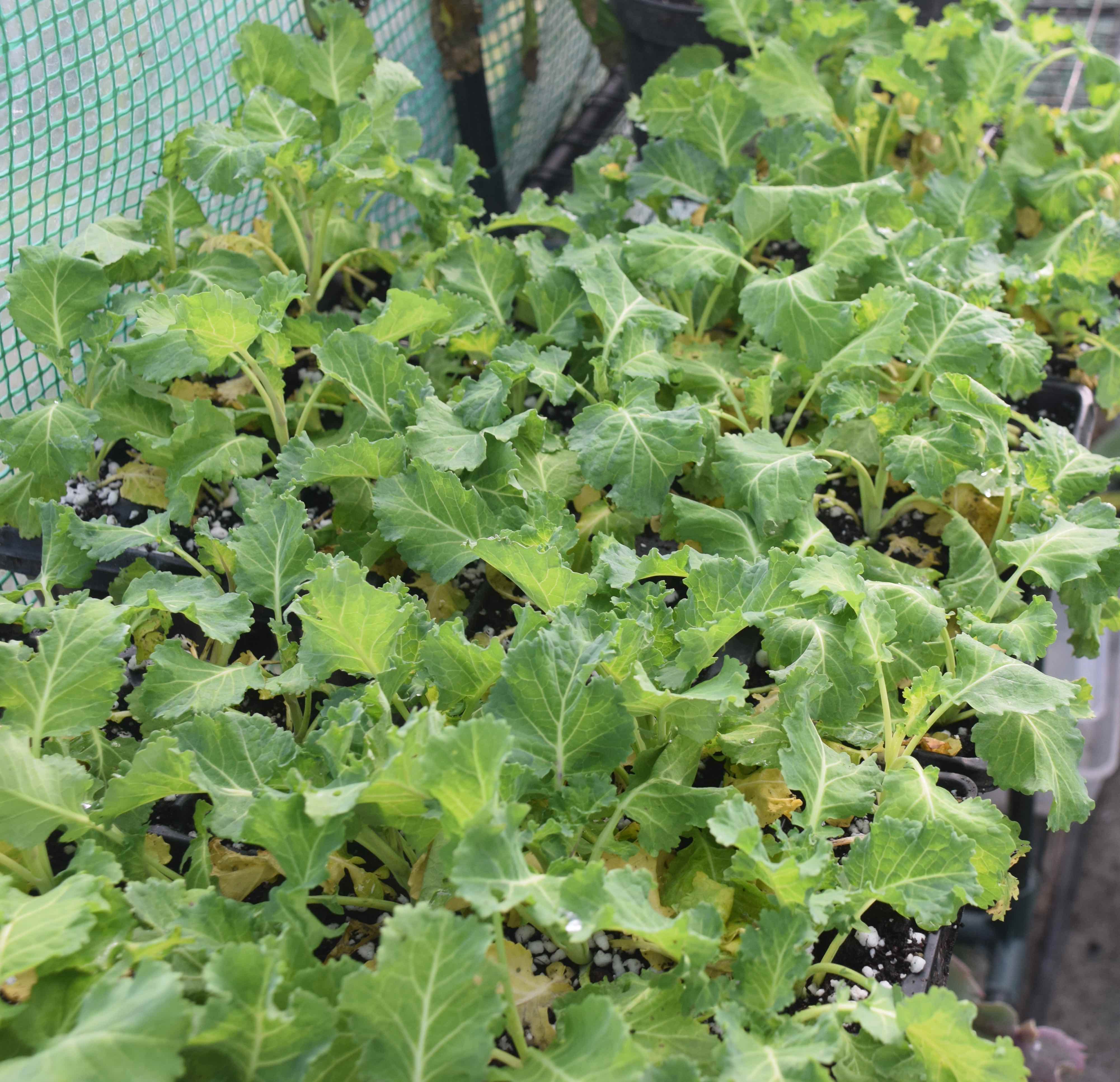
And if you want more of them you have to take cuttings. I have found that these root most readily from ‘heel cuttings’ with a piece of old stem at the base. I have read that the cuttings take up to three months to root but mine root in three weeks. As plants age and they flop, old stems on the soil will often root spontaneously.
These cuttings were taken three week ago and are already well rooted and growing away well.
Plants seem to live for at least four or five years but they look pretty scruffy by that age. A minor issue with perennial kales is that they are, by definition, difficult to fit into a crop rotation system on the plot so they may be best in their own bed, perhaps next to the rhubarb or a comfrey patch. The variegated kinds are pretty enough to put in the flower bed.
It is only my own experience but I have found them less likely to be attacked by pests than other brassicas. Mealy aphid can be an issue though and a real pain when they get into the growing points, making the new shoots useless to eat. Caterpillars seem far less likely to eat them and even slugs are less problematic, perhaps because the foliage is far from the ground – individual plants grow about 80cm high and wide. Squat cabbages and cauliflowers with leaves on the ground are magnets for slugs. Because of their height the leaves of this kale are easy to pick.
What I can do is allay my, and your, initial thoughts that the reason why pests don’t attack them is because they taste awful! I pick individual leaves but more often shoot tips, which encourages branching. The leaves are tender, tasty and not at all bitter and really quite delicious – with some butter – and this is from someone who would rather eat cake than lentils (I do eat lentils – just I like cake more). Kale is rich in vitamins C, and A and K, both of which are fat-soluble so adding some butter actually helps you get all the nutrients!
If you are used to buying pre-prepared kale in packs where they just chop up the leaves and leaf stalk so you get lots of woody, chewy lumps to deal with you will be amazed at how nice kale can be. These tender leaves do ‘cook down’ a lot so a panful becomes a manageable portion. If you like to put kale in a smoothie (I don’t) then it is perfect.
The variegated forms are attractive and they grow well in sun or part shade. They are good enough to plant in the flower garden and my ‘Luigi Leopold’ have grown for two years in the border. Like all their kin, a heavy soil (like mine) is best and a limey soil (not like mine) is best.
Of course it is all very well extolling the merits of a plant but pretty pointless if no one can actually grow it. I think that various kinds are available in most countries now, though they will need some finding on the ‘net’. The plain green is sometimes sold, by even the major seed merchants, in the UK (for about £10 a plant) and the white-edged ‘Panache’ seems ‘relatively common’. If you do look for perennial kales online be suspicious of sellers listing seeds – they don’t produce seeds and if they did the plants would be likely to not be perennial. Be careful of prices too -there are some listing them for silly money. I think my ‘Luigi Leopold’ is the most difficult to find (originally from Cotswold Garden Flowers) so I am propagating lots of plants that I will sell at the gate this spring (for charity) so more people can experience the satisfaction of growing their own healthy kale and preserve the history of this amazing vegetable.
 The Biking Gardener
I am definitely interested in this and will be looking about for a plant. We all like cabbage in this family but like you I am suspicious about the ‘perfect’ supermarket plants. We have limey and fairly heavy soil here but haven’t had much success growing our own cabbage, so far.
Well kales should grow well in heavy soil so it should do well in Suffolk. I see that T&M list the plain green from time to time.
I have just ordered one plant from T&M to be delivered in June!
Perennial collards, which might actually be a type of perpetual kale, is (or at least was in the 1980s) a traditional house warming gift in Watts and adjacent Communities of the Los Angeles region. It was not even rooted, but presented as long cuttings that rooted where plugged into soil at a new residence. I sort of wonder if it is merely a regional tradition, or if it is more widespread, or originated somewhere else.
Collards are an interesting one. I have grown them here but they are not common. I think people are fixated on tight cabbage heads. But collards are much more practical for home gardeners because you can pick them over an extended period. That is really interesting about giving cuttings of perennial collards to new home owners – that is a great idea. I have not heard of it. Maybe a reader of this might know.
Yes, it is an interesting tradition, and becomes more elusively compelling if I try to pursue it. What I mean is that it seemed to be a tradition only in that particular and relatively minor region. Because many of such traditions originated in the South (Southeastern America), I thought that it would be more familiar with those of that particular culture; but it is not. Those who now inhabit the region where it was so traditional in the 1980s are of different cultures, and did not learn about this particular local culture. Perennial kale is not as common as it had been. As new inhabitants move into older homes, they remove such kale because it is not very pretty, and they do not know what it is. It grew in the backyard of Brent’s former apartment, which is at the end of the block across the road from where he lives now, but that building was rebuilt when he left it. Only very few of the now elderly neighbors still grow it. I really should procure a piece of it when I go to Los Angeles in May. Ironically, I also want to procure a piece of the common sugarcane that was a similar tradition among the Hispanic culture there, and which remains more conspicuous than collard greens.
There are so many tasty cabbage recipes:
Polish stuffed cabbage (gołąbki)
Indian stuffed cabbage
Fry an onion, throw in wet shredded cabbage and some caraway or fennel seeds
Coleslaw
Bubble and squeak
…..
and red cabbage…..
Enjoy!
Thank you for the ideas! Cabbage and caraway seed is a good combo and these kales would be perfect for bubble and squeak.
I have a few plants of Cottier’s Kale here, originally received as rooted cuttings, and continued by cuttings here since. However, we don’t eat it regularly as we are not great fans of kale – childhood memories are of its use for winter fodder! I may be tempted to give it another try.
I know that as a child we never would eat kale. The farmer grew it in the adjacent field for sheep and as such I grew up with the mindset that it was fodder rather than food. But times change and kale is suddenly ‘cheffy’. I put my prejudices aside and find it actually good to eat and with the benefit that as I eat it I have that smug feeling that it is doing me good. Interesting that you call it Cottier’s kale – must be the same root as cottagers.
I’d be interested in obtaining some cuttings of the variety you grow if you’re willing to part with some. I’m actively working with breeding new varieties of perennial kale, and I’m trying to obtain as much diversity as possible to avoid inbreeding too much in the F2 and subsequent generations
Contact me via my own blog.
One minor correction I can offer is that seed from perennial kales like Daubenton will produce perennial seedlings. The trait is dominant and will persist even when crossed with biannual kales. The branching is reduced in the F1 but can be recovered some in F2 plants. Those struggling to obtain cuttings of the more traditional varieties can get their own unique selection by growing ‘Homesteader’s Kaleidoscopic Perennial Kale’. A landrace grex developed by Chris Homanics from OP Daubenton seed I shared with him back in about 2011.
Thank you for your interesting comments. I have only had my perennial kale for six years but even old plants show no signs of trying to bloom. How do you get them to produce flowers for breeding? I am happy to share the plant but do not know where you are. Also, since the variegation is chimaeral I doubt it would be inherited by seedlings but maybe you know otherwise.
I was just fortunate to have one of my Daubenton plants flower back in 2010 (if I remember correctly). I’ve been working with the subsequent generations since to try and get a red leaved Daubenton. The cross to biennials seems to restore the flowering habit to the F1. So you can work with the derivatives from there. I’ve had Daubenton flower about 3 times in total so at the moment it’s just a waiting game.
I’m going to be trying a couple of techniques that could help with getting Daubenton types to flower more predictably this season. Found a few research papers that give insight into why perennial bush kales don’t flower often. It basically seems to comes down to the fact they have an alternating growth cycle with pauses in between the “grow the main shoot” cycle, and the “produce side shoots” cycle. And the fact the inhibitors for flowering that break down during vernalisation are only affected in them if the plants are in an active growth cycle when they are vernalised. Not the most technically accurate explanation, but it covers the basic principal as best I can tell.
I do at this point have a plant with Daubenton growth habit and anthocyanin expression. Though not as strong as I’d like in my end goal. It’s been handed to Incredible Vegetables and named ‘Maes Glo’ (Welsh for coal field. After the valleys where it was developed) to try out and propagate. So hopefully they’ll be offering it at some point. Unlike ‘Keeper’ (one of my F1 crosses between Daubenton and Purple Tree Collards that they currently offer) ‘Maes Glo’ flowers moderately most years, so has value for breeding perennial bush types without the faffing required to get the traditional varieties to flower.
Honestly, I was just planning on going to the Cotswold Garden and trying to source ‘Luigi Leopold’ there. But I would be interested in trying a cutting if you have spare. I’m in Wales so we could probably work something out. Maybe I can send you ‘Maes Glo’ in exchange.
But the question about getting cuttings was directed at Paddy as I’m keen to see what the plants he has are like.
Interestingly some French references to Daubenton refer to it as “Irish cabbage” so it would be cool to compare what Paddy has to Daubenton and Eternal Kale.
But also really important to preserve Paddy’s plant in other locations because it could be a unique heritage type like Taunton Deane. Most of the old local forms are long gone now so saving what is left is critical. ‘Paddy’s Perennial Kale’ is something I’d like to see spread around with Paddy’s permission. Hence the request.
Sorry for the essay in response by the way. I’m not great at being concise
Hello and no apology needed for a long response – it was very interesting. I think the goal of a red-leaved or frilly perennial kale would be very good. I did originally get my kale from Cotswold but that was before the portcullis of Brexit came down. And because I am in Ireland I cannot send you plants. I did try to send something to the Isle of Man – was convinced that it would be OK – but no joy. So Cotswold is probably your best bet. But good luck with your seedlings and please stay in touch and let me know how you are doing. I do propagate ‘Luigi’ and pass on plants this side of the Irish Sea. It does revert every now and then but not a lot. As I do grow other kales perhaps I will try to stress some to see if I can get some flowers!
Another reason for me to resent Brexit then. I’d assumed with all the talk of them ensuring easy trade between Britain and Ireland that sending plants or cuttings wouldn’t be an issue. But apparently that assumption was wrong. Not the end of the world in regard to ‘Luigi’, but does scupper my hopes of getting hold of Paddy’s kale. Perhaps you guys could organise something so his variety is spread around. He could well be the only person left growing that variety which would put it under threat of loss. So given the fact it’s been shared and preserved in Ireland for a few generations at least I’d think it pretty important as a part of Irish heritage.
There are rumblings about us getting back into the EU so I’ll just cross my fingers that it happens soon.
On the subject of a frilled perennial kale, there is one that was developed recently from a cross between Ewiger Kohl and a curly kale. Sadly not available to me as it’s in Europe, but you should be able to get it pretty easily. They appear to ship to Ireland.
The link is: https://www.kraeuter-und-duftpflanzen.de/pflanzen-saatgut/kalmegh-kuechenschelle/kohl-ewiger/ewiger-gruenkohl-pflanze
On a purple type. If I’m able to use the grafting method I’m trying this season is successful in inducing flowering in perennial kales, I can probably send you a couple of seed from my red kale crossed back to Daubenton. If not, I can possibly use bud pollination to self the plant (though that wouldn’t be this year as none of the Maes Glo plants have been vernalised this winter). Would be a very small seed sample but enough to grow half a dozen or so plants and select the best red for for your purposes. I’ll drop you an email through the contact option and if I can get some seed produced I’ll send a few your way.
In regard to getting ‘Luigi’ to flower. Your easiest option would probably be to bring a putted plant in during autumn and keep it actively growing. Then when temps get down to between 6-10 degrees Celsius, observe the plant closely and put it back outside while it’s on an active growing cycle (actively pushing out new leaves). I’ve heard vague references to stressing plants working but I’ve not seen a system that is reliable as yet. So given what the literature says, I’d think the process suggested would be the best option short of trying grafting.
Fingers crossed that something works out for you. There aren’t many of us working on these plants, so would be good to have you on board too.