You clever little ‘B’
To balance yesterday’s post that was drenched with anxiety, a more upbeat subject today.
My choice of plants in the garden is diverse. Some are decidedly weedy, or at least a little unruly, and I am tolerating self-sown seedlings with an unusually laissez-faire attitude at the moment. Things will change as the garden fills but I won’t veer from my dedication to keeping the bees happy. There is something adorable about bumblebees and I love to see them. Even better is to hear them, when there are so many the air is loud with their activity. I like honeybees too but the fact that they are collecting nectar from my flowers to take to someone’s hives only for them to sell me back my own honey makes me think they are little thieves! Only kidding (almost).
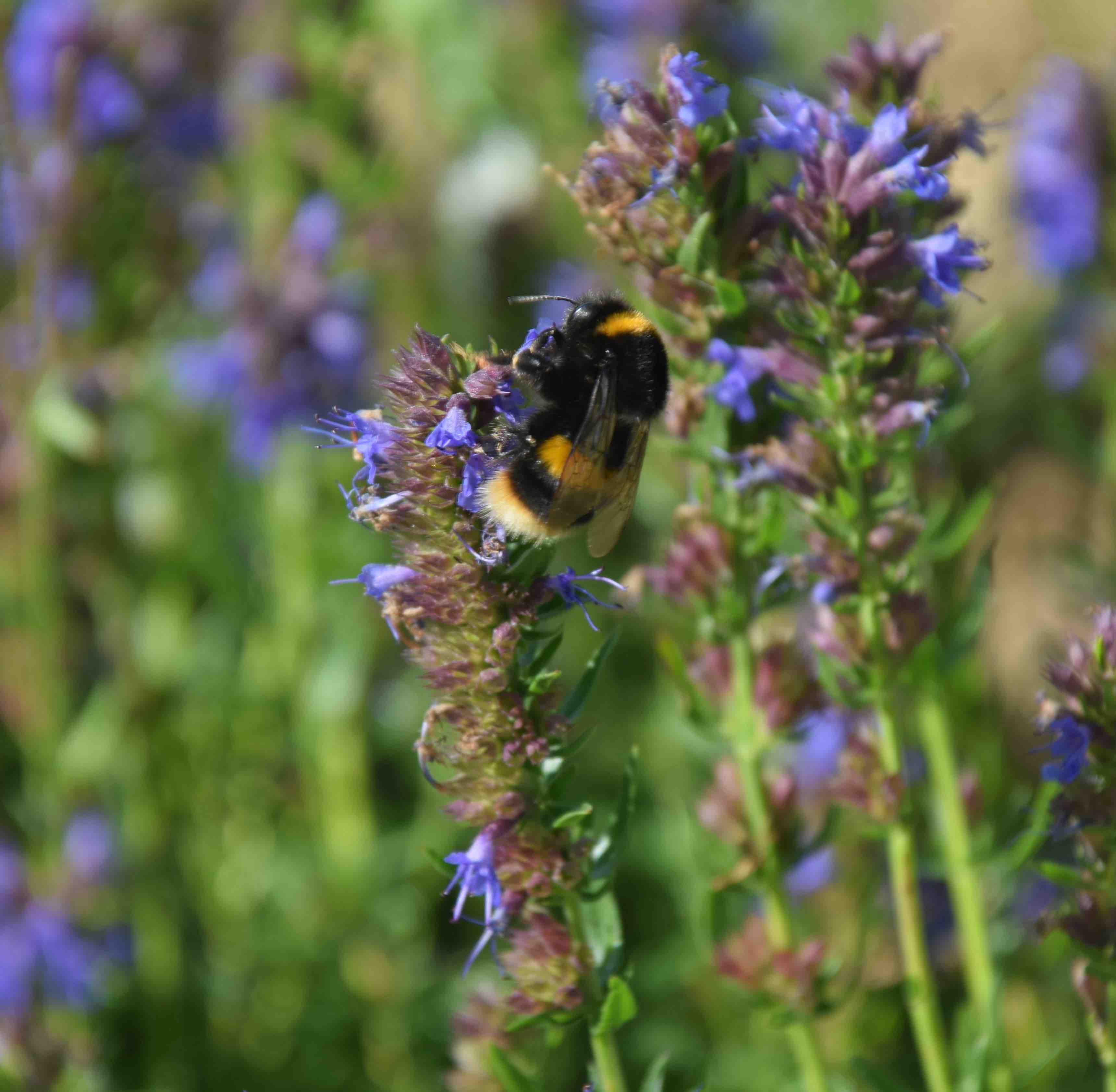
The row of lavender at the front of the house has been alive with bees for months, butterflies and moths too, but really needs cutting back now. The bees will have to move on elsewhere. Fortunately, for them, the hyssop is on bloom (top). Grown from seed, these were supposed to be blue, white and pink, but, of the 60 or so plants, only one is pink. But the bees, and butterflies, don’t care. The hyssop is a brilliant bee plant and both honeybees and bumblebees adore it, whatever the colour.

This is quite unusual and I often find that what suits the bumblebees is not always flavour-of-the-month for the honeybees. The Chinese forget-me-not (Cynoglossum amabile) is a case in point (apologies for the awful photo – it has been windy! ). This hardy annual self seeded from plants grown last year and makes a nice filler. The flowers are mobbed by honeybees but bumblebees are not that bothered. I have always noticed the same with limnanthes.
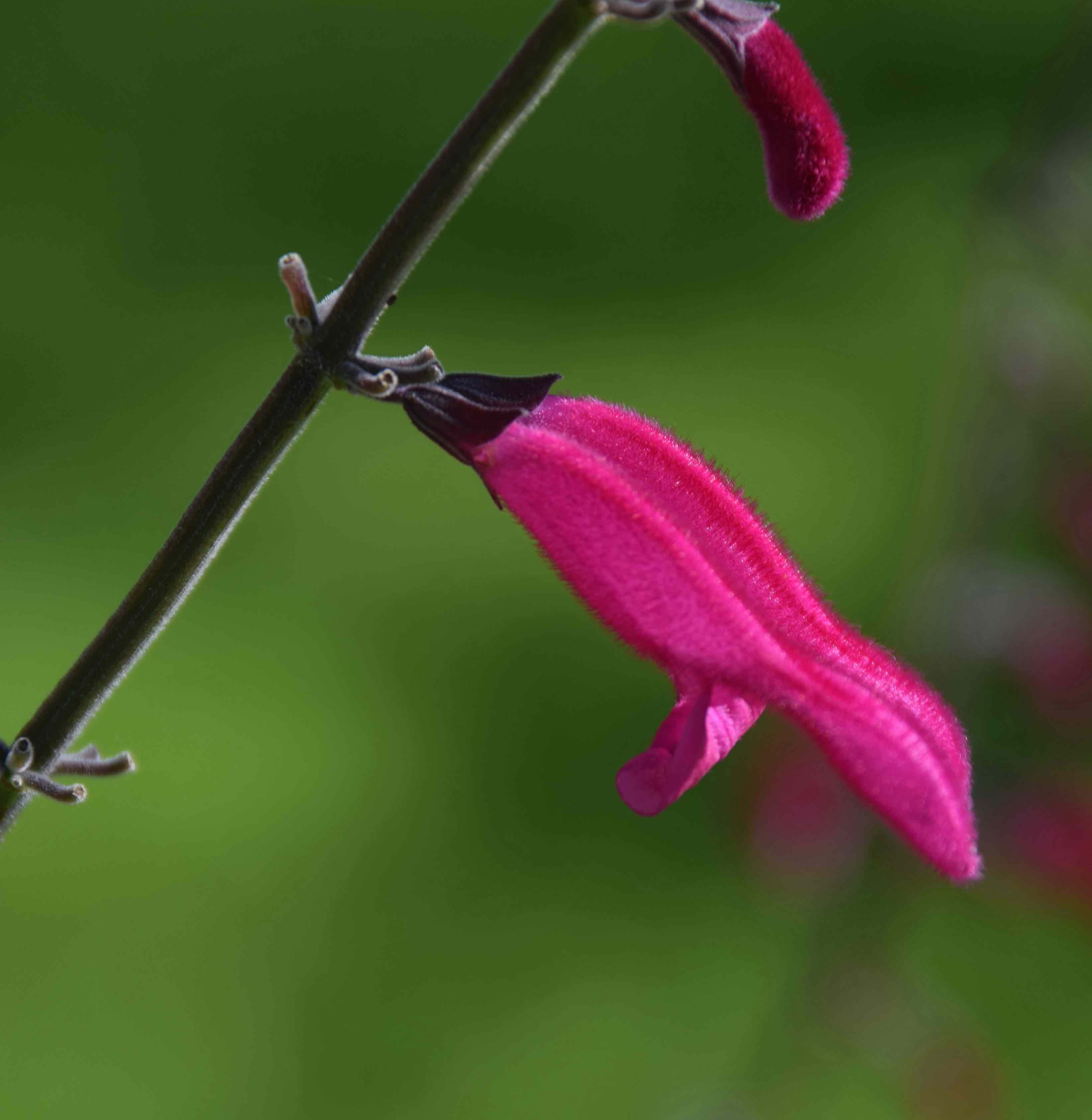
But what prompted these thoughts on bees was when I was pondering the salvia ‘Tubular Bells’ the other day, looking for shoots that would make good cuttings. This tall, slender salvia is a lovely thing but hard to photograph because the flowers are held at all angles – and it was windy! The blooms are bright cerise and hairy and the foliage neat and small. It blooms for ages. ‘Tubular Bells’ is the name given to my plant which is Salvia tubiflora and I was not sure if it was different to the species. I now think the difference is that it has richer-coloured flowers and dark stems and calyces, as opposed to green calyces in the species.
Of course, being a Mexican native, the flowers are long and pollinated by birds in the wild so not useful for bees – the flower tubes are just too long to reach the nectar deep in the blooms.

As I stood there, pondering, I noticed a big bumblebee flying from bloom to bloom. It only stayed on each flower for less than a second (hence the awful photo – and, as you might have realised, it was windy) and it worked its way across the four plants, visiting every flower in turn. What puzzled and intrigued me, was that it always landed on the top of the open bloom – never a bud – and crawled to the left of the flower and inserted its tongue into the base of the flower beside the edge of the calyx.
Now I knew that bees bite the back of tubular flowers, like salvias and fuchsias, to get to the nectar, but this would take longer than the second or so this bee was spending. Was there a gap at the base of the flower tube? That seemed doubtful. A closer look was needed.
And that revealed something amazing. At the base of every flower, on the left-hand side, was a hole.
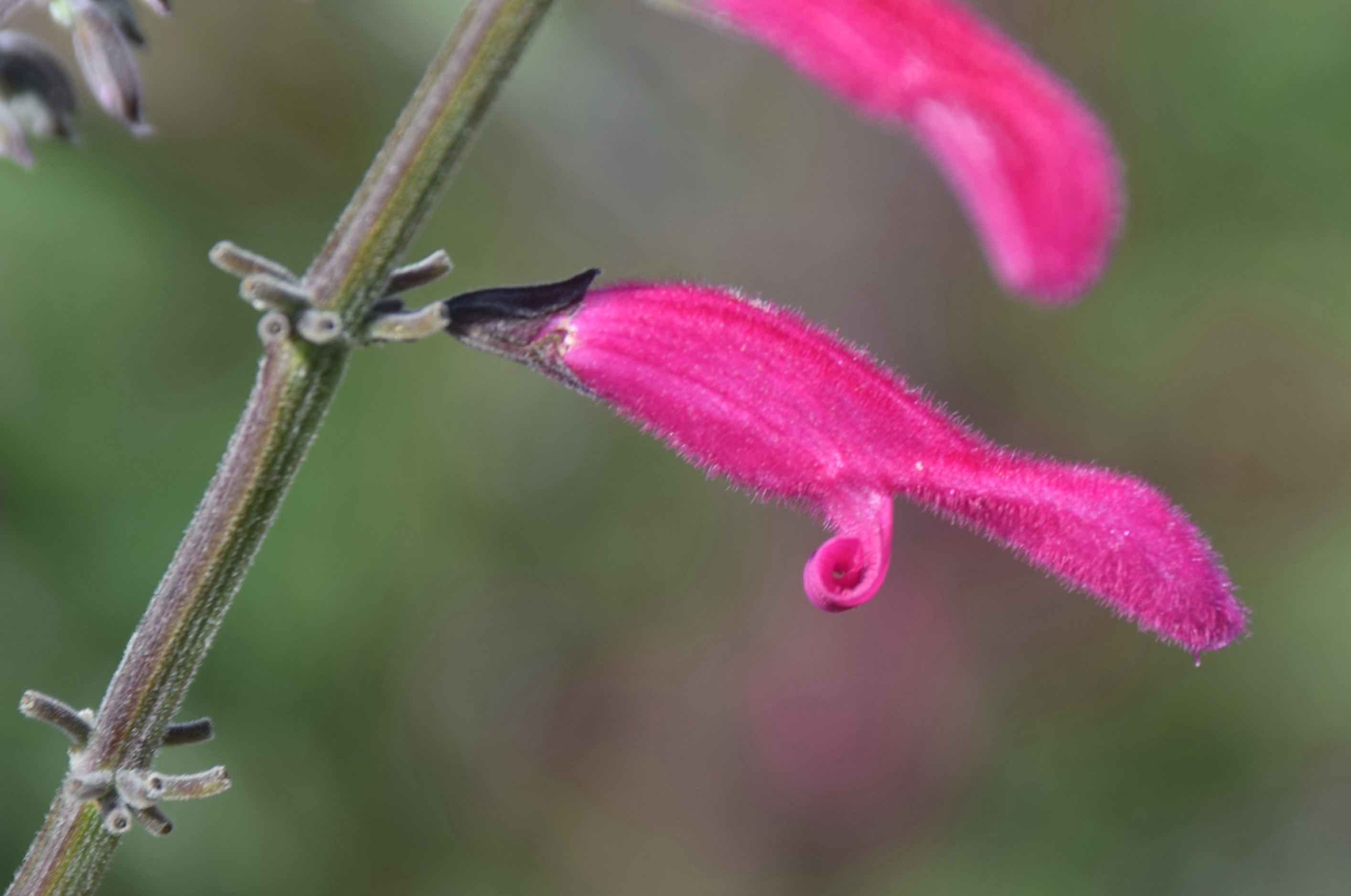
This means that this bee was ‘harvesting’ the nectar in a precise and systematic manner. It had obviously bitten the holes previously and was revisiting the blooms to harves the nectar that had, by then, been refilled. And, to prove the point, I observed the bee coming back later. Was it the same bee? Well, I can’t be sure but it looked similar (not proof) and it did exhibit the same behaviour (more like proof).
Of course, cheating like this is useless to the plant because the flower will not be pollinated or fertilised. But it is win-win for the bee because, if the flower is not pollinated it will last longer and keep on producing nectar. I need to check to see if this behaviour continues. There are lots of flowers still to open, and there will be for weeks. I can’t help but admire the cleverness of this bee. It is an effort for it to chew through the back of each flower but if it visits each bloom on a regular basis, and each flower lasts for several days, it must be worth the initial effort and it is likely (possible) that it is the only bee that knows the nectar is accessible so has its own private supply. Clever. And a good enough reason to take those cutting and hope that another bee discovers the secret next year.
 The Biking Gardener
Fabulously clever bees!
As usual I’m rather late reading your post but I was interested in your bee comments. I too have noticed that bumbles and honeybees do not necessarily favour the same flowers. One plant I have which both love is Convolvulus sabatius. A terrific little – or large, as my one is after several years – trailing plant absolutely smothered in flowers from early summer until first frosts. As well as trailing I have found it will also climb given a little training and support. The smaller little brown bumbles love it. I have also noticed tiny solitary mining bees visit very regularly and have also seen them on m single flowered Rosa rugosa. I have tentatively I D d them as a sweat bee (22 different species!), small black bees which resemble ants with wings. Ref . The National Biodiversity Data Centre, ‘The Secret Life of Solitary Bees’. Am not sure how to do the link, sorry! You will see that there are hundreds of other bees to look out for!