Roses make bees happy

The garden is bathed in warm sun and some of the species roses are in full bloom. Both these things are making the bees happy. Their pollen and nectar collection seems to step up a gear when the roses are in bloom but that is partly because their visits always involve vibrating the blooms. The bees rush in circles around the blooms, buzzing away, to coat themselves in pollen. You can hear them in the blooms a significant distance away. There are two roses that seem to excite the bees most, the large, pastel flowers of Rosa roxburghii and Rosa ‘Sealing Wax’.
Rosa roxburghii is a strange rose. I am not surprised it is not widely grown.

The growth is stiff and angular and it looks awkward as a youngster. The leaves are rather small on the large bush, and are divided into up to 19 leaflets. They develop some autumn colour before they drop but the large, squat, bristly hips drop to the ground before they appear to ripen. They remain greenish yellow or faintly tinged with orange but never red. This rose was first known in ‘the west’ as the cultivated double form (before 1824), and it was later introduced as the single-flowered form. E H Wilson found it wild in Szechuan, China, and this introduction was from plants just 1.2m high. Roy Lancaster introduced it again, from Japan, in 1981 and these are apparently taller. I am not sure of the origin of my plant, bought from a nursery, but it is already more than 2m high.
The hips have been long used in China for medicinal purposes and are supposed to be aromatic, though I have never noticed that – not surprising as they lay on the ground among the fallen leaves.
Lots of descriptions of the flowers seem to be copied and reposted. They are variously described as tiny and powerfully fragrant. The variation may be due to the different introductions. But on my plant the flowers are large and very showy. They are carried singly at the ends of short shoots that grow from the previous season’s growth. They can be rather hidden among the foliage. They only seem to last a day and the petals drop before the flowers get old. Flowering lasts two or three weeks. The flowers have, to my nose, which is usually good to average, little scent. They are fragrant but not strongly so. But they are beautiful with rather crumpled petals and the shading from rich pink at the edges to white at the centre, showing off the bright yellow stamens.
Think of this as an interesting and beautiful flowering shrub rather than a rose and you will not be disappointed. It is robust and the stiff branches in winter and the peeling bark makes it more of an all-rounder than most roses and it is not particularly spiny.
Bees also love it. The other rose that the bees flock to is Rosa (moyesii) ‘Sealing Wax’. This is the less-planted companion to ‘Geranium’. It was raised at Wisley before 1937. I chose it rather than the more popular ‘Geranium’ for a rather pedantic reason: ‘Bean’ describes the flowers of ‘Geranium’ as ‘geranium-red’. One of my pet hates is that pelargoniums are called geraniums. There is no red geranium. There is no red pigment in the genus geranium! So it makes me cringe every time I think of Rosa ‘Geranium’ apart from the questionable decision to call a rose a geranium!
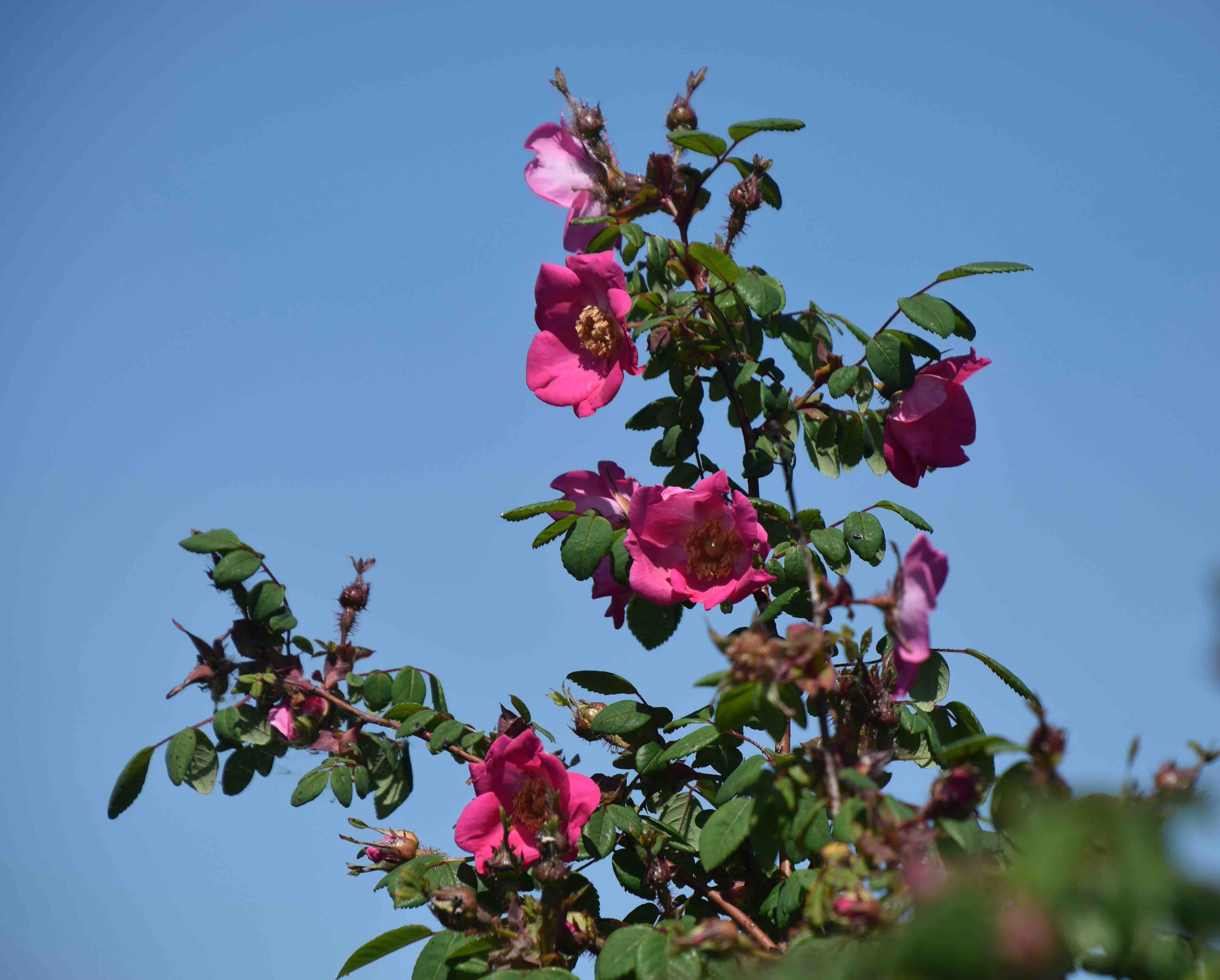
‘Sealing Wax’ has deep pink flowers (like some geraniums) rather than the red of ‘Geranium’. The large red hips are similar though. It is a large, arching, prickly shrub and a nasty thing to weed under. The flowers are not fragrant but, at its best it is spectacular in bloom and the bees love it.
 The Biking Gardener
The first rose you described reminds me of the wild roses that grow in wooded areas here in Virginia, USA. The bees also love them. I dug one up as a child and replanted it in the edge of my moms woods.
I wonder what rose that was? Rosa virginiana? The wild roses do have a special charm.
The one I dug up I believe was Rosa virginiana. It was a deep pink rose. Many that grow along the sides of the rose are Rosa multiflora, which I believe is invasive here.
I am not aware that any ‘introduced’ roses are a problem here apart from the possible exception of Rosa rugosa that is common by the sea. I know it is not native but it is difficult to dislike it and I am sure the benefits for wildlife outway any negative features.
Two great roses!