A trio of tobaccos
I would quite like to grow a lot of nicotiana; I find them fascinating. It is a combination of the fact they are in the solanum family (full of plants that can feed us, cure us, intoxicate or kill us), are often scented, have intriguing and beautiful flowers and are generally easy to grow. I suppose I first grew the colourful hybrids, many years ago. The older types were quite tall and bushy and had flowers that closed (or collapsed) during the heat of the day, limiting their popularity. Then the ‘Sensation’ type was introduced which remained open during the day but were still large plants. Unfortunately the most modern hybrids are often not just compact but stunted. But there is a lot of potential among the many species and recently we have had the interesting (but not great, in my opinion) ‘Tinkerbell’ * and various forms of the colour-changing N. mutabilis.
The South American N. sylvestris has been popular for many years but seems to be edging into the spotlight again. Although strictly a perennial it is easily grown as an annual and my plants were sown in March. Nicotiana seeds are small and must be surface-sown, not covered with compost because the seeds need light to germinate. The seedlings are tiny at first so wait till they have produced a true leaf or two before trying to transplant them. This has big, basal leaves that easily exceed 30cm long so it needs plenty of room and, because it can potentially exceed 2m in bloom it is worth giving it good soil to try and build up a big mass of basal leaves before it sends up the tall, branched flowering stem. The flowers are held in large heads and are pure white, drooping (but not closed during the day) and intensely fragrant. It is worth picking off the dead flowers (when they turn brown) because they often remain among the fresh flowers and spoil the effect, and cutting off the flower clusters when they have finished, to keep the plants neat. The whole plant is sticky or clammy and ‘traps’ small insects such as greenfly and midges, which is a nice bonus but can make the plant look a bit messy and like a green flypaper.

Geoff’s rating 9/10
Garden rating 8/10
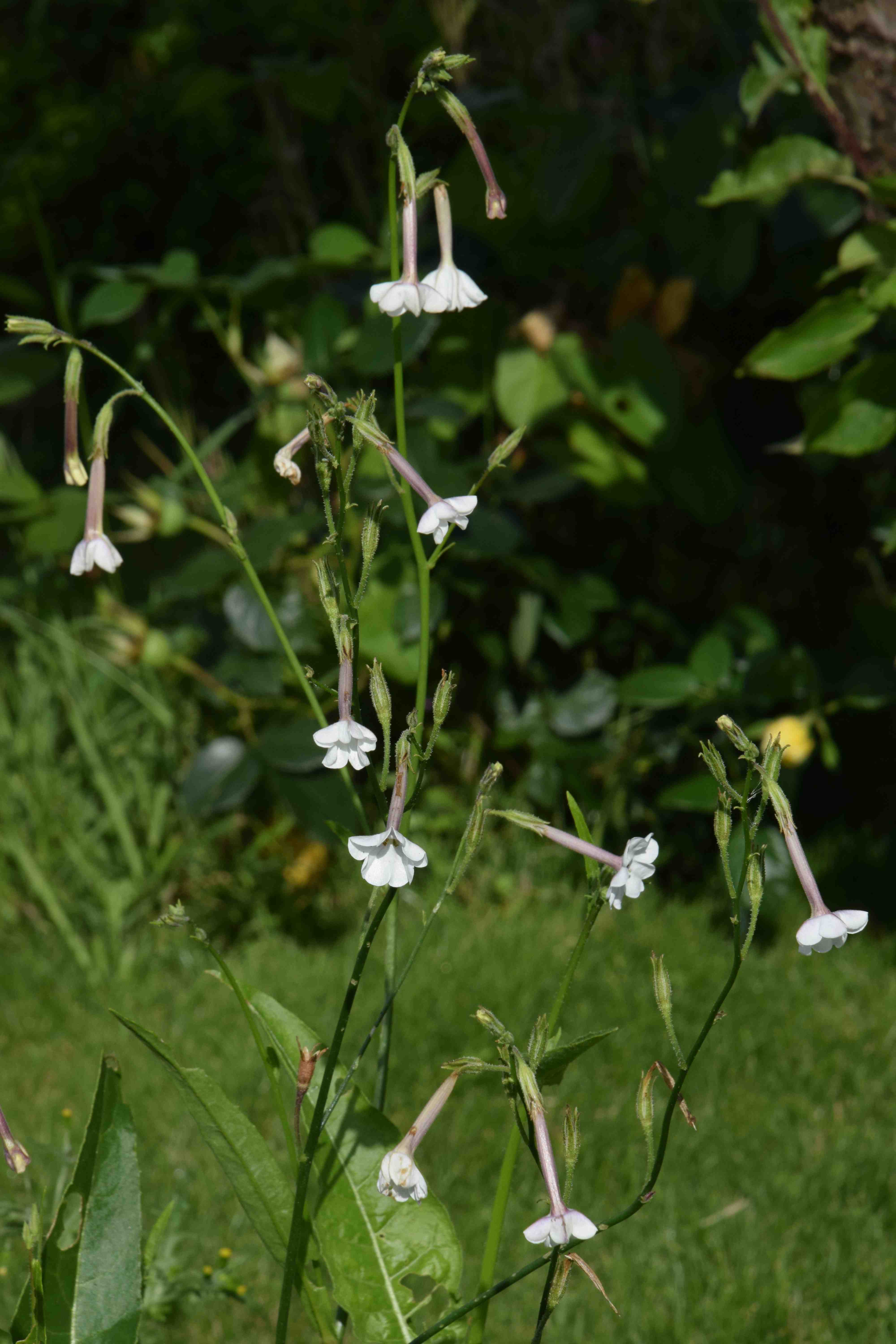
Nicotiana suaveolens is also white-flowered but a very different creature. For a start it blooms much earlier and has branching stems with sparse, small, white flowers. Nicotiana are native to much of the Americas with some in Africa and a lot in Australia and this one comes from SE Australia. The flowers are fragrant at night but, like many other nicotianas, they ‘collapse’ during the day and look slightly miserable.
Geoff’s rating 7/10
Garden rating 7/10
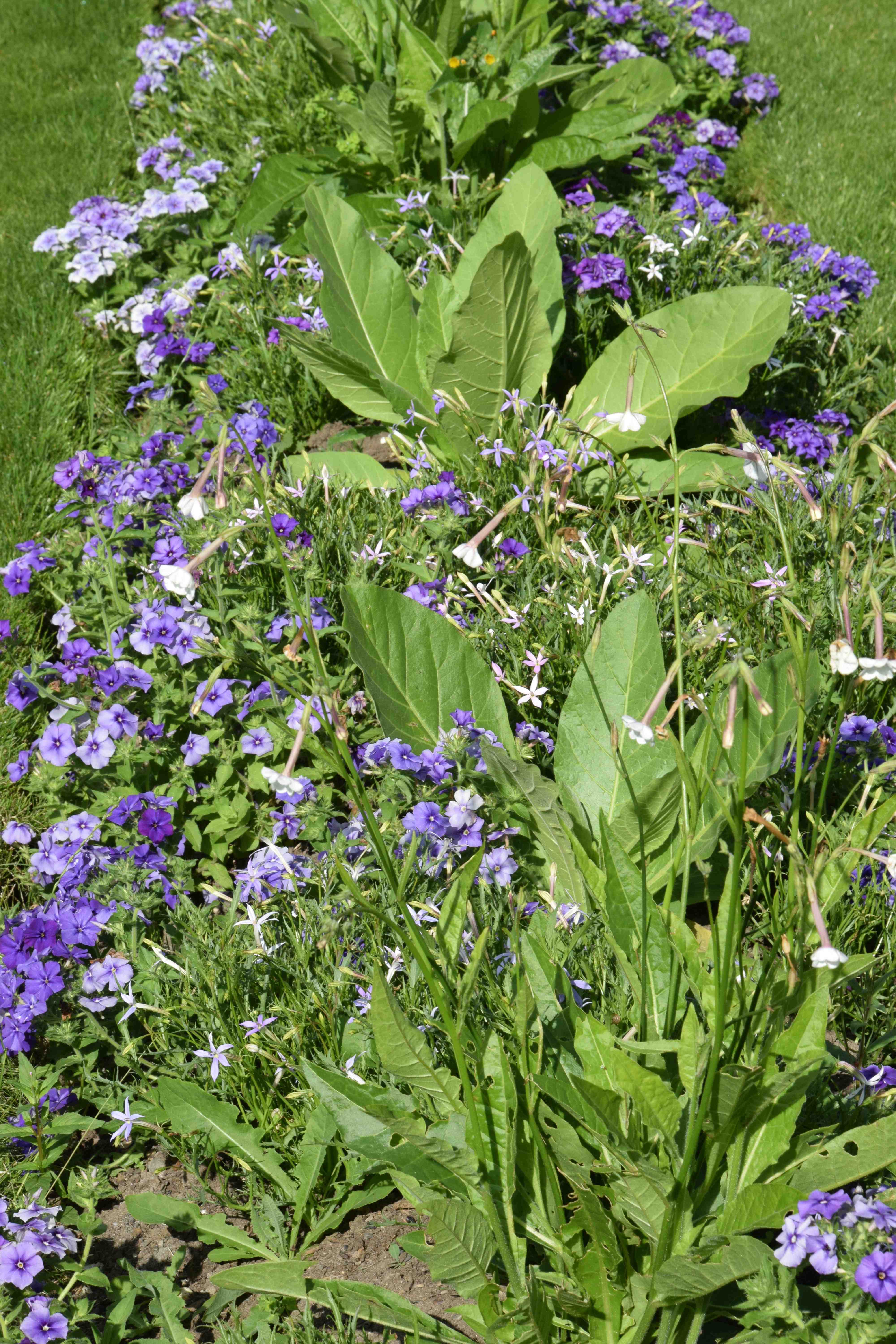
I planted these two nicotiana with phlox ‘Moody Blues’ and isotoma* in two narrow, formal beds but N. suaveolens, in particular, would look better with something taller and airy around it to help give it some impact.
I can tolerate small, dainty flowers on plants but I can see why breeders have created larger flowering plants, mostly based on N. sanderae. These are fine but I hate some of the new creations that are excessively dwarf. The mix I grew this year was ‘Eau de Cologne’ from Thompson & Morgan. It contains a range of colours but I left them in the trays a bit long and most of the (rather potbound) plants started to bloom. This was not the best way to treat the plants but it did allow me to select the flower colours from the mix and I planted up two pots with the green-flowered plants. I popped a white cosmos in the centre of each too but the nicotiana have grown so well and flowered so profusely that they have more or less smothered the poor cosmos, for now at least. I do like these green hybrids. They retain the wonderful colour of species such as N. langsdorfii and N. rustica while making them more socially acceptable with their large and attractive blooms.

Geoff’s rating 8/10
Garden rating 9/10
* Something very odd happened with the isotoma this year. Last year I grew only blue isotoma and I saved seed from these. The plants this year have shown amazing colour variation with about 20% pink plants and a few whites. The flower shape and size is also slightly variable. I would be delighted at this if I hadn’t planted them with the blue phlox! I suppose that a bit of contrast doesn’t hurt but it is no surprise that the few plants I put in some pink-planted urns have all turned out blue!
* ‘Tinkerbell’ was bred by the innovative Ray Brown at Plant World Seeds.
 The Biking Gardener
I’m a big fan of Nicotinia. After all, they’re scented! I don’t grow them as often as I should, though, for various reasons. Instead, I grow Night Scented Stocks. I find them easier, and just as perfumed, if not more.
Yes night-scented stock is lovely and next year I must grow mignonette, its traditional companion. So many plants-so little time!
Growing up on a farm in the Burley tobacco center of the universe, a large part of my youth was spent wrangling Nicotiana tabacum. The cash from the tobacco crop help keep our small farm running, although that way of life is quickly going the way of the passenger pigeon. I remember the scent the tobacco barn, as clear now as it was 40 years ago. But now I’ll happily stick to growing that other member of the nightshade family, Solanum lycopersicum (http://ow.ly/AtTv1)!
There is something special about the scent of tobacco. I have some tobacco chocolate that is wonderful and as chocolate is addictive anyway it doesnt matter about the nicotine content I guess! I remember my dad growing tobacco when i was a child and he smoked a pipe but I was too young to know if it was ever any good.