The best perennial in the world?
I like hardy geraniums.
I don’t love them. I could live without them.
They don’t make my heart skip a beat. But I like them.
Sometimes it is good just to like something – it allows you to judge it rationally.
Hardy geraniums are useful. They should be a part of every garden just as oats and wholemeal flour should be a part of your diet. Porridge is nice. It is hard to dislike it but you would hardly ask for it as your last meal on death row.
Hardy geraniums are generally easy to grow, have attractive flowers, put up with a wide range of soil types and growing conditions, are good for bees and are just generally good eggs. But most don’t ever have a mass of flowers at one time so they are easily overlooked as your eye goes to more flamboyant plants. That is until we had ‘Rozanne’. Then everything changed.
‘Rozanne’ was an amazing new plant when it was introduced in 2000. And not just because it was a geranium that got me excited.
‘Rozanne’ was first shown to the public at Chelsea Flower Show by Adrian Bloom and it has proved to be a wonderful plant, performing well all over the world. Apart from the fact that it has beautiful flowers and attractive foliage, it flowers on and on and on. It has a sprawling habit that covers the ground effectively but it is not scrawny at all. It is a flowering machine. It was introduced by Adrian Bloom but not bred by him. He was asked to introduce it by Donald and Rozanne Waterer in 1992.
Soon after it was introduced a very similar plant called ‘Jolly Bee’ was introduced from The Netherlands. I had a bit of a relationship with both plants. I was doing some work for Darwin Plants (a wholesale nursery) and went to The Netherlands and saw ‘Jolly Bee’ in commercial production and Marco Van Noort, the nursery owner gave me a jar of ‘Jolly Bee’ honey. The differences between the two plants were minimal and Blooms of Bressingham took out a law suit to contest the origin of ‘Jolly Bee’. It was ruled that the two plants were not distinct genetically or morphologically and Marco lost the case after spending 200,000 euro on it, perhaps proving that in these cases only lawyers win. The two plants were very similar, and I grew both and could not see much difference, especially because the flower colour does vary a little according to the weather. Oh and the honey leaked in my case on the way home.
Later I was shown the plant in Adrian Bloom’s garden at Foggy Bottom in Norfolk (England). Adrian and I sort of have history. Although I grew up near his Bressingham home and visited as a child to ride the trains and Merry-go-round that were as famous as his father’s plants, our paths did not cross until I was asked to write a feature on heathers for (the now defunct) Practical Gardening magazine. It was the first of a new ‘head-to-head’ series where two people would give different opinions on a subject. I was asked to write about not liking heathers, a long-held feeling that I still hold. Heather is OK in itself and I do admit winter-flowering heathers into my beds but I just think that mass plantings of them belong on moors and not in island beds. So I was horrified to find that up against me was Adrian Bloom, the father of planting heathers and conifers. As he showed me round the garden he showed me that he had incorporated other plants with his original plantings of heathers and conifers and very good they looked too. His contribution to the way we plant our gardens and to the plants we grow should not be underestimated – he has always been at the forefront of garden trends.
And with ‘Rozanne’ he produced a winner. In 2008 it was voted the Perennial Plant of the year in the USA and it has the RHS AGM. But the real accolade was at the Chelsea Flower Show’s centenary show when it won not only Plant of the Decade but later Plant of the Century! That may be over-egging it a bit but it is a great plant that is suitable for a wealth of planting places. In most cases when a perennial or shrub is recommended for hanging baskets it looks fine for a while but can’t really compete with bedding plants for impact. But ‘Rozanne’ can compete and looks pretty good, for a long time.
As Adrian Bloom was showing me around the garden in October, with towering miscanthus creating great powder puffs of white and pink ‘Rozanne’ was covering the ground with a sea of blue, looking even better than earlier in the season as many of the leaves take on reddish tones as autumn approaches.
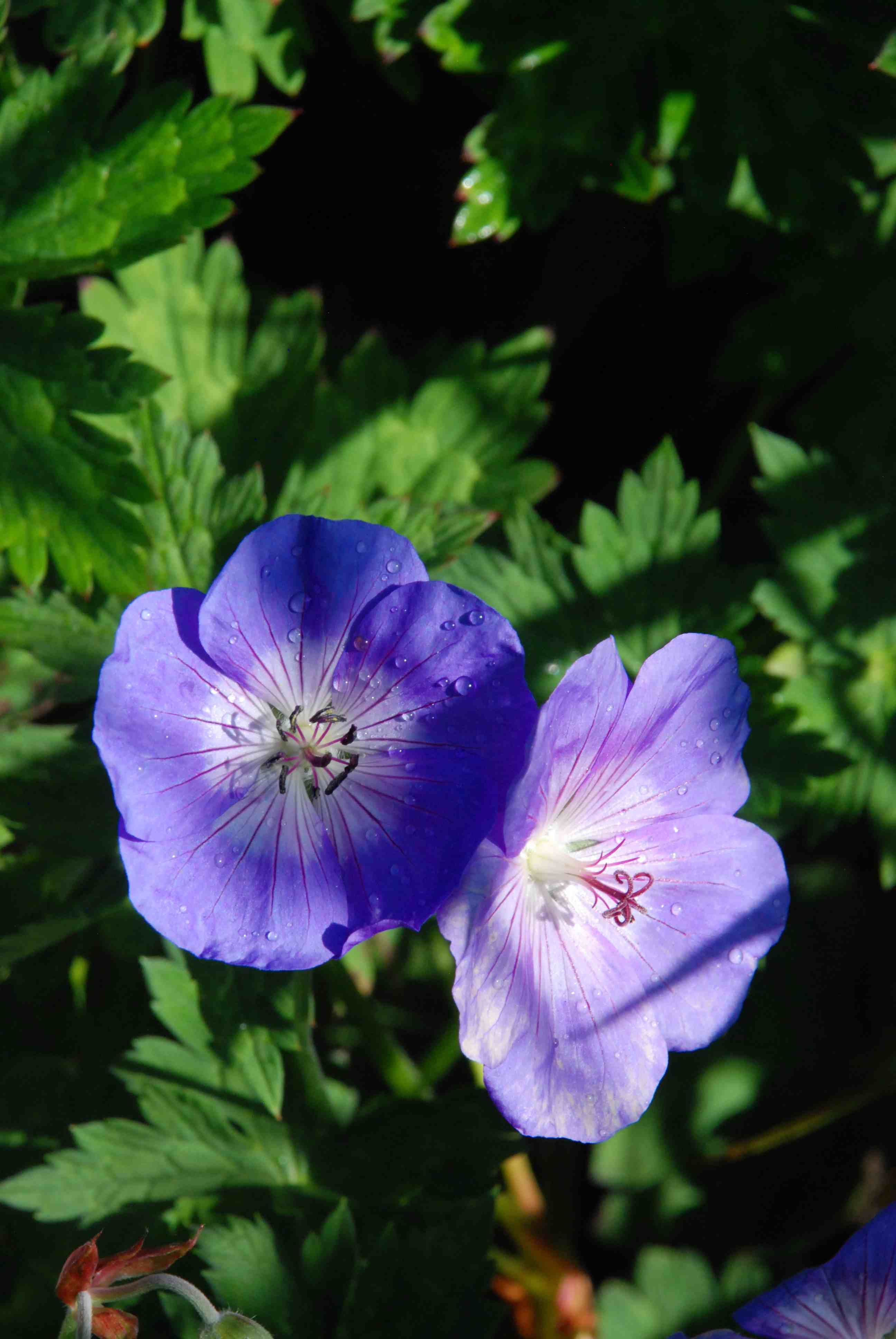
To date more than 12 million plants of ‘Rozanne’ have been sold throughout the world, quite a few to me! And it now has pride of place in my blue border.

Geoff’s rating 9/10
Garden rating 10/10
 The Biking Gardener
i had never seen that before just the ground cover I need I love blue