Well ‘ard: chard
It can be a bit difficult to find things to eat in the garden right now. The broccoli is at an end and cabbages and kales have run to seed. Without the salad leaves in the greenhouse there would be hardly anything. It is a bit early for asparagus and I do not have any ‘Good King Henry’ or seakale which could provide some meals. I could go looking for nettles, which certainly has its merits, but fortunately there is one crop that is still providing meals.
When it comes to a reliable, nutritious and versatile crop you can’t beat chard. The trouble is that it suffers from a bit of an identity crisis and people get terribly confused about it. So let’s start at the beginning and the wild plant. Are you sitting comfortably?
Once upon a time there was a scruffy plant that grew by the sea called Beta vulgaris. It had thick, plasticky leaves and rather thick stems. It had small, boring flowers and withstood drought and salt spray. I use the past tense but you can still see sea beet whenever you go to the coast. I guess people realised it was edible and started to develop it into ‘better’ plants. One group of plants were selected for their swollen roots (probably actually the hypocotyl, the bit between the roots and the stem) and the most popular had red roots and leaf ribs although there were also some with white or yellow roots. These became beetroot.
Another group were developed without the swollen roots but for their foliage and some of these had leaf ribs with red, yellow or white colouring as well as green. These became chard or leaf beet.
Now beetroot is not very confusing despite the fact that mangels (mangelwurzels) and sugar beet are basically forms of the same plant. (rutabaga is what Americans call swede. The Irish call swede turnip. They are related to cabbage and nothing to do with beet!)
The forms that were developed for their stems and leaves cause more problems to name but certainly not to grow. The basic forms with relatively undeveloped, green leaf stalks and profuse leaves are leaf beet, or perpetual spinach. Although only distantly related to real spinach it is much easier to grow. Real spinach is very quick to grow but it runs to seed very quickly too, especially in hot weather, and you need to sow it every few weeks, and water it well, to maintain a constant crop. Leaf beet is much easier. It is a biennial, like beetroot. Sow it in spring and it will crop for many months though some will run to seed in hot weather. Or sow it in August or September and you will get some crop in autumn and the plants will survive winter, giving you slender winter pickings, and then crop well in spring before running to seed in May or June, by which time the spring sowings will be ready to harvest. Sow in March/April and again in September and you have spinach all your round – you can’t beat that!
To add to the confusion, the variety in the photo below, with the plain green leaves, is ‘Popeye’. Now as far as I know Popeye ate ‘real’ spinach and not leaf beet so this really is taking the Mickey a bit. All these leaf beets are pretty similar but if a catalogue claims that one is resistant to mildew, about the only problem you are likely to encounter, go for that.
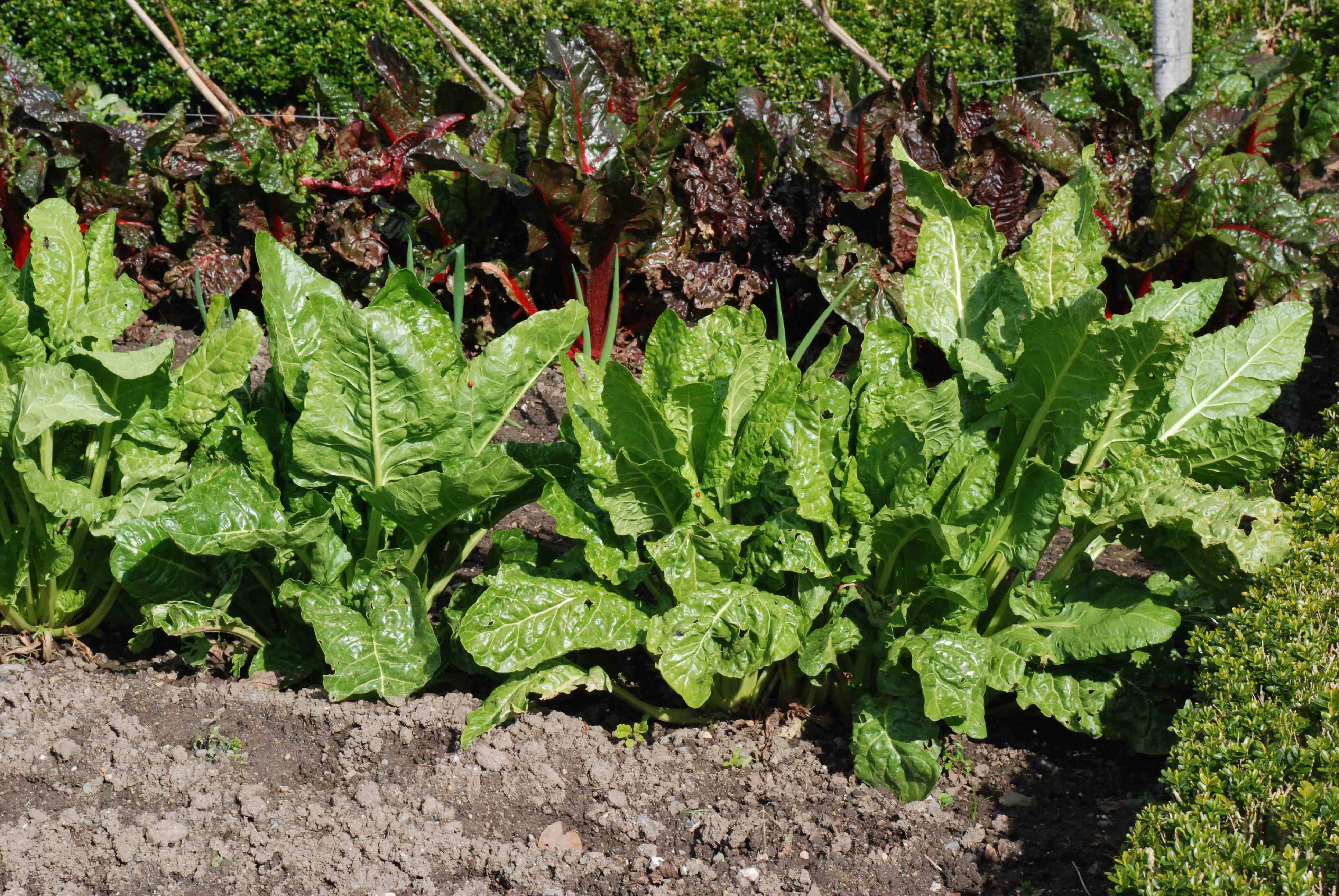
Some leaf beets were selected for their bigger, ‘savoyed’ leaves and thickened leaf stalks. These are what we call chard or Swiss Chard, and also sometimes silverbeet. It seems the French named them Swiss chard to avoid confusing them with leaf beets. By far the most popular are the forms with red leaf stalks (at the back in the photo above) and these are also sometimes called rhubarb chard but that is confusing too many plants together! Some have white leaf stalks and others bright yellow. There is a popular mixture called ‘Bright Lights’ with all three plus some pinks.
Catalogues will tell you that chard is a dual-purpose vegetable with two crops in one. When you snap off the leaves from the base of the plants you pull the leaves off the stalks by running your hands up them to strip away the greenery and you are left with a thick stalk with ragged greenery on the end. Cooking the leaves is simple – just wash and put the leaves in a pan and boil (no extra water is needed) as you turn the leaves continually. You only need to cook for a few minutes until a huge pan of leaves becomes a small lump of green in the base of the pan! Then squash the leaves to squeeze out the water, add some butter and seasoning and you have a healthy, delicious veg that is packed with vitamins A, C and K. Use it as you would spinach. Like spinach it is a natural companion for eggs – perfect for Easter.
You can then cut the leaf stalks into sections and boil or steam them to serve as a separate vegetable but they won’t appeal unless you really like bland food. They tend to lose their colour and any taste they may have had raw and I can’t honestly recommend then unless you add a lot of flavouring. They may be ok curried or as a component in a stew or ratatouile and they are ok with a cheese sauce but you wouldn’t really grow this plant for its leaf stalks alone.

Yellow Swiss chard is less popular than the red but is just as beautiful and deserves a place in the flower border
Being a beet all these are easy to grow and to sow, the seed clusters are large enough to sow individually either in pots (do not let them get too big before you plant them out or they will bolt) or where they are to grow. If you sow in situ you can use the thinned seedlings as baby leaves in salads. Plants will suffer and get mildew in very hot summer temperatures.
It is also worth stating that chards are very beautiful plants and they can certainly be allowed space in the flower garden. The advantage they have for this purpose over similarly attractive lettuce is that you do not have to harvest the whole plant to get a feed so you do not end up with gaps mid season.
 The Biking Gardener
No comments yet.