Sights of spring – Guttation

You may not have heard of guttation but you will certainly have seen it. Looking rather like dew, but formed in a different way*, guttation is the formation of water (or more accurately, liquid) droplets at the edge of leaves through special structures called hydathodes. It is caused when the pressure of water, from the roots, pumping water into the plant, exceeds the transpiration (water loss) from the leaves. It is most common in cool, wet weather when the soil is saturated and humidity is high so evaporation is slow. It is most obvious is early morning because at night most plants close their stomata, through which they lose water through transpiration during the day (and also absorb carbon dioxide and excrete oxygen).

In warm weather, when water is lost fast from the leaves, ingress of water into the plant is augmented by ‘transpiration pull’, rather like sucking a drink through a straw – if you take the liquid out of the top of the straw it pulls up more from the base. But in cool, humid conditions this is not relevant and water enters the plant through root pressure.
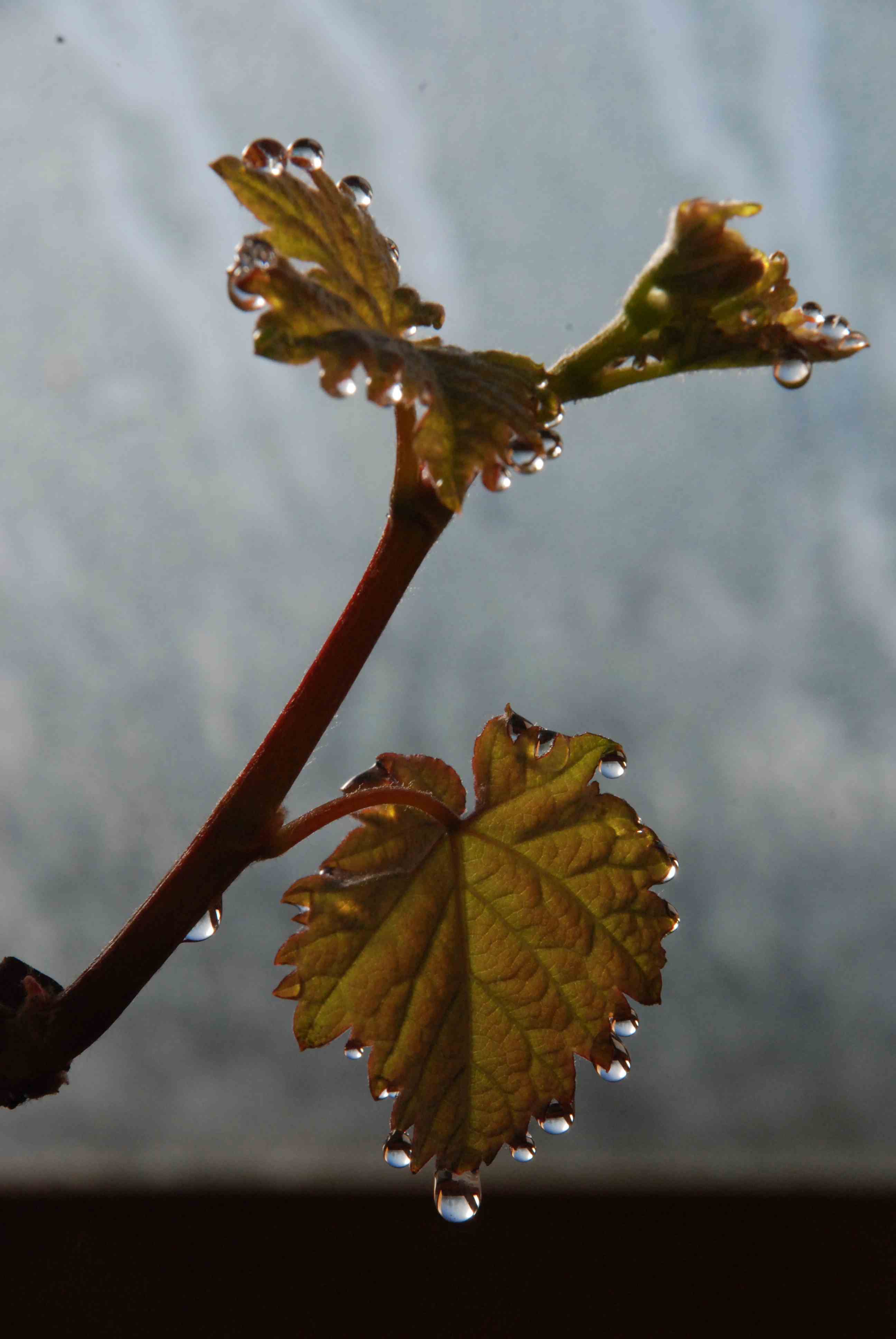
These photos are of a grape vine, recently awakened from winter slumber, on a cool, sunny morning – today in fact!
* Dew is condensation of water droplets on leaves
 The Biking Gardener
No comments yet.