Rose – Vidal Sassoon
For this year at least, this blog will, unashamedly, be a bit heavy on roses. This is, in part, because of the new rose garden I have planted but also because roses are interesting and beautiful things. I won’t go on to justify roses in the garden every time I mention them but there are not many hardy shrubs that flower for six months, have a wide array of colours, are frequently scented and have individually beautiful flowers.

Long ago I became interested in odd colours and went to the famous LeGrice Nursery in Norfolk (east UK) to write a feature on their introductions for the now defunct ‘Practical Gardening’. It is a photoshoot I remember well because of the beautiful combinations we were able to ‘create’ by cutting stems of roses and ‘shoving’ them in other shrubs. The palette of browns, sienna, copper, parchment, ochre, lilac, purple and wine made it an exciting afternoon and it reinforced why these stranger shades are so often described as ‘popular with flower arrangers’.
Although LeGrice were at the forefront of breeding unusual colours they were certainly not alone and the public have come to accept them far more readily, in large part, I would say, to the fantastic success of ‘Rhapsody in Blue’ and ‘Hot Chocolate’ (Hot Cocoa in the USA) – more of that later.
One rose that is rarely seen but is well worth a few square feet of your garden is ‘Vidal Sassoon’. I will get into rose naming later perhaps but basically roses have a ‘proper’ international name and then are giving selling names, appropriate to the country in which they are being sold. So ‘Vidal Sassoon’, which was bred by McGredy in New Zealand, is known across the world by the name ‘MACjuliat’. The first part of the name is an abbreviation of the raiser and the second part may, or may not, have something to do with the selling name. In a juvenile sort of way I always thank fortune that rose breeders included Cockers in Scotland and Dicksons in Ireland so we have been blessed with such roses as ‘COCcrazy’ and ‘DIClady’.
Anyway, as would be expected, ‘MACJuliat’ was named, in the UK, after the famous hairdresser who died in 2012. It was introduced in 1994 – maybe before in New Zealand where it was named ‘Spiced Coffee’. Someone in the USA obviously had their reasons, but they don’t make sense to me, but there it is sold as ‘Siegfried Sassoon’ the famous WW1 war poet – very odd indeed.
Anyway, whatever its name, this is a good rose and a nice one to grow if you want something that bit different but not too scary. It is a good, rather upright (good for cutting), less than averagely thorned (good for cutting), free-flowering shrub (good for cutting), that is classified as a Hybrid Tea (Large-flowered) rose though the blooms are usually held in small clusters rather than singly (good for cutting). This year it was the first of all 50 varieties to bloom and was among the last to finish (that award goes to the ridiculously good ‘Belmonte’). It was healthy and there has been no sign of disease so far (I did no spraying in 2013). Its ultimate height is about 90cm but it has only reached about 60cm in its first year.
But we are growing this for its flowers and the colour of these is difficult to describe and varies with the weather. The exact shade is obviously dependent on the weather and especially temperature but I am no exactly sure how. Descriptions usually give the colour as coppery parchment or buff with pinkish tinges and the first flowers were definitely of this spectrum but later flowers were increasingly pink. This is odd because the weather in July was warm (the first flowers were a bit later than usual because of a combination of late planting of the bare root plants (April) and the very late season (the surrounding trees were not in leaf in May) after the very prolonged winter). All the blooms through summer and into autumn were distinctly pink with buff overtones, more ‘colourful’ than expected. I would have expected the blooms to be browner in cool weather and pinker in warmth – I will double check that this year.
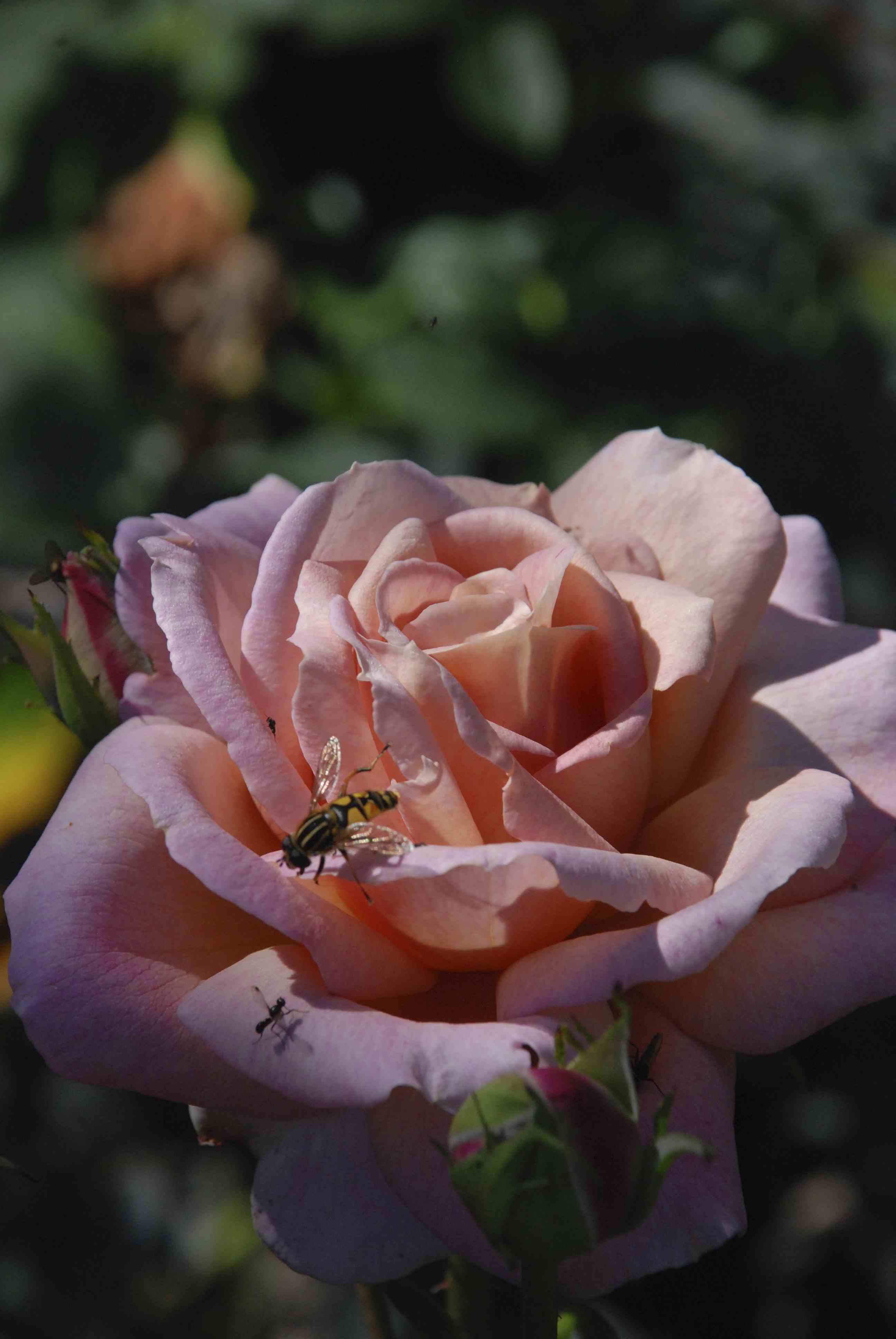
My three plants are not in with the rest of the roses but in an area by the cutting garden beside a newly planted hedge of Rosa glauca (R. rubrifolia) with its delicate pink flowers and purple-red leaves. It is one of the most talked about roses in the garden and always rewards attention with its sweet fragrance.
 The Biking Gardener
Trackbacks/Pingbacks
[…] https://thebikinggardener.com/2014/01/04/rose-vidal-sassoon/ […]