The poly and the ivy
Nature has a way, sometimes, of creating interesting planting combinations. If I was thinking of plants for a shady spot in the garden I would probably recommend some hostas and ferns, perhaps a few hardy geraniums for some colour, liriope or ophiopogon for their grassy, evergreen leaves and some ground cover of ivy, lamium or periwinkle.
You certainly wouldn’t think of ivy and ferns for a south-facing wall, not at the base of one let alone at the top of one. But that combination is just what nature has invented for a spot in the garden here at the top of a stone wall, about 2.4m off the ground.
Admittedly the ivy is planted on the north-side of the wall and has reached the top where the schizophrenic nature of this plant is clear to see as it has stopped climbing and produced its adult, mature growth where the flexible growth is replaced with shrubby, upright stems, each ending in a cluster of flowers and, later, berries.

This is not the common, native ivy but what is often called the Persian ivy – Hedera colchica and this variety is the popular (and AGM-awarded*) ‘Sulphur Heart’. Being in Ireland I should mention that this is also called ‘Paddy’s Pride’.

Here the ivy has clothed the north side of the wall and is overflowing over the top onto the south side where it blooms more profusely. Although we associate ivy with shade and cool, dank places, remember that this one comes from the ‘near east’, around the Black Sea and Turkey so it is likely to be able to cope with heat and more sun than our native ivy. It is a really useful nectar plant for bees, but especially flies, wasps and the last flying Red Admirals in the final warm days of autumn.
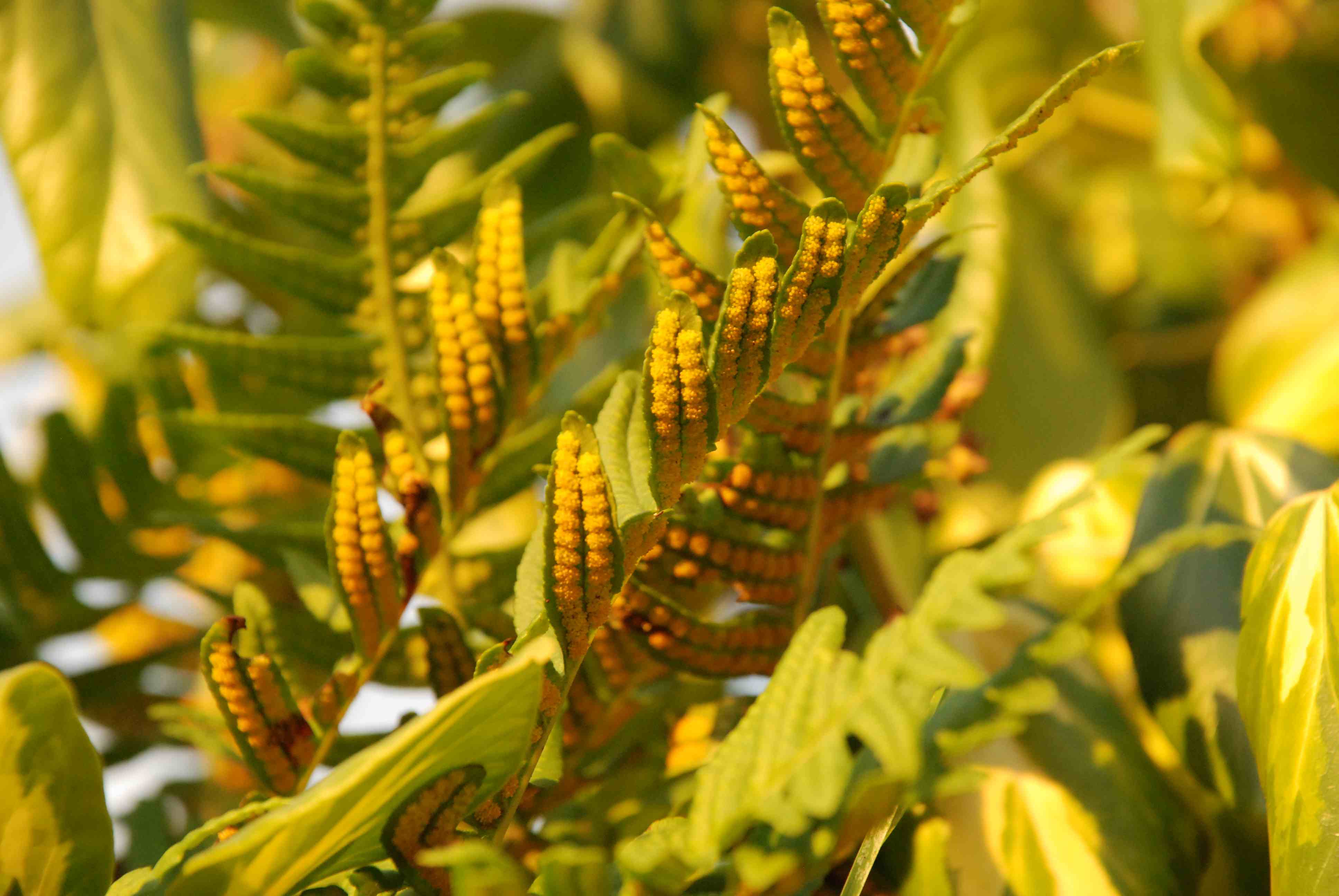
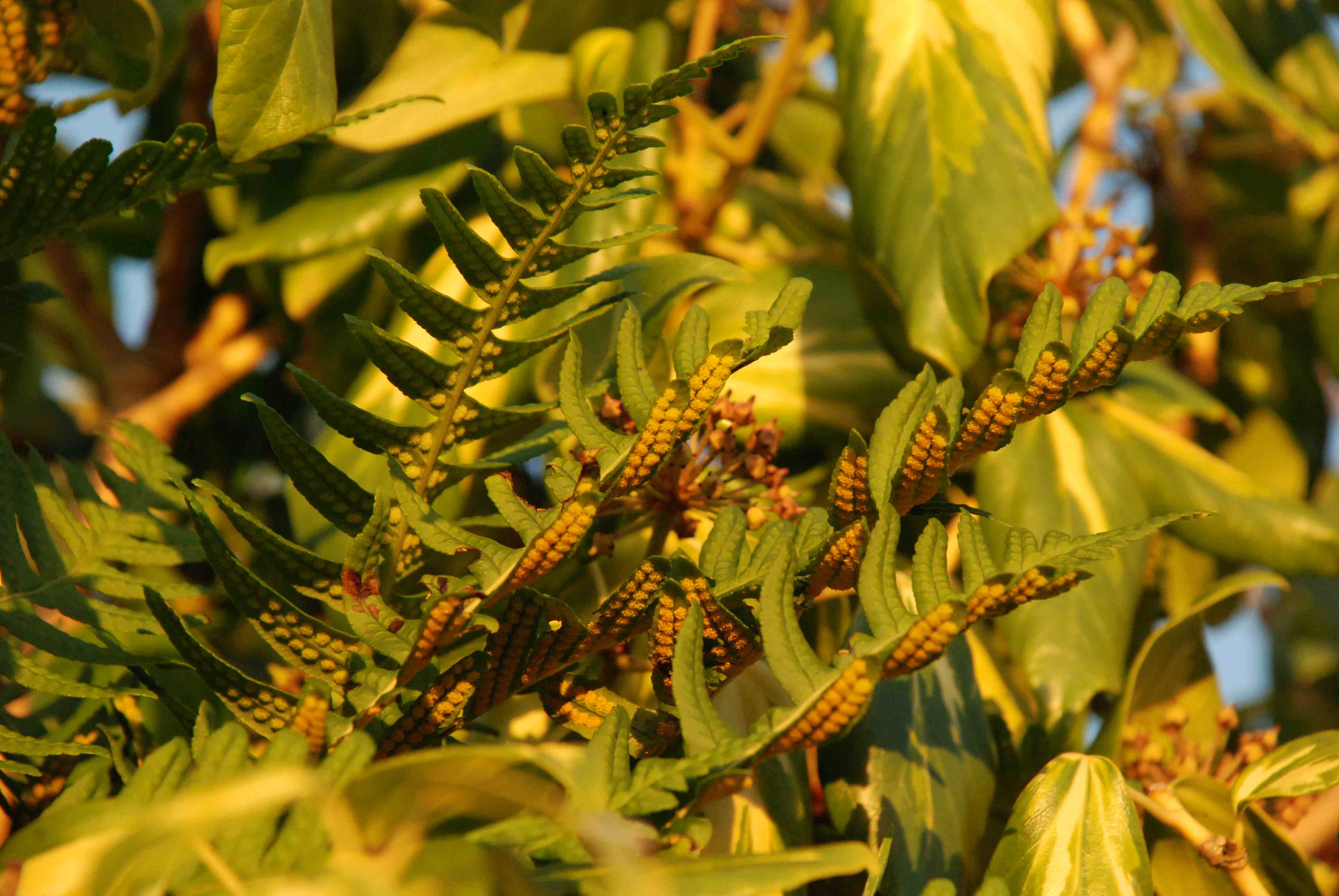
Its companion here is the common polypody (Polypodium vulgare). This is a common fern throughout Europe and grows in drier places than we associate with most ferns, on tree branches and on walls. It is a low, creeping fern with fronds less than 25cm long. It is evergreen and the new fronds all appear in one flush in late spring. On the undersides of the fronds are the sori (that produce the spores) and these start of cream but are orange in winter when they release the spores. In the low, setting sun the other day they appeared golden and the perfect combination with the green and butter yellow of the ivy.
* Award of Garden Merit – the Royal Horticultural Society award scheme for garden-worthy plants. If a plant has an AGM it is probably a very good plant. If it hasn’t got one it may be that it hasn’t been considered for an award so it may not necessarily be bad.
 The Biking Gardener
Trackbacks/Pingbacks
[…] The poly and the ivy […]