Vive ‘La France’
Carnations and pinks are a confusing bunch of plants. Although we are all familiar with carnations as button holes (if we are old enough – I know they are horribly old-fashioned now) how many people actually grow carnations. Every now and then I dabble with greenhouse (perpetual) carnations and I love my garden pinks. Keen gardeners often root shoots from bunches of carnations but these are perpetual carnations, better suited for a greenhouse than the garden and they grow, bloom and survive but they are tall, ungainly plants. I cannot abide the horrible potted dwarf annual carnations sold in garden centres for pots. They are too compact and they rarely have much scent.
But you can grow carnations from seed and treat them as half hardy annuals (though they are strictly short-lived perennials). The most common of these are the Chabaud carnations. Carnations are derived from the Mediterranean Dianthus caryophyllus and have been cultivated for centuries for their appearance and fragrance. Although the name dianthus is derived from dios or God the name carnation has less charming roots. It is from carne or flesh, a reference to the pink colour of the blooms, which obviously reminded people in the past of a raw pork chop.
Of course carnation flowers can be almost any colour you can imagine. Even green is possible and they are still grown and have a special charm. And they were made famous by Oscar Wilde who wore one as a buttonhole and so the flower was associated with decadence, and more, that I won’t go into. For me it is associated with the afterlife because, as a child, I thought people were talking about green carnation, rather than reincarnation.
Carnations are, apparently, the flower most associated with American Mother’s Day. Allegedly this is because, unlike many other flowers, the petals do not drop but the flower clings on to them as the flowers die, in the same way that a mother does all she can to to be close to and cling to her children.
The most famous are the fabulously fragrant, but tricky, Malmaisons, dating from the 1840s. I have dabbled with these in the past but they are notoriously tricky to keep for long. The Chabauds were introduced in the 1870s specifically as cut flowers, just in time for La Belle Epoque and the beginning of Art Nouveau. The carnation often features in the sinuous designs of Art Nouveau and growing these plants, especially in the delicate pink ‘La France’ is a glorious link with the past. Oddly, the Chabaud carnations don’t seem to be considered seriously by people who grew and wrote about carnations for gardens and exhibition. It is difficult to find more information about who introduced them.
So I turned to an old book by Stanley Whitehead (‘Carnations Today’ 1956). It is one of those books that has travelled around with me all my life in case it was useful one day and today was the day! Here I learn that the Chabaud hybrids were raised by (wait for it) Monsieur Chabaud of Toulon in 1870. Oh well. The aim was to produce plants to provide cut flowers for a long season. Among those listed were yellow ‘Marie Chabaud’, white and mauve ‘China’ and red ‘Legion d’Honneur’ and ‘La France’, both available from the French supplier I used. It is noted that the individual flowers do not last as long as Perpetual carnations (the kind you buy from florists or supermarkets shipped from Columbia). They do last a week in a vase though and fill a room with delicate perfume.
It is rather remarkable that they survive at all really. They are not at all suited to commercial cut flower production. But they have an enormous range of colours including picotees and stripes. And more remarkable still is that they have such amazing fragrance. Sown in early spring they will bloom the same year and, with some luck, they can survive the winter. A few years ago I sowed the double white ‘Jeanne Dionis’. It grew well and some plants survived and bloomed the following year. This year I sowed (in early March) ‘La France’ and planted them out in late April. I am going to sow some more this week and overwinter the plants in the polytunnel in the hope of getting earlier flowers, for cutting, next year. It may work.
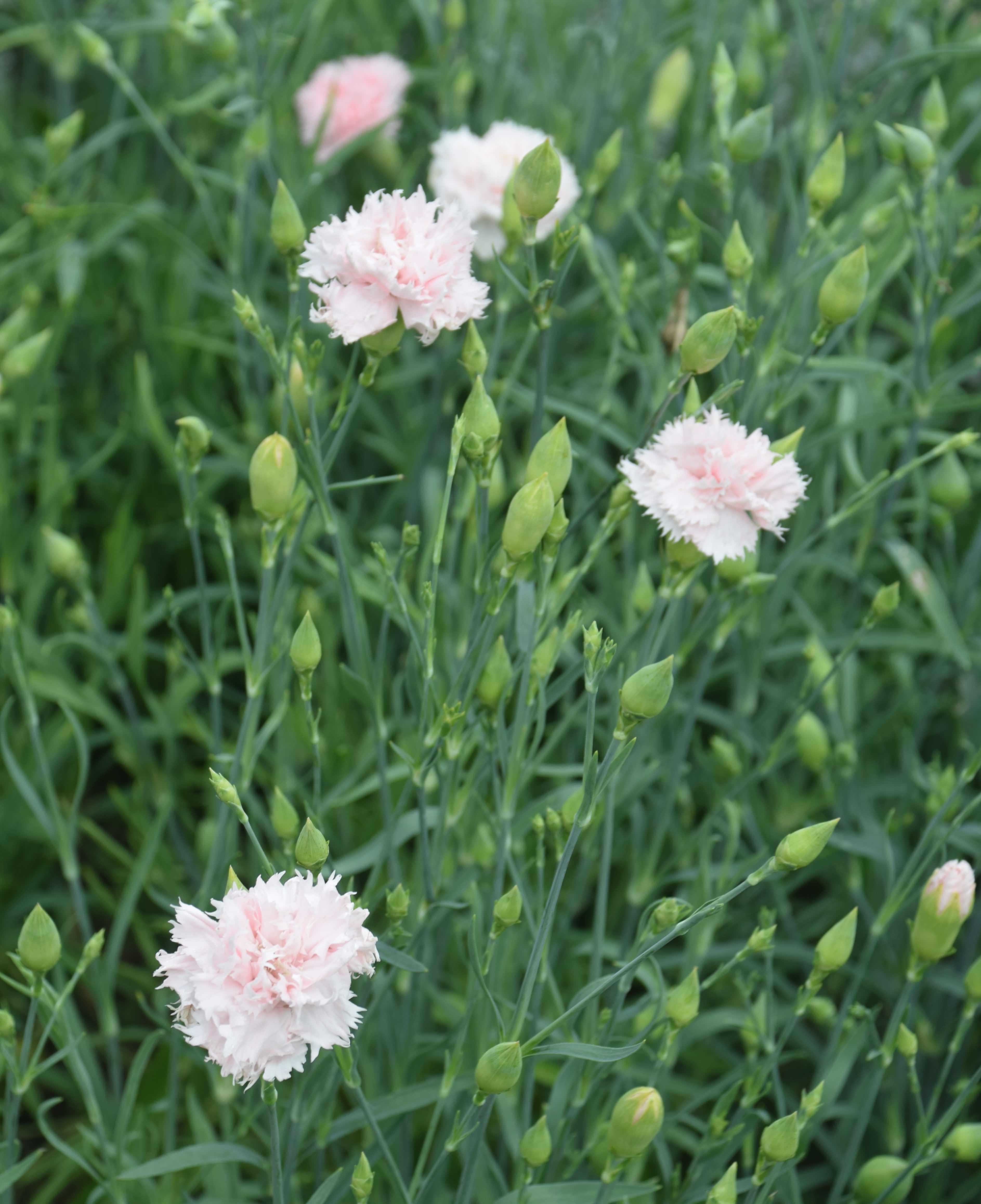
The plants branch freely and are covered in buds. In fact the problem with cutting them is that you remove so many unopened buds. To get some blooms for the flower stand at the gate I even disbudded some early stems in the hope of getting bigger flowers and longer stems to avoid removing so many large buds.

Another problem is that the stems are very brittle so you have to be really careful or they break at the nodes. Of course, growing from seed means you have to trust the seed supplier. The seed company I use has surprised me with some awful seeds in the past (and this year) with seeds not being true to type but so far most of these plants have been true. There are a few singles and one poor plant that produced flowers without petals but I can cope with that because I have more than 100 plants. A few have deeper coloured flowers.

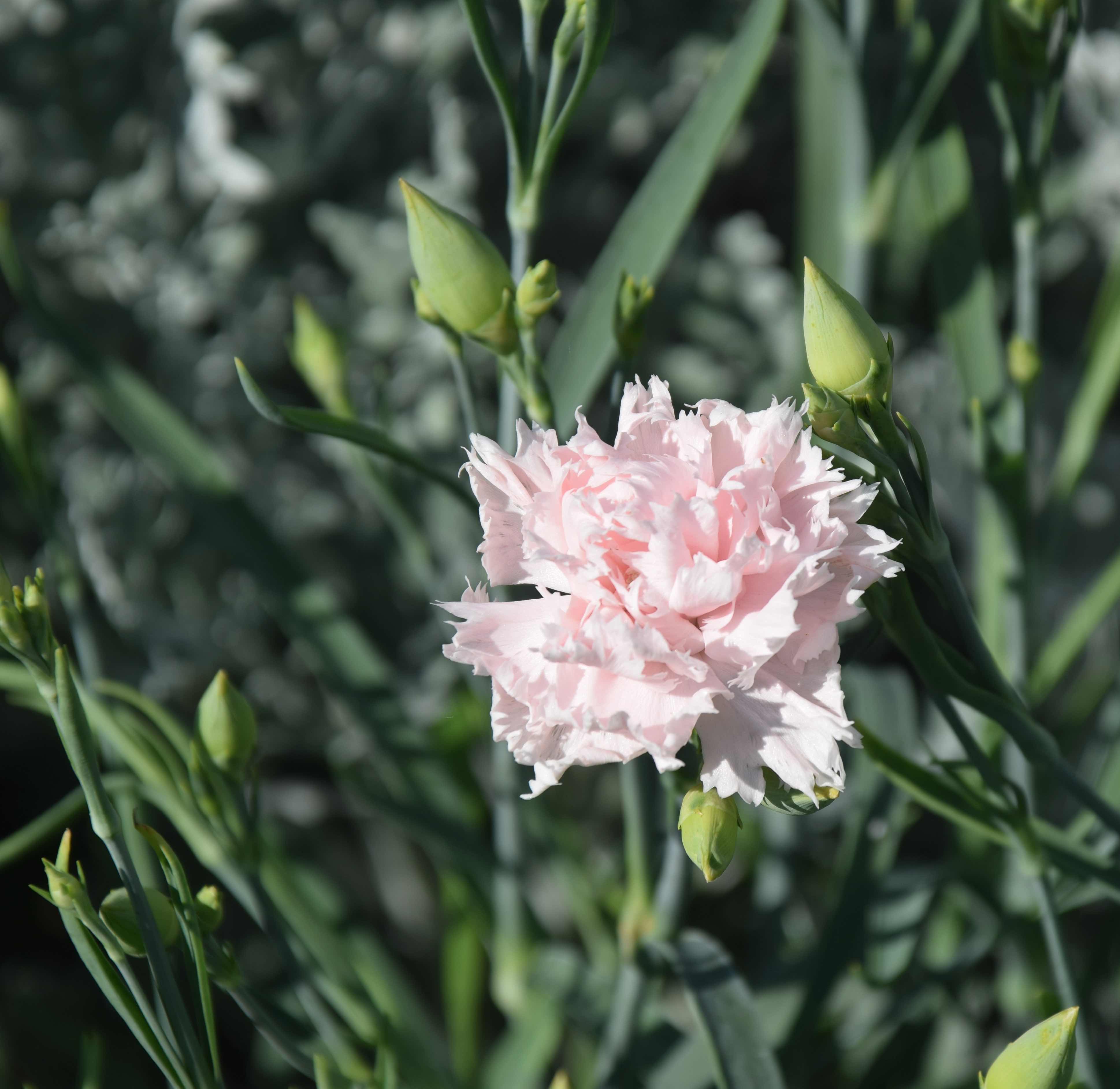
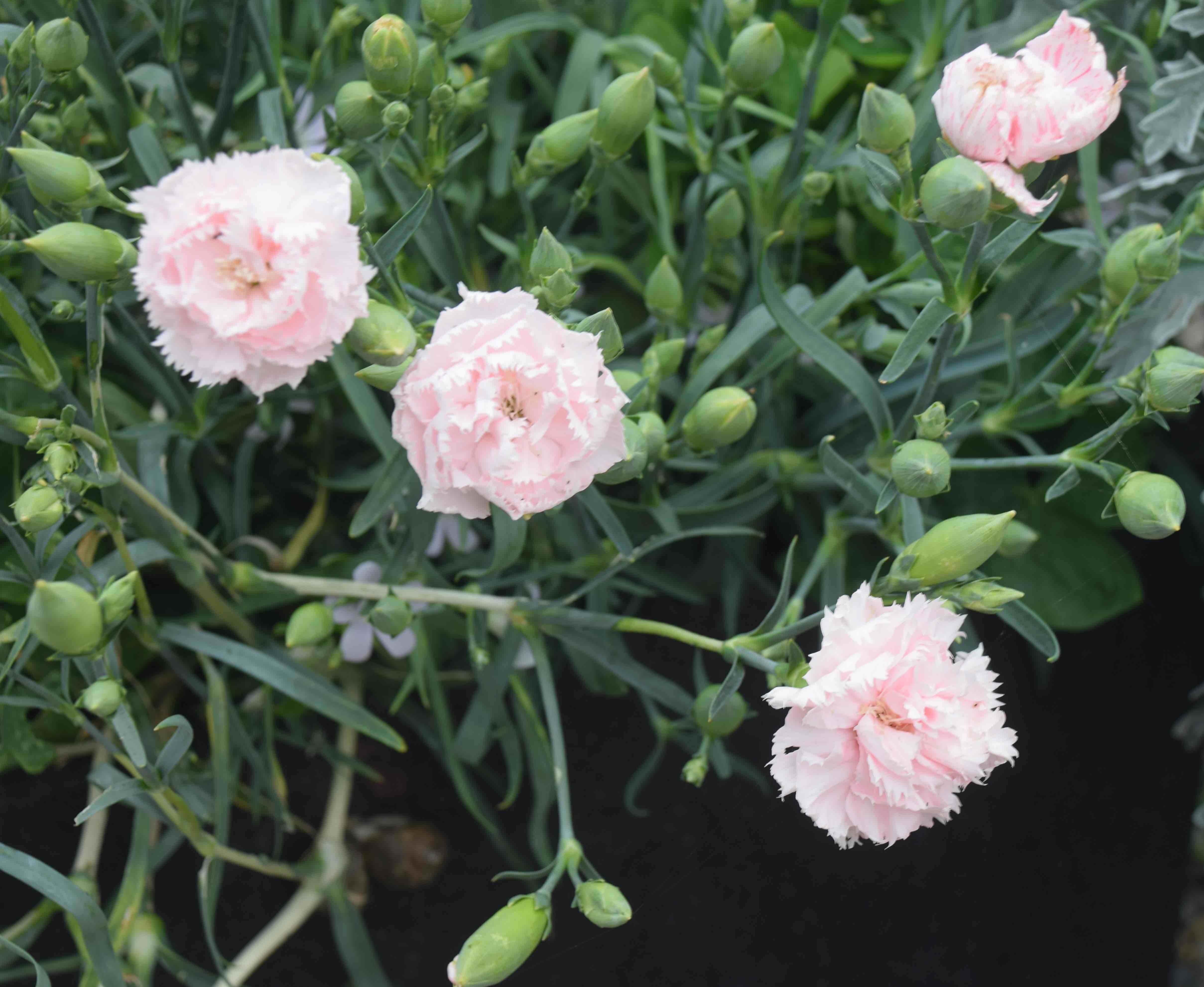
The flowers, which are beautifully fragrant, with a real kick of cloves, are such a beautiful shade of pink that I could forgive them anything. I think they are ignored because they are rather tall for a bedding plant and really need some sticks for support. Some in a patio pot are relaxing over the side, in a rather refined and elegant way as you would expect from a French lady. Now they have started to bloom in some profusion I will be able to pick more. So far the few bunches I have had have sold quickly.
 The Biking Gardener
Jim Marshall who lives near me has the National Collection of Malmaison and Perpetual Carnations. They seem an awful lot of bother. Your La France is pretty but I much prefer pinks., specially the laced ones. Or for a white one with a green eye, Musgrave’s Pink is adorable.
I agree that the Perpetual carnations, though lovely, are a lot of bother and I have given up for the moment. I like pinks too and agree that the laced ones are adorable.