Strip for the bees

Don’t panic – this is not the latest charity fad to raise money for bees. Steve was mowing the lawn and had almost finished, and was himself almost finished – it was a hot day – and I noticed he had missed a bit. With fear in my heart I mentioned it but it was OK – he said it was for the bees. There was so much clover in the area, including the only patch of red clover in the lawn, that he thought he would leave a strip for the bees.
We do all we can for bees in the garden and I specifically plant for them.

Looking after the bees can be a chore. Every time I go in the greenhouse I have to rescue at least one and I hate to see the husk of a bee in a cobweb in there. We have (or had) lots of spiders in there and I have tentatively identified them as false widow spiders. I have been concerned about them for a while because they have round, shiny, ruby/black abdomens and they give me the creeps. I am not averse to spiders and I usually let them be. I rescue them from the house and I like seeing the wolf spiders splayed out on the alstroemeria foliage in the polytunnel. But these nasty horrors in the greenhouse make really tough, diffuse webbing and I don’t like them. With their shiny round abdomens they look quite tick-like and that freaks me out! I asked a friend who knows about these things and said they are not native and they can actually bite humans – their bite is about equal to a wasp sting. They are from the Canary Islands and are apparently well established in Ireland (and the UK). Mine may be the cupboard spider (Steatoda grossa) which is often seen in homes in winter which may be why they like the greenhouse. Anyway I gave the greenhouse a thorough clean a month or so ago but I obviously did not get rid of them all.

There seem to be few bees around at the moment so I am pleased to see any, anywhere. Unusually, the rose hedge is silent. the bees usually vibrate the blooms, presumably to dislodge pollen, but they are notably absent. I do have a lot of comfrey and the bees are always on that so perhaps there is just too much choice. I have noticed that the various bumblebees tackle the flowers in different ways. The smaller ones visit the blooms by actually entering the flowers while the larger ones bite the base and so extract nectar without collecting pollen.
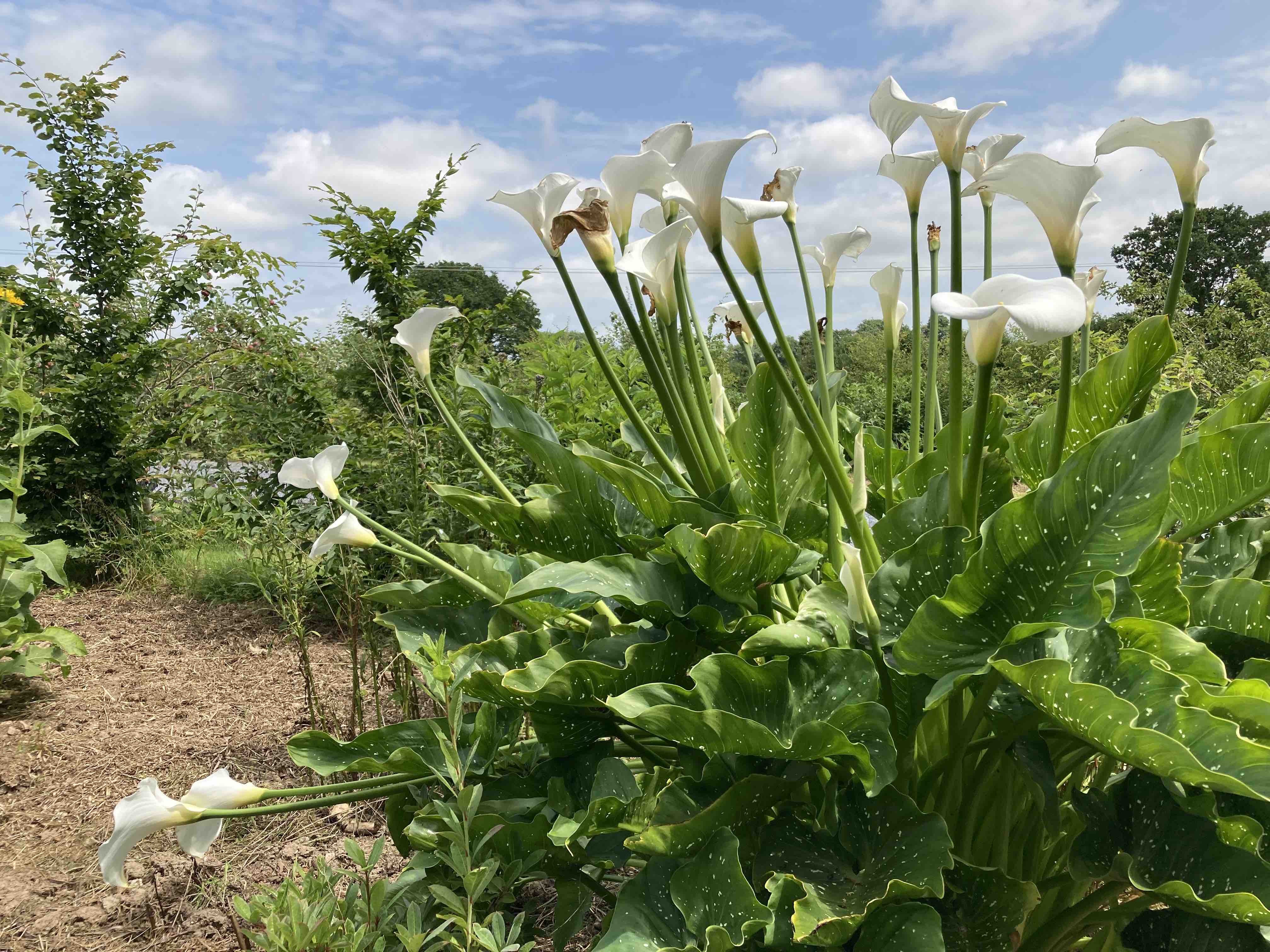
Elsewhere in the garden the season has been quite kind and progress is being made in some areas. In early spring the ‘bed of death’ (where everything I plant dies in winter because of waterlogging) got a very liberal application of strawy manure and it seems to have helped with drainage, for now, after being dug in, and some plants are doing well. Of course the zantedschia ‘White Giant’ positively relishes the wet and the manure provides extra nutrients and ithas reached the expected 2m high this year, although the recent heat has been a struggle for it, causing the flowers to splay outward in a lazy attitude.

Despite the ‘wrong’ cosmos (the ‘off’ plants still annoy me) the formal bed is looking better and I can’t wait for the salvias and carnations to add to the colour.
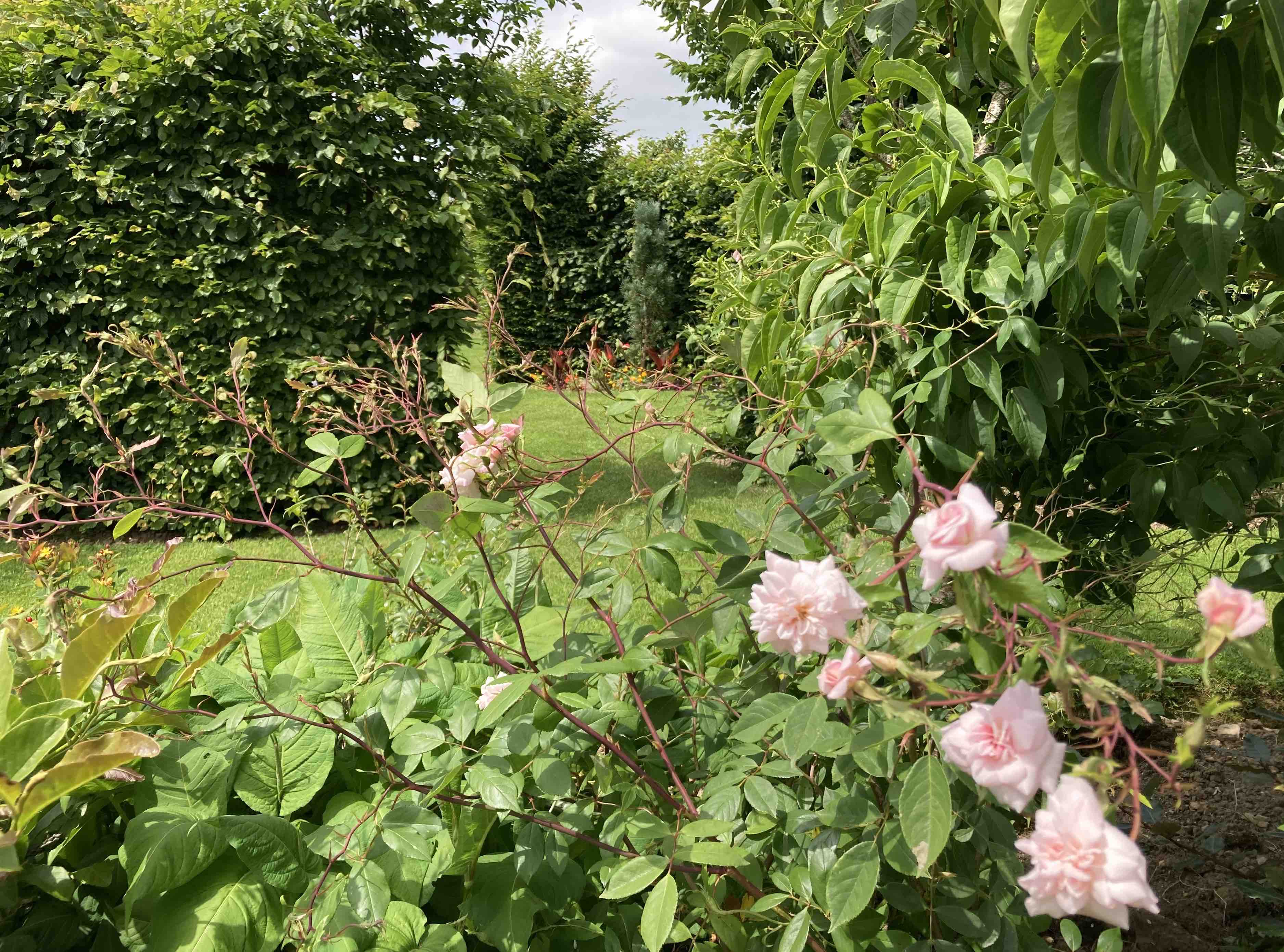
I moved most of the roses this spring. They were an odd mix of my favourite roses and they didn’t really fit together in one bed. It worked for a while but I had to separate them. Now they are dispersed around the garden. They were four years old and moved well. I pruned them hard and put Rootgrow on the roots to help with establishment. ‘Cécile Brünner’ the sweetheart rose (from 1881) was just too different to sit happily next to HTs and others. So it was moved to the bed opposite the ‘bed of death’ between magnolia ‘Leonard Messel’ and heptacodium. It has settled in beautifully and the sparse, large sprays of tiny pink flowers look much more appropriate here. The first flowers are now opening.

I also moved the hostas from the front of the styrax bed in spring. They were ‘Canadian Blue’, a very good and easy hosta that I have divided over the years so I had about 20 along the front. But it never looked quite right so I moved them and replanted with viola ‘Victoria’s Blush’ and they edge the bed in a more pleasant way: less formal for the edge of a bed that is planted informally (a mess). And they don’t have an inferiority complex growing beside ‘Empress Wu’ that must have always depressed poor little ‘Canadian Blue’.

 The Biking Gardener
Many eco warriors fail to recognise the contribution gardens make to supporting bees etc. The range of exotic plants we use are in fact providing the biodiversity they so often shout about – especially in gardens in rural settings, such as yours and ours.