Falling in love again …
We are in the jaws of a heatwave. But being Ireland the jaws are more like a good suck from a geriatric, dentally challenged chihuahua than a Rottweiler, but it is still warm. Warm enough for the horseflies to make any attempt at gardening more of a rushed affair replete with flailing arms and shouts of panic and annoyance. But at least it suits the bees and butterflies and there are plenty of grasshoppers around, much to the delight of Mia ((the cat) who finds them fascinating and a tasty treat.
It was warm yesterday too but some overnight rain refreshed the garden though to was not enough to moisten the soil which is getting very dry now – I knew this day would come but it seemed so unlikely just a month ago.
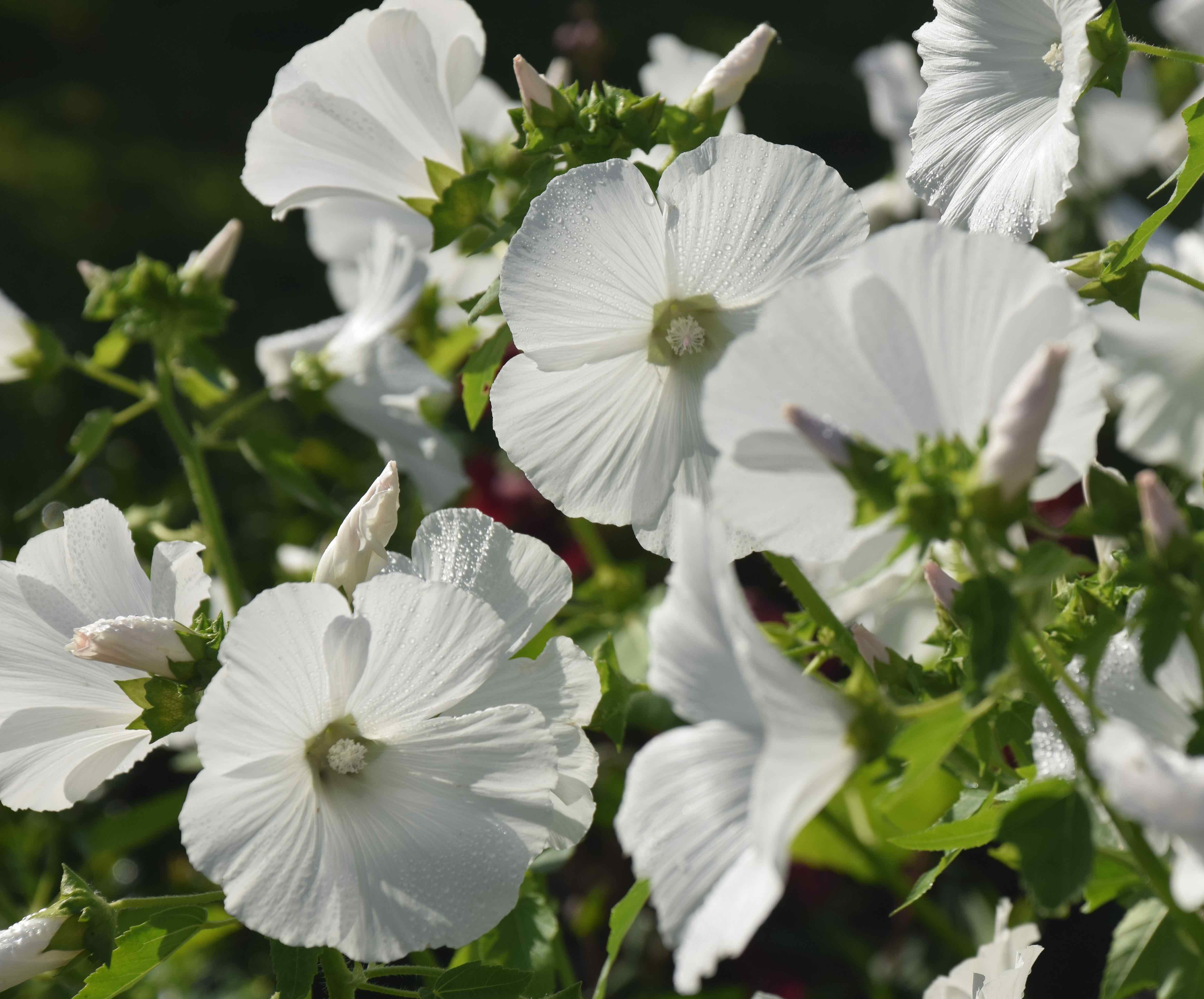
An early morning stroll was more like a pack drill because, after selling very few flowers at the gate last weekend, it has been very busy this week. Because I want the flowers to be as fresh as possible, I pick as they sell. But I took a moment to admire the Lavatera trimestris ‘White Regis’ which surrounds the pink cleomes. Now I am not absolutely sure these are ‘White Regis’ because they are very tall – now 1.5m – and the seed company I use a lot has proved very unreliable with ‘cheap’ seeds. Expensive F1 hybrids seem OK but open-pollinated annuals often prove to be not exactly as they should be.
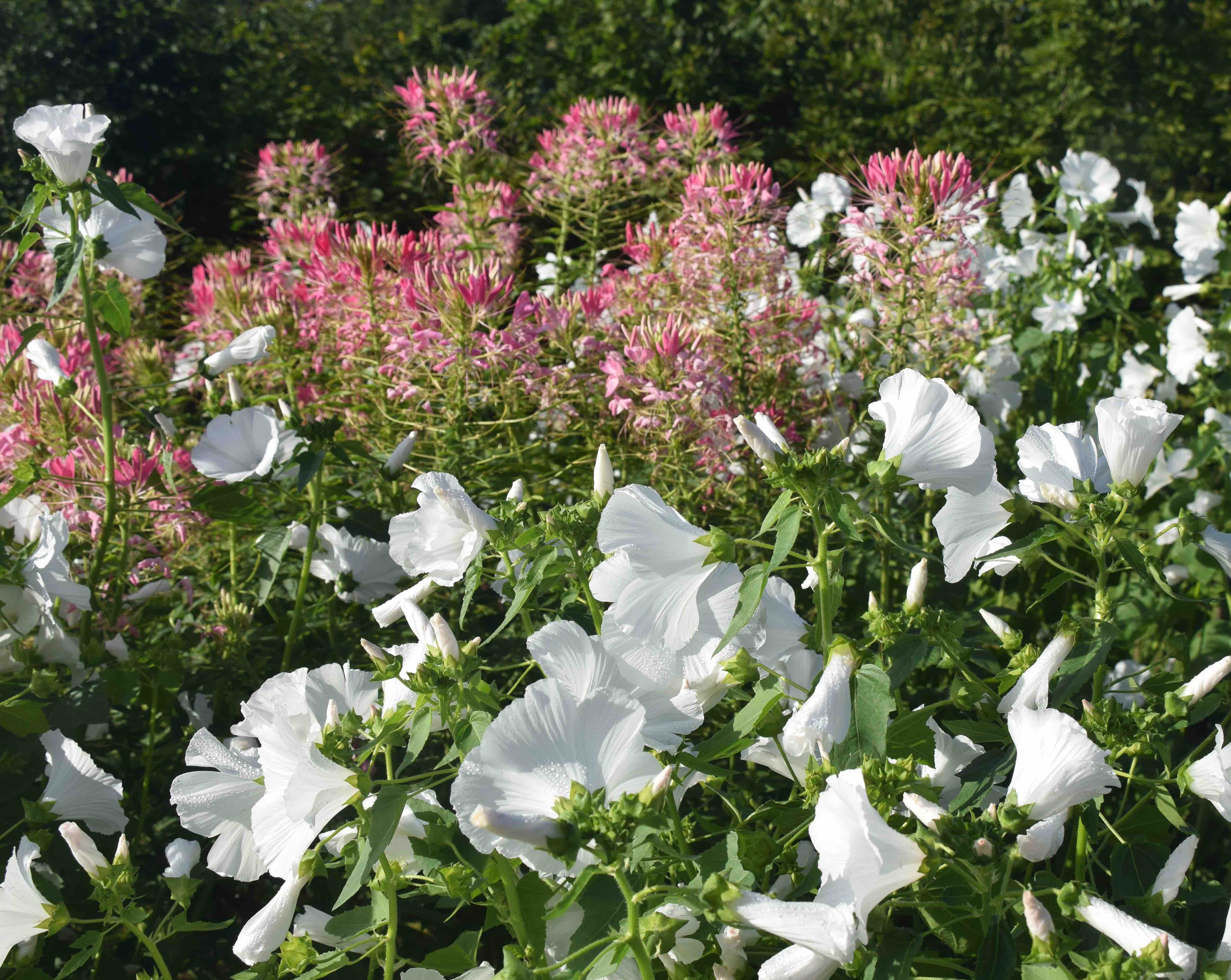
Even so, the plants are amazing. They are starting to ‘lodge’, as I expected after some strong winds in the past week, but it does not detract from the flowers. Although the buds sometimes do seem to have the very faintest hint of pink – something I had not noticed in the garden but that seems to show in photographs – the blooms are pristine white.
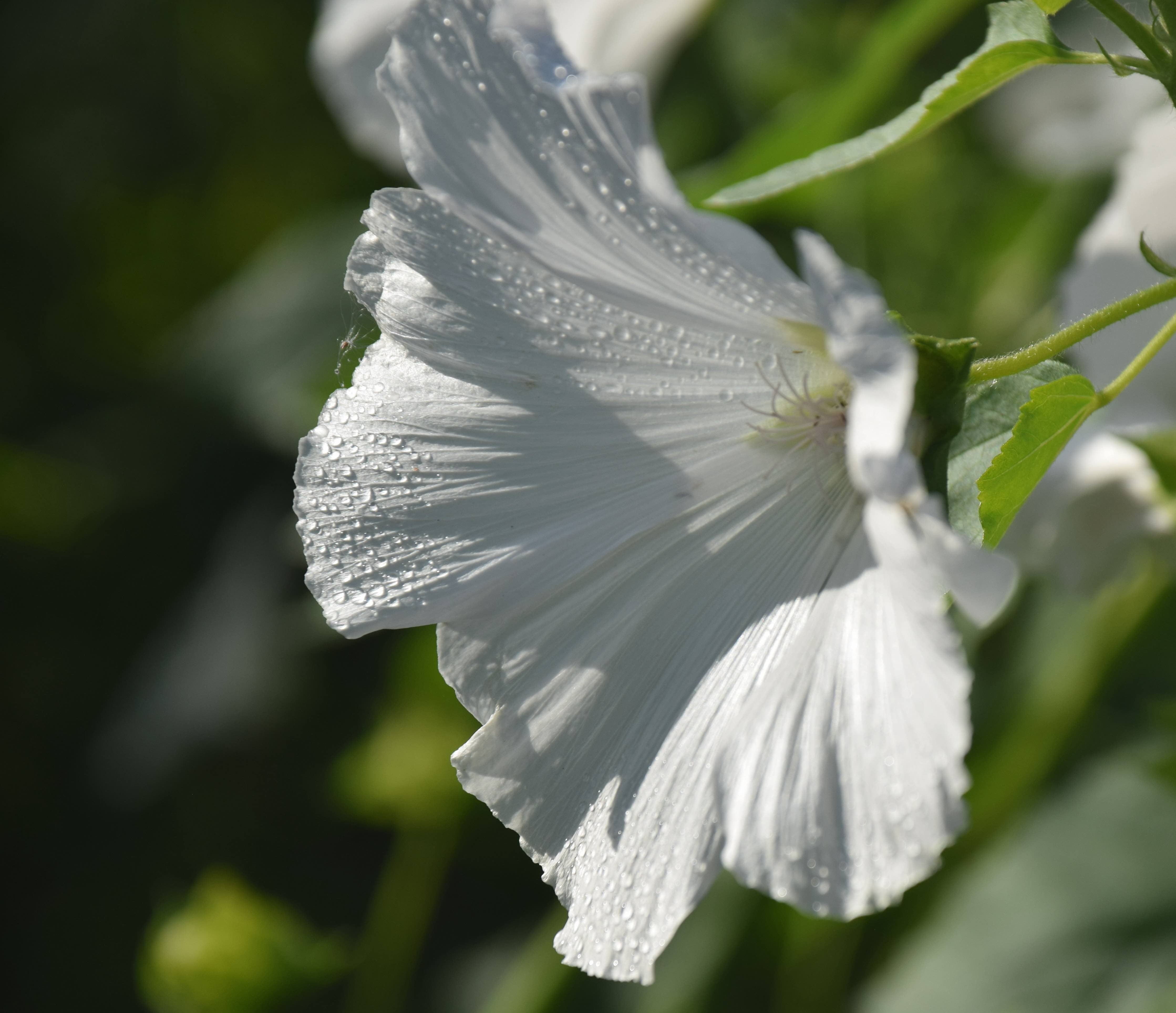
There is something extraordinarily beautiful about Malvaceae flowers with their five, broad petals that unfurl from elegant buds and the central cluster of stamens around the style with five stigmas. It is one reason why I cannot abide double hibiscus, both hardy and tender. The scruffy nonsense of extra petals just ruins the beautiful simplicity of the flowers – their form is just perfect as they are.
In this case the blooms are a good 8cm across and unsullied by contrasting anthers or pollen – all is white.
The green foliage is bright and just the right colour to show off the flowers. When the five segments of the calyx shows through the silken petals it just adds to their beauty.

The overnight rain was still on the flowers but only on half of the outside of each petal, revealing that the rain must have fallen just as the flowers were only partly open, very early in the morning, possibly when I had to let the cat out at 5am.
I know that they will be gone by the time we head into September but that makes the current love affair with them even more poignant.
Considering that I only sowed a small portion of the packet, that only cost a few euro, I can’t think of a more beautiful way to spend about 50cents.
 The Biking Gardener
Oh my, those are pretty, and so white! Those sorts of mallows are not grown here. Some sorts of hibiscus are popular, but not the less shrubby mallows.
We can’t grow H. rosa-sinensis here but H. syriacus does OK as long as it has a sunny spot. All the huge H moscheutos kinds really struggle here. They are sold in bloom, imported from The Netherlands or Belgium but they don’t last.
Hibiscus moscheutos seems to be difficult everywhere. It is not even happy here.
I need to have another attempt at making them happy. But the plants are so expensive and they arrive in garden centres at such a peak of perfection and decline immediately afterwards. I like the idea of them but, in some respects, they look so unnatural that I wonder how they would fit into the average garden planting. They would make amazing specimen plants but only if they grew and bloomed well and so far they just dwindle away with me and I could not risk them in a prominent spot.
Do you get the impression that they are weak because of extensive breeding? Those who are familiar with the species in the wild do not understand why it would be difficult to grow, but of course, they do not grow modern cultivars. I really do not know how different the cultivars are from the wild sort, or how extensive their breeding is. Because they still have the same species name, I suspect that breeding is more a matter of selection than hybridization. I really do not know.
I think these hibiscus are carefully bred because many are F1 hybrids. I remember in my teens seeing ‘Disco Belle’ or/and ‘Dixie Belle’ F1 hybrid seeds for sale. I think perhaps we don’t have the summer heat for them to thrive because they sprout so late in spring.
So, if your climate lack the warmth that they crave, and my climate lacks the humidity that they crave, perhaps most climates lack something that they crave.
It does make you wonder