Going back in time
Wordy post alert!
Most of my books are kept in the hall and although I try to keep them in order, I often randomly grab one to read. Last week I plucked Gertrude Jekyll’s ‘Old West Surrey’ (1904) off the shelves.
The choice was not, for once, completely random because, next weekend I am off to Surrey, returning to the area where I spent my teenage years. The trip will bring back lots of memories.
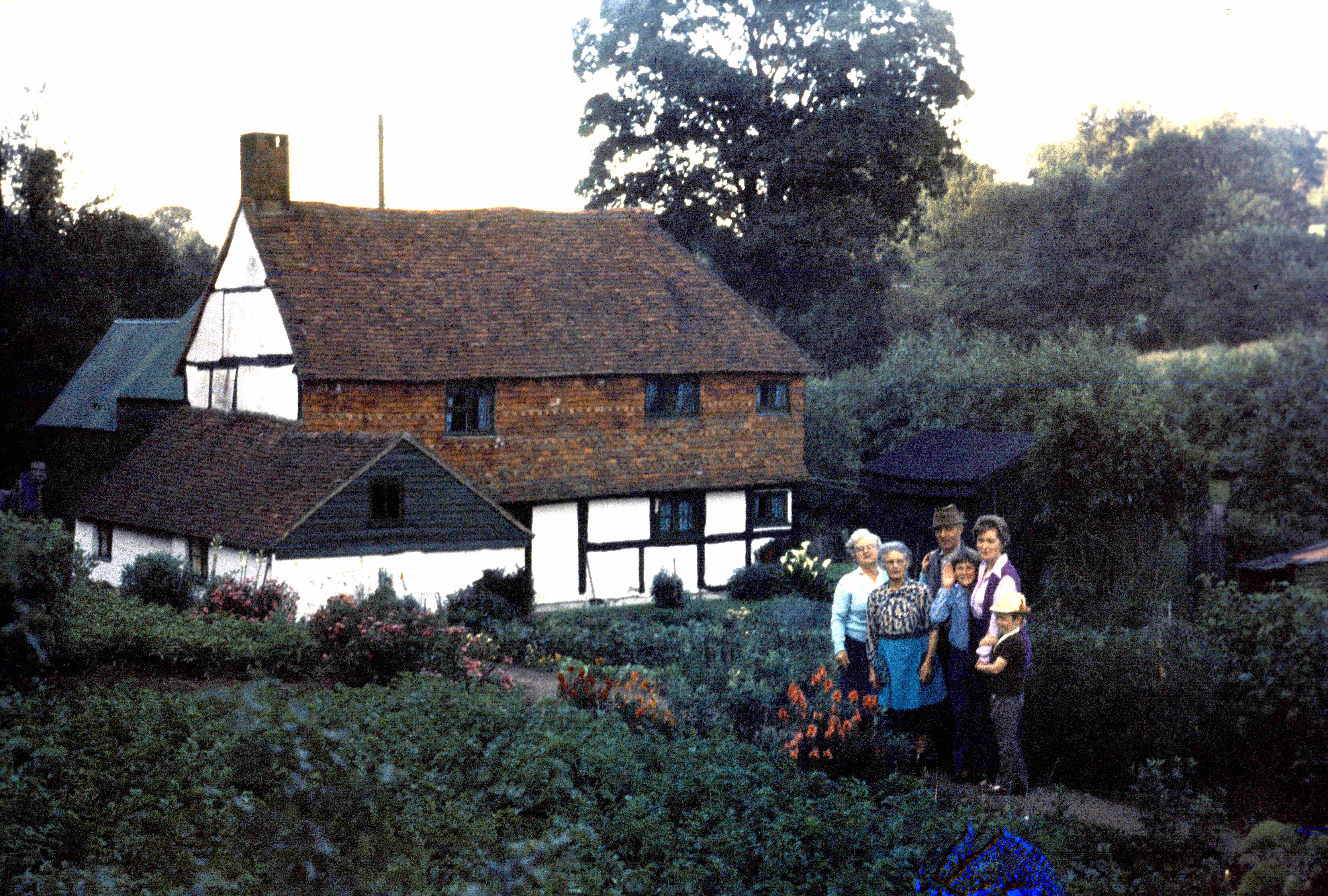
We lived in east Surrey but my great uncle and aunt, brother and sister, Carrie and Bert, lived in west Surrey, just off the old Portsmouth Road. Their home, Hole Cottage, was near Cosford Farm and that was the reason I chose, among the other hazels and filberts, ‘Cosford’, one of the most popular and which I assume originated here. Hazels were certainly an important plant to uncle Bert and he coppiced the hazel woodland around the home, for bean poles. The area is in the Surrey Hills, an outstandingly beautiful area and probably the least affordable place in the UK to buy a house.
But Bert and Carrie were locals and lived an almost subsistence life, with a typical cottage garden. They had cows and chickens and grew their own crops, the flowers popped in among the soft fruit and apple trees. My mother was ‘evacuated’ there from Lowestoft, a busy fishing port, during ‘the war’.

The place was idyllic, though I did not always appreciate the importance of what I was experiencing. The worst part of the day trips to see them was the ‘facilities’, a tiny shed with a bucket and sheets of torn up newspaper. We were always fed with homemade food and it was often rather frugal. Their staple meal seemed to be ‘bread and Oxo’. We used to have it at home too. It involved tearing up white bread in to a mug, crumbling an Oxo cube over it, dropping in a knob of butter and a sprinkle of pepper. Then pour over boiling water and stir – the original meal in a mug! More notably, fresh soft fruit was accompanied by fresh cream. I was always a bit squeamish about the fact that it often contained a few hairs, but this was freshly skimmed from their own, raw milk. It was the colour of butter and completely unprocessed. It was so unlike the thin, white stuff sold in shops.
Hole Cottage itself was something ‘out of the ark’ even then. It seemed almost impossible that their water came from a well. How ironic then that I now have a house with a well. The floors were bare stone with ‘rag rugs’ made by aunt Carrie on winter nights from old clothes. They would probably be worth a fortune now. The floors of the upper rooms sloped and dipped. I know that, when they died, the house was bought by an artist but I know little else of its fate.
It was the garden and the surrounding countryside that affected me most deeply. Their small plot of pasture was sloping and had a small stream at the bottom. The pasture was studded with wild orchids and wild flowers bloomed in Arcadian profusion. The stream was gilded with clumps of ‘wild’ mimulus. At the back of the house, edging the veg patch was a row of Madonna lilies (L. candidum) fertilised, as so many cottage flowers were, with ‘nightsoil’. I have never seen such healthy Madonna lilies since. Pansies self-seeded among pinks, chrysanthemums, sweet Williams and other flowers and their pride and joy were the ‘veronicas’ and fuchsias. The veronicas were probably ‘Autumn Glory’ and it is another irony that I was ‘educated’ enough to know these were hebes, even at 12 years old, and that they are now veronicas again! Winter jasmine and ‘Japanese quince’ clothed the cottage walls. Scented pelargoniums grew on the windowsills inside, perhaps to deter flies.
How I wish I had a time machine and could return. I would be far more appreciative of this magical place and time.
The book describes many fascinating aspects of life in west Surrey, an area that I really know only through visits to Hole Cottage through we travelled through Godalming and Abinger Hammer, named after its water mill which forged Sussex iron, usually stopping so we could see the clock ‘working’. The clock features ‘Jack the blacksmith’ who strikes the hour. Watercress was grown in beds fed by chalk streams at Milford.
In a chapter on Godalming, Gertrude Jekyll describes the inns there, which were a regular stopping point for coaches travelling from London to Portsmouth. I was especially fascinated by her description of fish being carried from the ports to London. ‘ Most of the fish for the London market was conveyed in special fish-vans from the various sea-coast places, such as Littlehampton, Bognor, Emsworth and Havant. They were painted yellow and had four horses. But some of it, as well as supplies for other inland places, was carried in little carts drawn by dogs.’
‘The dogs were big strong Newfoundlands. Teams of two or four were harnessed together. The team of four would carry three or four hundredweight of fish, besides the driver.’ (one hundredweight is about 51kg /or 112lb or 8 stone.)
‘A dog-drawn cart used to bring fish from Littlehampton to Godalming, where oysters were often to be bought for three a penny.’
One famous hostelry was the ‘Kings Arms’. She records how there was a record in the Bodleian Library in Oxford of a visit by Peter the Great and his entourage (20 in total) on their travels to Portsmouth from London. (Vegans look away now) ‘At breakfast they consumed half a sheep, half a lamb, ten pullets, twelve chickens, seven dozen eggs, and the contents of two large salad bowls, washed down by a gallon of brandy and two gallons of mulled claret.’ It makes a ‘full Irish’ look like a diet breakfast!
Another record (about 1840) is an even more remarkable example of over-indulgence. ‘About fifty years ago, two English Dukes stopped at this inn to change horses. Two mutton chops and a bottle of claret were taken out, which they are sitting in the carriage. But either the fare was so good or the Dukes were so hungry, that they did not proceed further till they had devoured thirty-six chops and quaffed ten bottles of claret.’
I apologise for going way off-topic! Anyway, next weekend I will be giving talks at Nags Hall Garden centre where I worked when I was at school.
 The Biking Gardener
any trip down memory lane is never a waste of time… beautiful memories…
thank you
I lived in Surrey for 20 years until 2002. I remember most of those places, but never knew why Abinger Hammer is so called.
I also remember the rag rugs. My grandma used to make them. I helped on occasion. Perhaps we should revive the skill. It would help with the problem of so much fabric going to landfill.
A fascinating glimpse into the past. Thanks for reviving old memories of my past.
I am glad the post brought back some memories. Yes, I think rag rugs are due a revival
Fascinating and enjoyable reading – some of which resonated especially the Surrey bits where much of my life has been spent as visitor – and still do go – to Godalming!
I have not been back for decades, but maybe I will get the chance soon
It was certainly the good life. And, re the outside facilities: I used regularly stay at my mother’s birthplace and it was a case of boys up the haggard and girls down the haggard.
It was a good life but a tough one. I am not sure what ‘the haggard’ was? That needs more details – or perhaps not!