A gift and a gate-crasher
Ornamental grasses do not provide as much interest in this garden as fashion would dictate. This is for several reasons including the fact that the borders are all recently made out of what was a field and grasses pop up in the borders and spread from the ‘lawns’. And when a weed grass gets in a clump of ornamental grasses (or dierama) eradication is almost impossible. So-called ornamental grasses are not always much prettier than wild grasses and while they can be lovely, my selection is limited to those that are decidedly different to wildlings. So miscanthus is welcome, pony-tail grass is a favourite and hakonechloa would be embraced with open arms – if it grew better. So far it struggles.
Two annual grasses have also been added and both have decided they like it here so much they seed around. Agrostis nebulosa, or fibre optic grass, is a delightful thing and I sometimes save seeds in case it does not self seed but it comes up every year in my formal beds even though I dig these every winter. I don’t know how it manages to come up again and it does germinate very late, but once again there are lots of seedlings coming up. I am happy.
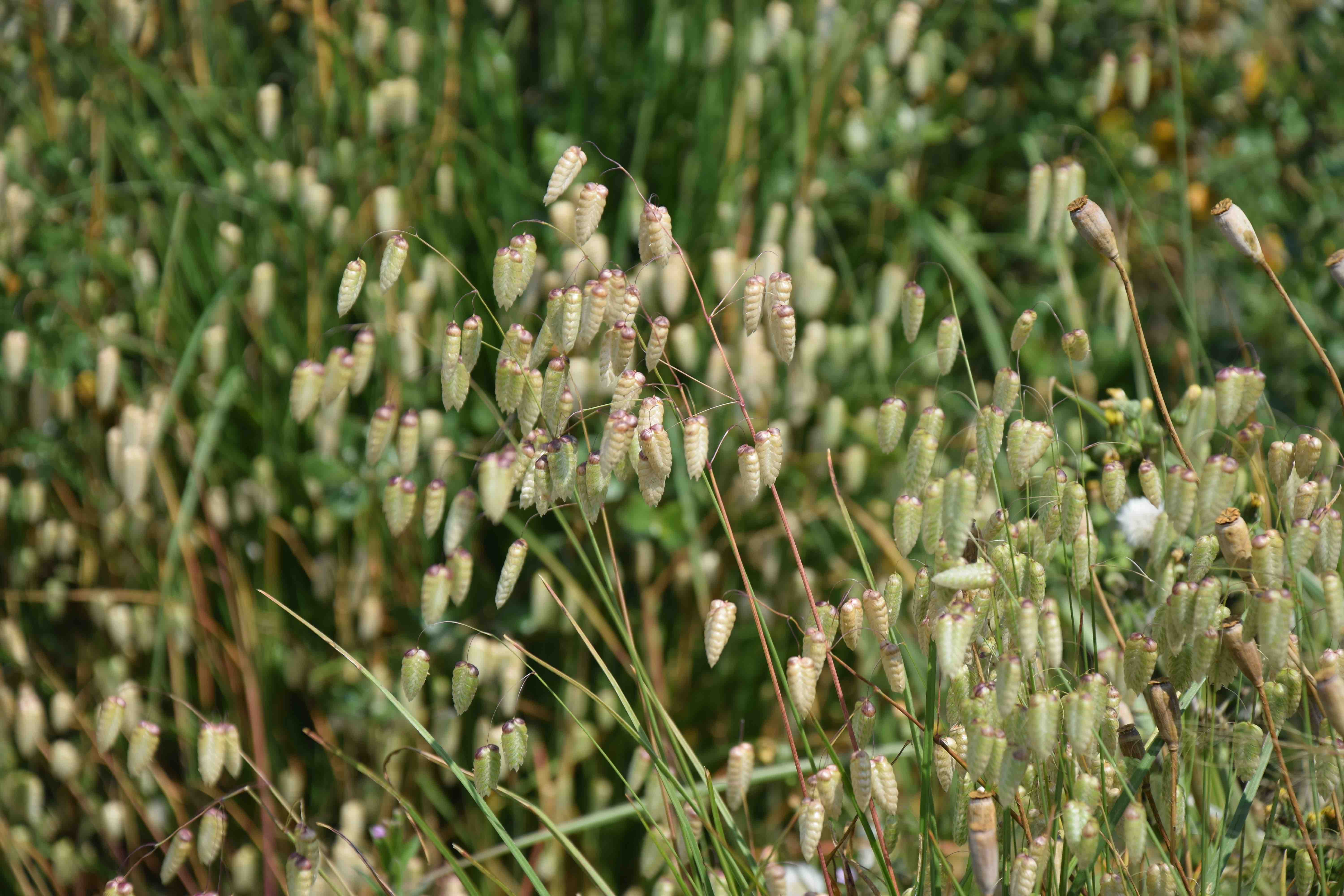
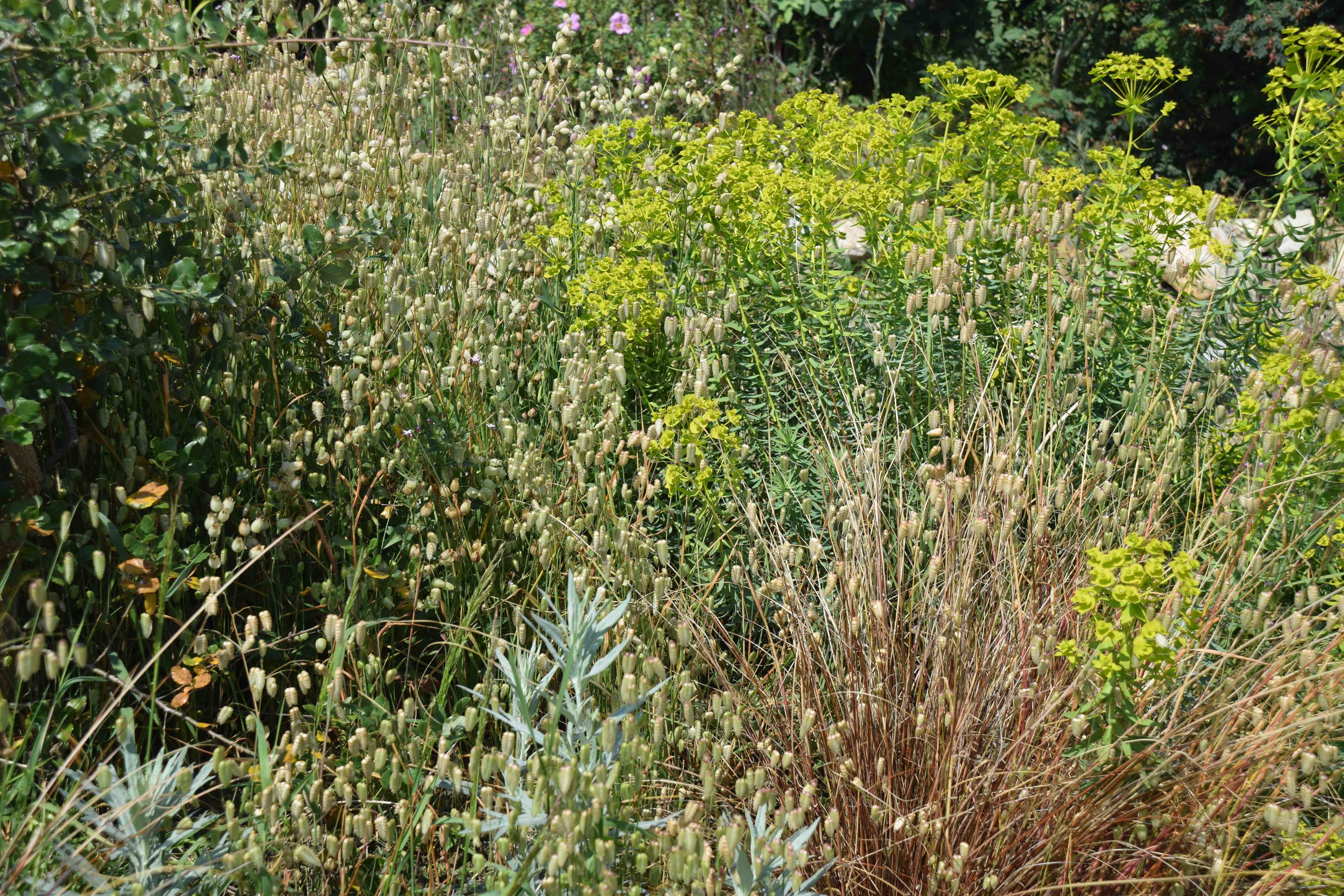
The other grass is Briza maxima, quaking grass, a native from the Mediterranean basin. This is an annual, unlike the perennial B. media which has a more northerly distribution, including Ireland. Briza maxima has, appropriately, larger seed heads. These are like lockets and hang from wiry stems, making it a great mixer and a lovely addition to the garden. Of course, it seeds freely and the seeds, with their inflated shape, spread in the wind. Each locket breaks up into 20 or more seeds so you can see that this can be a prolific plant in a sunny spot. I tend to take a casual attitude to its wanderings and just pull up the unwanted plants (lots of them) in autumn and spring. Their rather soft, broad, slightly hairy leaves make them easy to identify. They can be sown in spring but, now they are in the garden, the seeds germinate in autumn and overwinter as young plants. Most of mine are in a dry bed where they mix with annual poppies, bronze carex, cistus, white silene, artemisia and euphorbia in a totally natural grouping and I am content, for now. It is an uncharacteristically ‘loose’ bit of planting for me and I enjoy it.

Far more like my usual sort of thing is Diascia personata. I was given this as a cut stem last year (thank you Meriel) and took half a dozen cuttings from it. They rooted and most survived the winter in the cold greenhouse. Unfortunately they were attacked by aphids but once these were eliminated the plants grew strongly. I should have pinched out the shoot tips in spring (I had done in autumn) and they are rather straggly, flowering at 1m high. I planted them around my butia palm and they are branching at the base and flowering their hearts out, and should do so till the autumn frosts.
Diascias are now common bedding plants but when I started gardening (a student at Kew) only D. barbariae, especially the cv ‘Ruby Field’ was common and its use as bedding was ahead of its time. Now there are many hybrids and they are short, common bedding plants. Diascias (sometimes called twinspurs because of the two spurs behind the flowers) are South African and some are ‘just-about’ hardy. Diascia personata is similar to D. rigescens, differing mostly in shorter spurs at the back of the flowers. The two were often confused and although D. personata was first described in 1881 it was not officially named till 1984. It should be hardy but I will take cuttings just to make sure I keep it. It is a small effort to make to keep such as useful and pretty plant.
 The Biking Gardener
I’m afraid I could live my life without the ornamental grasses. On the other hand, the diascia is a good garden plant.
I understand completely! The diascia has proved easy to root and grow and is tall, airy and more than pulling its weight in the border. All the new, dwarf kinds are impressive but this combines elegance and colour, which is very impresive
Earlier this year I found a small amount of that quaking grass growing at the base of a wall. A present from the wind or the birds, but so glad to have it.
I wonder where it came from? The seeds are like discus and are blown about by the wind – I think the birds would eat the seeds. Watch out, because it will spread where it is happy!
I hope it does, I love it!
This is completely unrelated, but how does your Butia capitata perform there? I am surprised to see it there.
I am in SE Ireland which is the most Continental part of ireland. Having said that it is more Maritime than when I was in the east of England. So, I am drier in summer and colder in winter than the ‘legendary’ gardens on the west coast where frosts are rare. I tend to get frosts as early as the come in autumn and get a (mild) late frost in April. The butia used to be kept in a greenhouse when small, in England, but when I brought it here and had no greenhouse, it had to stay out. So far it has showed no sign or winter cold damage and is much happier in the ground than in a pot. It is still small (about 1.2m high and bit wider) but I am optimistic. I have trachycarpus, which is absolutely hardy, chamaerops, which is pretty hardy and fine here, and cordylines. I have yet to try a phoenix canariensis, which is commonly sold here but is a bit risky.
The growth rate is what would concern me. It seems to me that it tolerates frost and brief cold weather, (although frost here is not the same as frost there). However, it likes warmth through summer to grow. Even within warm climates, it grows slowly. Of course, for confined gardens, or if a shrubbier foliar plant is preferred, that could be an advantage. Phoenix canariensis would concerne me even more. It is odd that they are even available there. I know that they live in Brookings in Oregon, but they are not available from nurseries there. Someone must have brought them from here a very long time ago. They survive, and are nice dark green, but are obviously distressed.
The growth rate of the butia is very slow and it probably is lack of summer warmth. I have had the palm about 15 years. It spent most of its life in a pot, moved into a cool greenhouse in winter. It was probably too dry and hungry most of the time. Growth has been better since it was put in the ground. Phoenix are grown cheaply in southern Europe and shipped over in quantity and can only be expected to die in the UK. From photos I get sent, most die when the centre gets full of water and frozen in winter.
It is immoral that such commodities are sent to regions in which they are not expected to perform well. Sadly, it is quite common.
Unfortunately it is. I want to stretch myself and what I can grow but when these plants are sold as hardy it is wrong
Exactly! If I choose to risk growing tropical plants that I bring from the Los Angeles region, that is my business, but to sell such plants to those who do not know any better is very wrong.