Not so vanilla
The term ‘vanilla’ is sometimes used to describe something that is dull or boring. This is because it is the most ubiquitous of sweet flavourings – it is almost a non-flavour. As a child, it had to be strawberry or chocolate ice cream – never vanilla. And yet when you become an adult, vanilla is really delicious – or at least real vanilla is.
Of course, vanilla pods of commerce are the fermented seed pods of the vanilla orchid. Although there are many species, the one that provides vanilla pods is Vanilla planifolia. It is the only species of orchid, the largest of all the plant families (by species), that has a commercial value (apart from purely ornamental). It is a climbing or vining plant that can grow in soil or hang from trees, and clings to the trunk by its aerial roots, rather like ivy. It has plain green, rather narrow leaves with thick, rather succulent stems.
It was one of the first tropical orchids (perhaps the first) discovered by European explorers and is native to the Gulf of Mexico and the north east and north west of South America. It was cultivated in the area as a flavouring (famously for chocolate) and fragrance since at least 1185. I could go into the history of the plant but it is not really relevant here. All I will say is that it is worth using real vanilla or extract rather than essence, which is chemically produced from wood. In the wild the flowers are rarely pollinated and then only by orchid bees. In cultivation the flowers have to be pollinated by hand to produce pods. Commercial production of pods took a long time to ‘take off’ and was limited by the difficulty of pollinating the flowers. Apparently it was an 8year-old boy that cracked it and the industry was established. The flowers only last a day so the plants have to be checked and pollinated daily.
Vanilla is a truly tropical plant, needing warmth and high humidity.
So it was with great surprise that I noticed some flower buds on my plant a few weeks ago.

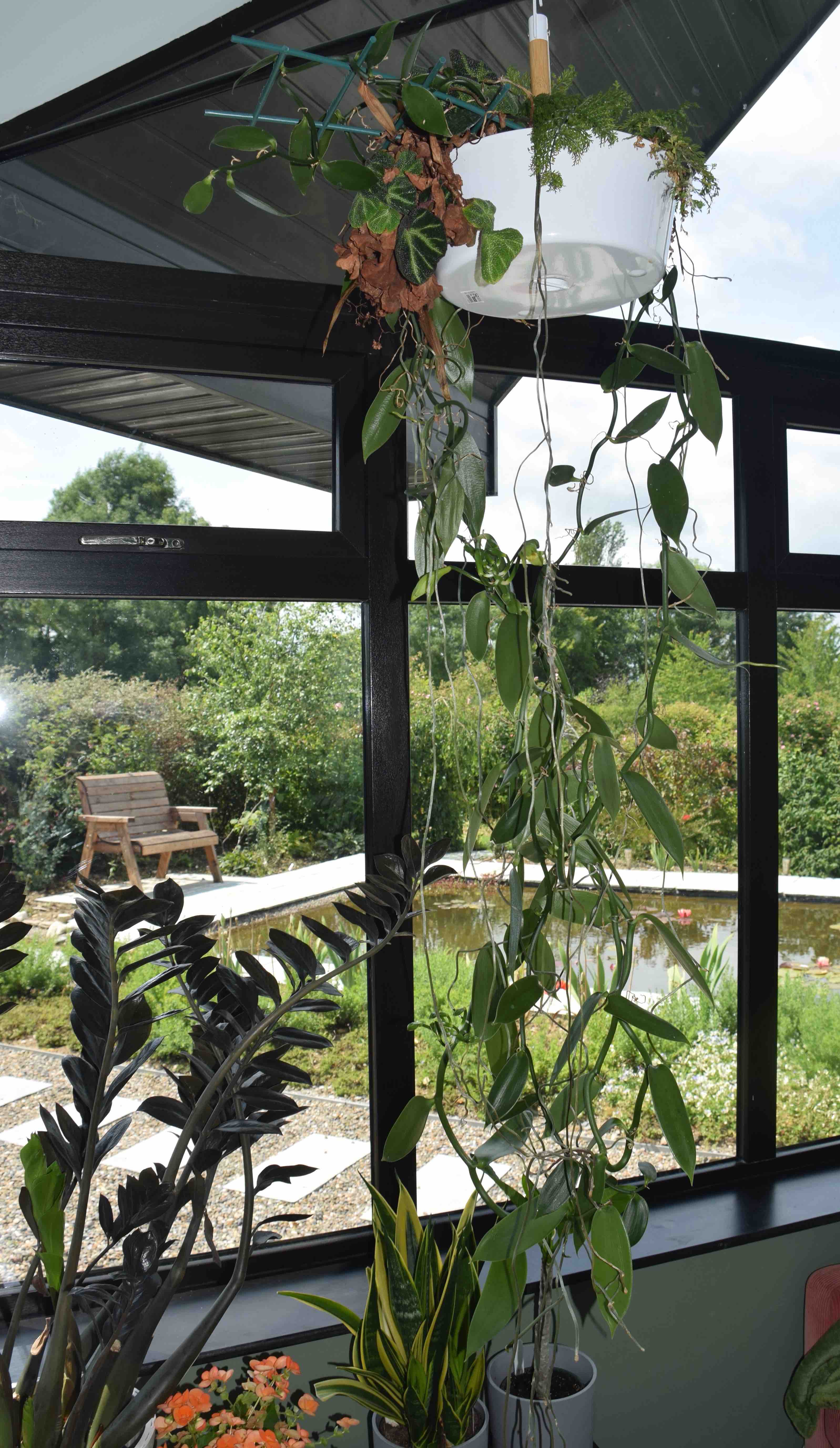
My plant was bought about 3 years ago. They are usually sold as small plants up a plastic trellis. I put mine in a hanging pot (from IKEA) and allowed it to droop down. It gets a bit dry at times and it is misted sometimes but I regret to say that it has not been misted for a few months. But it was above some large houseplants, into which it had festooned, so probably got some humidity that way. It has trailed about 2m and when the stems get too low I tuck them in and let them go up again so the plant is hardly tidy.
But we have two clusters of flower buds and I am delighted. The plant only gets rain water, like all the houseplants, and does get fed when I feed the other plants. The feed varies but at the moment it is MiracleGrow. But I use anything rather than nothing and it gets fed about once a week/10 days in summer.
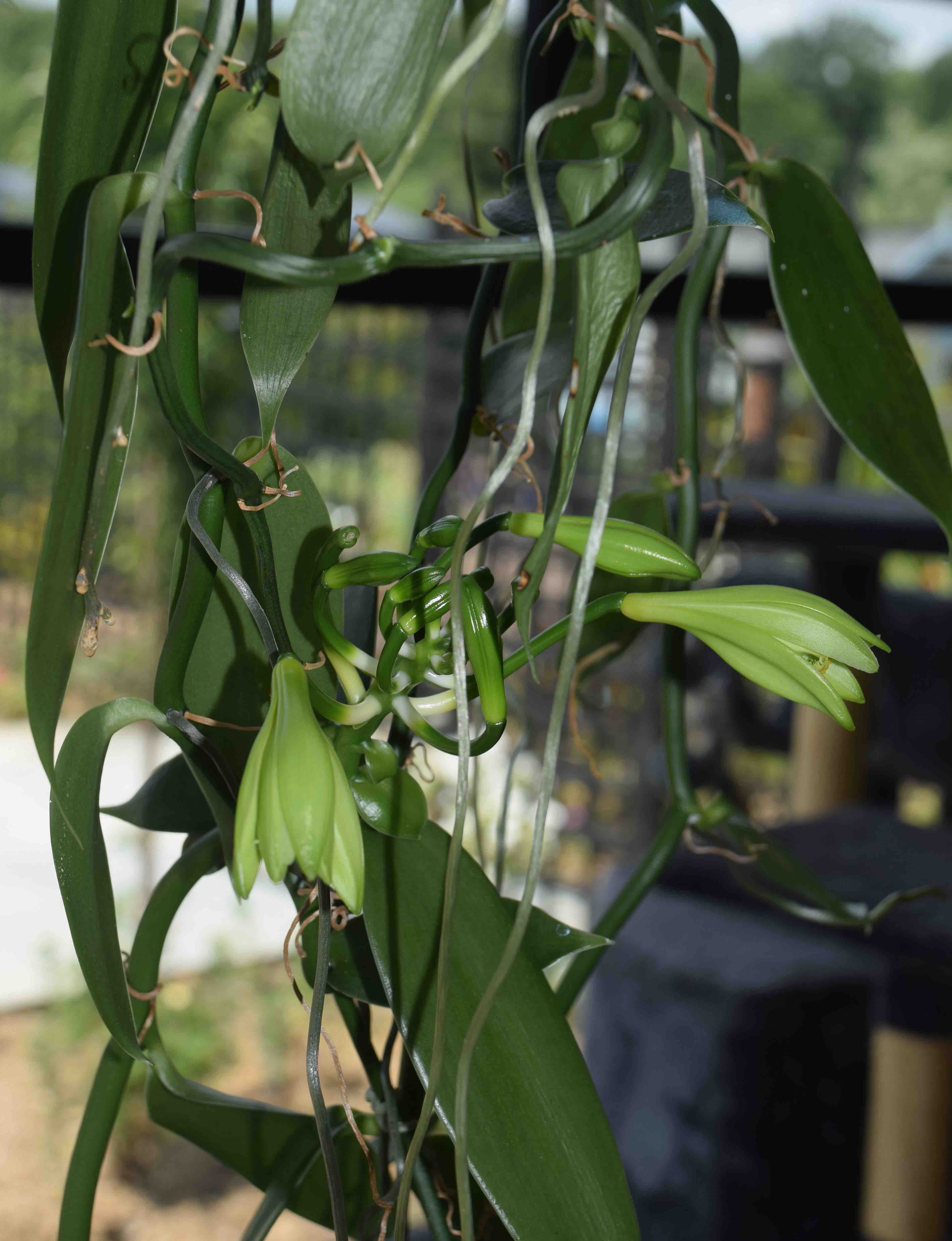
Yesterday the first flowers opened. They don’t open very fully and they start to close in early afternoon, hence the rather closed look of the blooms. I will try to pollinate a few but the pods take a year to mature. Then there is the process of fermenting before use which I am very unlikely to master.

I don’t know how I managed to get this plant to bloom and it may never happen again. But I think I love vanilla and will never ever say it is boring again!
 The Biking Gardener
I wonder if it is too early to place an order for a pod – I have custard in mind, or ice-cream.
It is a bit premature – I need to make like an orchid bee first!
That is impressive! They are so sensitive to frost that they need shelter even here. Pods do not develop well here because, even when the weather is warm during the day, it cools somewhat at night. I suspect that pods would develop better among houseplants, which experience less temperature fluctuation, or plants in a greenhouse.
My plant is in the conservatory with bright but not direct light. It drops to about 12c in winter but has been very warm over the past month because of the warm weather
I sort of wonder why I never see it growing in coastal (but not directly on the coast) climates of Southern California. It may be because it is not as visually appealing as other orchids. It could be because the pods do not develop good flavor. Well, we do not grow tea here either, and it is easier.
It could well be that the plant is a bit uncontrollable and the flowers are subtle and don’t last long. But it is curious what people grow and don’t grow!
Well, that would make sense. Visually appealing plants are more popular than utilitarian plants here. While trying to find sugarcane, I can only find ‘ornamental’ cultivars with purplish foliage. I can only read about how pretty it is, but not how much sugar it provides.