A berry strange phenomenon
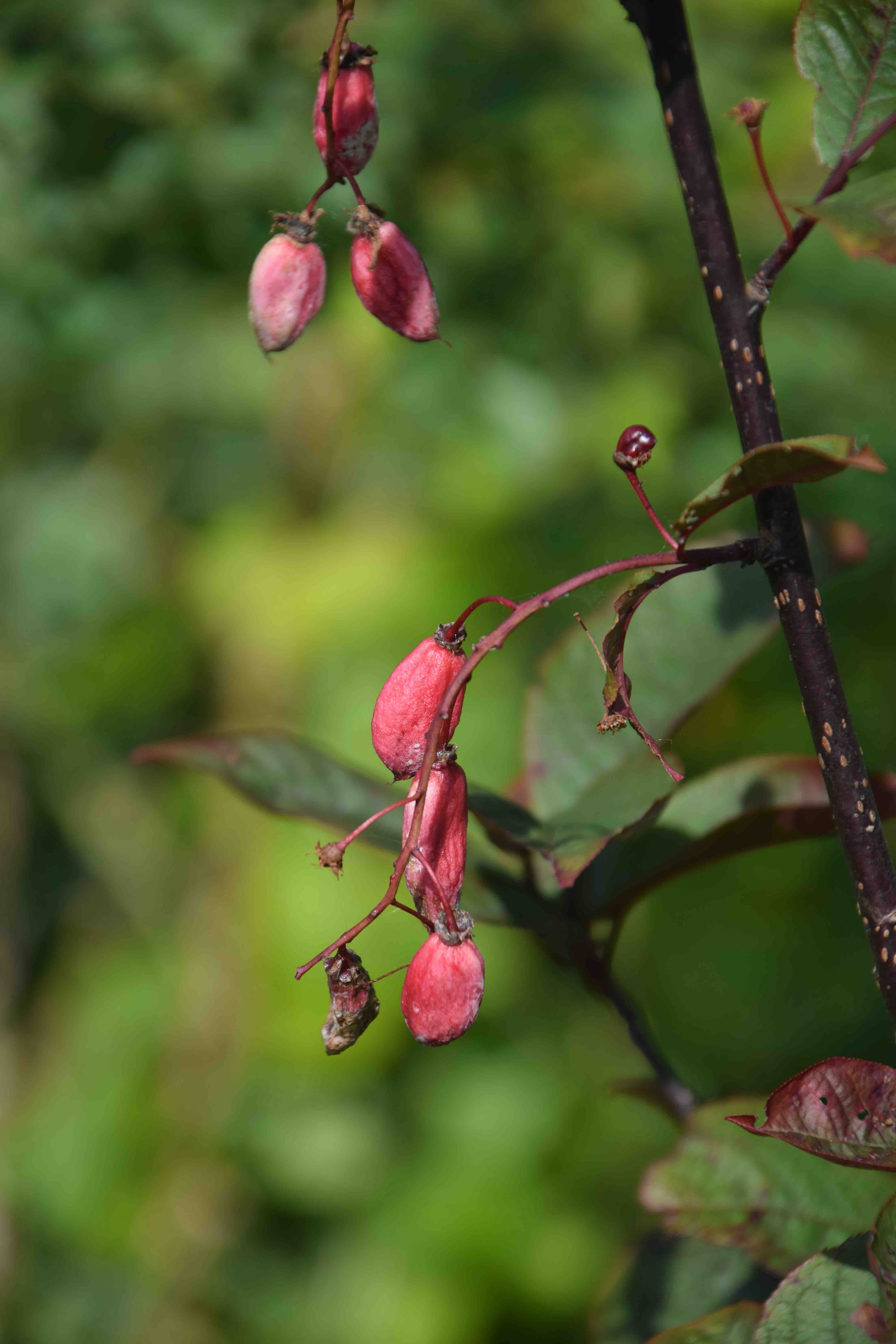
This year the bird cherries (Prunus padus ‘Colorata’) were in their second year and all flowered quite well. The flowers lasted well and I was pleased with my decision to plant a group of them. But as the flowers faded I noticed something odd going on. Not a single fruit formed. I was surprised and a little disappointed because a part of the reason for choosing them was the abundance of small, black fruit that the birds should have enjoyed. This was not completely altruistic because I hoped the blackbirds would feast on these and leave me the honeyberries and redcurrants.
But instead of the small, shiny, black berries, a lot of the flowers produced large, pink, peculiar ‘fruits’. These are leathery and inflated and contain no seed. They look as though some fungus has infected them and produced something strange like a smut or rust. Or perhaps some tiny gall wasp has caused the damage, though I could not see any sign of that. The trees are otherwise completely healthy and I am not just mystified but confused about whether I should be worried or not!
I would be glad to hear your opinions or experience.
Update March 2024
I think I have got to the root of this one. It is most probably Pocket plum, caused by the fungus Taphrina pruni. It is most common on wild sloes/blackthorn (Prunus spinosa) and affected trees produce these strange fruits and ‘willowy’ foliage. We are surrounded by wild blackthorn and that may be the source of the infection. It has not, as far as I am aware, affected the culinary plum trees and it is too early to tell if the bird cherries will be badly affected this year.
 The Biking Gardener
Stone fruit trees typically do not produce much in their second year, regardless of marketing claiming that they should. They grow vegetatively for their first year, and, as you have noticed, produce stems that bloom for their second year. However, because they still prioritize vegetative growth and root growth during their second year, they abscise much of their fruit prior to development, even after adequate pollination. Bird cherries are generally an exception though. They should produce at least a few fruits by now. The few oddly inflated fruits in the picture look more like unopened floral buds of some other species than like deformed fruits, but are not totally unfamiliar. Some sterile and therefore fruitless flowering cherries sometimes produce a few fruits that resemble these. It is as if they try to produce fruit, but then abort the fruit because it contains no viable seed. Prunus padus should be potentially self pollinating, but I do not know. Since yours are of the same cultivar rather than seed grown, they would require a pollinator if they are not potentially self pollinating. Also, if they require a pollinating vector, such as bees, but their pollinating vector was not active during bloom, pollination could be inadequate. I sort of suspect that they require a pollinator of another cultivar or variety. ‘Black Beauty’ elderberry inhabits one of the landscapes at work. It is supposedly potentially self fruiting, but has never produced any berries. I suspect that it might produce a few berries now that it has gotten established over the past few years. We got it ‘Madonna’ as a pollinator to enhance berry production regardless. Even if it really is potentially self fruiting, it should produce better with a pollinator.
Hello and thank you for your extensive comment. These padus cherries are supposed to be ‘Colorata’ and thus a cultivar but there is variation in leaf colour and bloom colour so I suspect they were actually grown from seed. There is also no obvious graft at the base of the stem. Last year, their first year with me, they did produce a few fruits but there are none at all this year, just these odd structures. All the flower buds opened normally. There are seven of them so there should be a good chance of pollination. Also, not far away are wild cherries (prunus avium) sloe (Prunus spinosa) and my edible plums and cherries. As you say, plums take a while to crop, despite what the catalogues say, and mine finally flowered well this year. The weather was wet and cold when the plums were in bloom but it looked like there was a good set – not all the six plums I have flower at the same time, though some are supposed to be self-fertile. However, the majority have now dropped off while tiny. This may be because of poor pollination or a lack of calcium. The soil is acid and although I have limed, perhaps I need to lime more since calcium is needed to form the ‘stone’. I keep trying.
Elderberries have been giving me the same frustration. Blue elderberries are supposedly self pollinating, but because there are so many growing wild here, I will never know. Nor do I care. However, I am more concerned about other species. An ornamental European black elderberry in one of our landscapes was supposed to be self fertile, and seems to be in other landscapes, but after a few years without fruit, we got it a pollinator. I do not know what to believe about it. I suspect that, where it seems to be self fruitful, there may be pollinators nearby. American black elderberries can be somewhat self fruitful, but are more productive with pollinators. However, nurseries do not specify if their non-cultivar specimens are grown from seed or cutting. If grown from cutting, they are clones of each other, even if not designated as a cultivar; but there is no graft union to indicate that they are a clone from cutting.
I cannot imagine that Sambucus nigra cvs are ever grafted because they root so easily from cuttings. The wild species is something of a weed here because the berries are so popular with blackbirds (Turdus merula) that feasts on the berries and drops the seeds in their bright purple poo! Seedlings appear everywhere in the garden and grow rapidly.
I get a good set on my plants but then there are wild, flowering trees in the hedges and I have quite a few cvs including some planted specifically for their fruit. So I can’t state, from experience, whether the plants are self-fertile. Howvever, I have done some digging and an American Nursery site states –
“American elderberries are not self-fertile and require a different American elderberry variety as a pollenizer to produce fruit.
European elderberries are not self-fertile and require a different European elderberry variety as a pollenizer to produce fruit.
Blue elderberries are self-fertile, so do not require a different variety as a pollenizer to produce fruit.”
A UK nursery states
“Pollination Requirements: European Elderberries are partially self-fertile. Plant two varieties for heavier crops.”
So that almost clears it up!
Yes, that is the same information that I find, . . . generally. One nursery markets ‘Black Lace’ European elderberry as an ornamental cultivar that is also very productive with fruit, but makes no mention of a pollinator. Because it does not grow wild here, It can not be pollinated by wild specimens. Some sources insist that no pollinator is needed. Because I do not know if non-cultivar American black elderberries are grow from seed or cutting, I may just grow them from seed if I do not get cultivars.
Very interesting to see this post. My neighbours on the plot used to have what I think is the same cultivar and I noticed the same issue with the berries, which reminded me of pocket plum, which I had only seen on P. cerasifera before. As I propagated the tree from a sucker before they removed it, and as it is quite pretty and has just started to flower this year, I was looking around to see how good it is for wildlife. That’s how I came acroos your post. If this cultivar is very susceptible to Taphrina pruni I don’t think I want it around my other plums…
Thank you for visiting and commenting. I suspect that my ‘infection’ may have come from the many sloe/blackthorn trees that are abundant in the area. I have not noticed it on my culinary plums, that include a damson, mirabel and Japanese plum, but I suppose it may appear on them – they are just 5 years old and have not produced much fruit yet due to late frosts and bullfinches! If you are concerned then perhaps i is not a good choice. I will keep mine for now and see what develops – hopefully just fruit!