Off with their heads: rhubarb flowers
With apologies to the Queen of Hearts*, deadheading plants is one of the most important jobs you can do in the garden and although you may think that not much has actually flowered yet, it never hurts to start early. Now deadheading usually refers to the removal of ‘dead’ flowers. There is a good reason why we do this – in fact there are several. The aesthetic one is that dead flowers don’t look very nice and if they are left on it can spoil the display. Nowhere is this more important than with white flowers; their pristine purity is ruined by dead, brown flowers. Somehow it doesn’t matter quite so much with other colours but white blooms are high maintenance.
I am going to try to avoid the innuendo and smut but, at the end of the day, all plants are interested in is sex. And once they have had it they don’t want to bother much with anything else. Sound familiar?
So once a flower has been pollinated and seed has formed the plant basically has done what it needs to do. In the case of plants that are capable of producing more flowers, they may produce some more but not as many as if they had had their dead flowers removed to prevent the formation of seed. If they are thwarted in their need to reproduce they keep on trying.
Of course not all plants can produce more flowers and even if you do remove the dead flower on a daffodil or peony it is not going to produce more flowers – well not this year anyway – they have a finite number of buds. But if you remove the dead flowers, to prevent the production of seeds, the plant won’t waste energy making something you don’t need and the ‘energy’ will be put into producing foliage or flowers for next year.

Strong flower spike on a healthy rhubarb clump
So where does rhubarb come into this? Well a mature clump will eventually produce a flowering stem and in some years, particularly after a cold winter I think, plants flower profusely. You can recognise the flower spike because it is enclosed in great white bracts. The stems grow really fast and, if left, will grow at least 1m high with hundreds of tiny flowers like a giant dock (to which it is related). You do not want the plant to flower because rhubarb is grown solely for its leaves – well its leaf stalks. If you let the plant flower its work is done for the year and no more leaves will be produced.
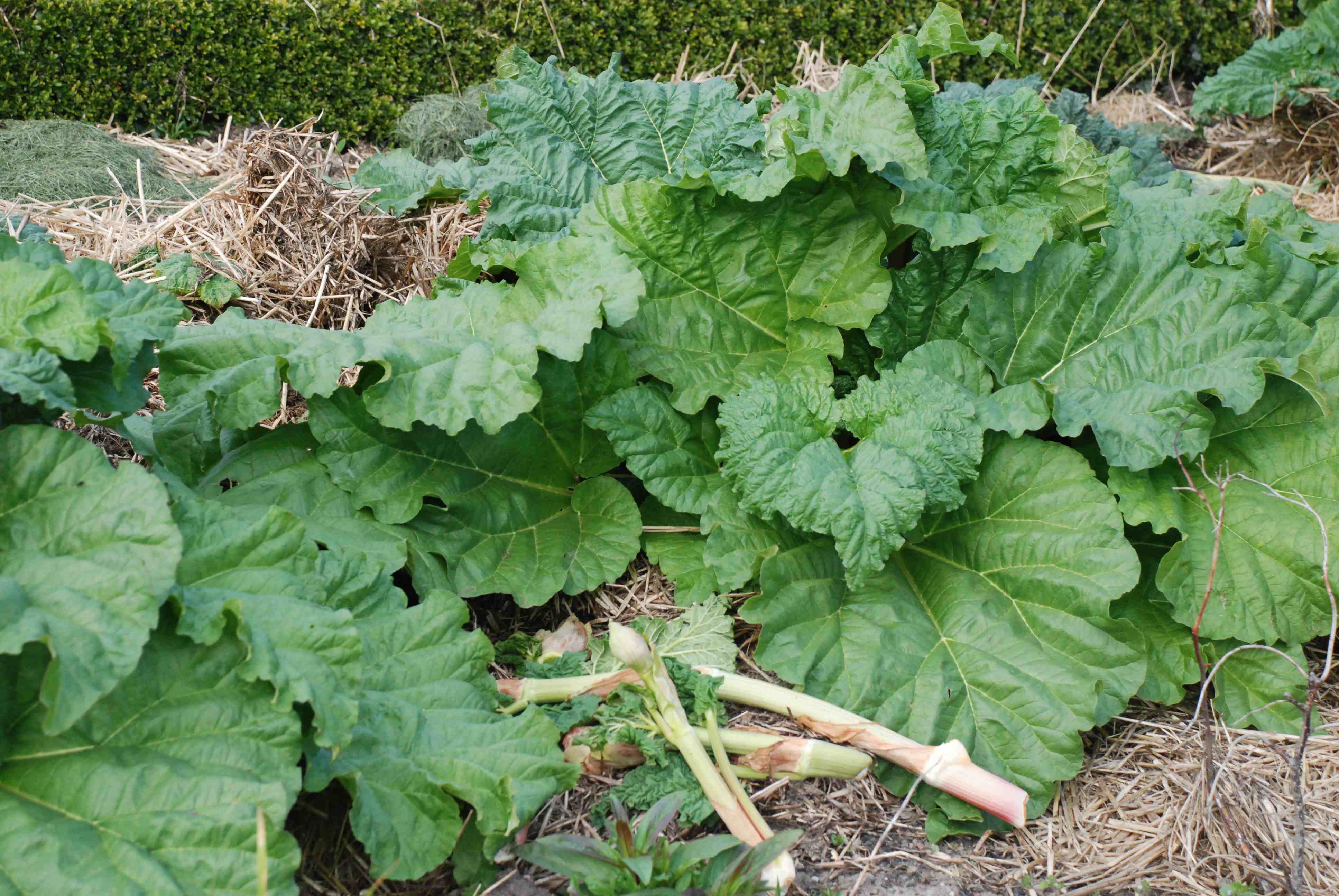
Of course you don’t have to leave the flower stems on the ground – you can add them to the compost heap – along with the leaves – they won’t do any harm – honest
When you crop rhubarb, pulling off its leaves, you weaken it because the plant needs the leaves to increase the size and health of the crown (root). That is the main reason why we stop pulling the leaves in July – it gives the plant time to grow and recover for next season. On a personal note I would also argue that why on earth would you be eating rhubarb when there are strawberries, raspberries etc now in season. Rhubarb is all very well when there are no fruit to eat, but when the garden should be full of real fruit (botanically rhubarb is a vegetable) give the rhubarb a miss. Then there is the palatability issue. As the season progresses and the ‘stalks’ get older they get tougher and contain more oxalic acid, the substance that is concentrated in the leaves that makes them mildly toxic.
So, take the flower stalks off your rhubarb to keep it productive: deadhead your daffodils and tulips to help them build up for next season and deadhead your pansies, petunias et al to keep them blooming.
* The image we know of the Queen of Hearts was based on the Duchess of Norfolk, Elizabeth de Mowbray (1942-1506). Her image, on the stained glass in the church of Long Melford, Suffolk, was used by cartoonist John Tenniel as the basis for his illustration of the Queen of Hearts for Alice’s Adventures in Wonderland.
 The Biking Gardener
rhubarb crumble on our menu today with thick cream
I put manure on my rhubarb!
lol will stick to the thick cream thank you
I was thinking of making some egg custard today to go with some – eggs seem an appropriate thing to have today