Brukale ‘Petit Posy’
Brukale ‘Petit Posy’
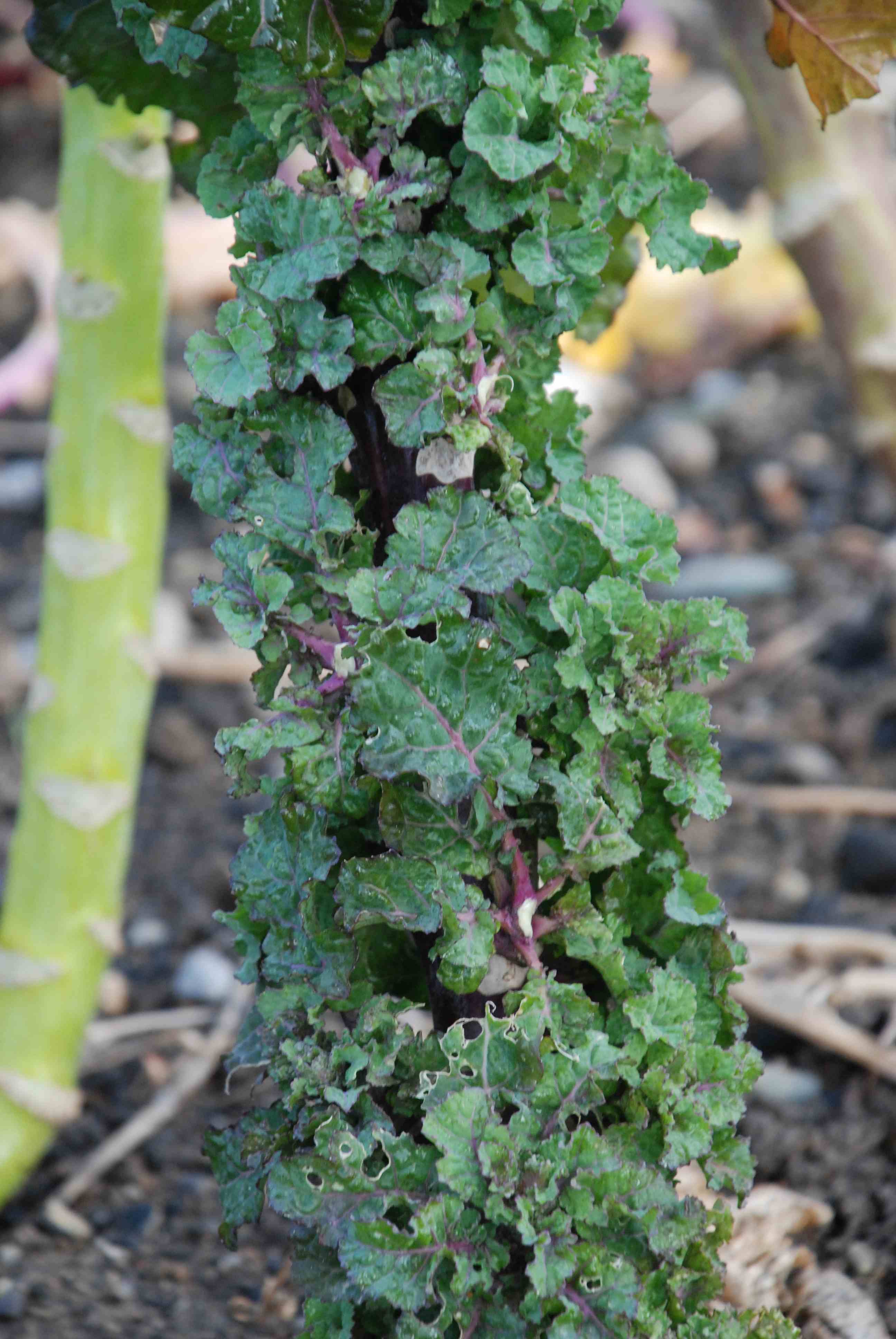
‘Petit Posy’ not looking its best because it has been harvested up the stem, but showing the general idea
A few years ago this innovative vegetable made a few waves on the radio and in magazines because it is the result of really imaginative breeding. We know that kale is good for you, hardy and fairly easy to grow but, until recently, when it was promoted by chefs as the next great thing, it had an image problem. So kale was crossed with Brussels sprouts, another veg with an image problem. It was inspired and the sum is far greater than the two parts.
The trouble with kale is that it can be a bit tough and the leaves catch dirt. If you grow your own you can pick the tastiest, tender leaves at the top and you can strip the leaves off the tough midrib. I always look in astonishment at those bags of pre-chopped kale in supermarkets and wonder what people think they are eating. You can see the chopped midribs in the bags, often white and dry because they were chopped days ago. I wouldn’t feed it to a rabbit. Even pigeons and caterpillars leave the midrib. Yuk! No wonder people refuse to eat veg. And then there are sprouts, which to many people, seem to have been invented solely to spoil Christmas. Now they are not my favourite veg and I know why people don’t like them but if you stop cooking them while they are still green and you don’t continue until they match the colour of Corporal Jone’s uniform on Dad’s Army, they are quite nice really.
So Brukale – you can see where the name comes from – grows in the same way as Brussels’ but instead of buttons up the stem you get a column of tiny, frilly, kale heads. They are frilly in the way that ‘Red Russian’ is ruffled and not intensely frilly like ‘Redbor’. The plants look a bit like poodle legs to me and quite comical. The upper leaves form a dense umbrella that protects the crop below and, so far, packs tend to contain seeds for two colours of plant; a reddish green and purple – but check this if it worries you either way. The ‘florets’ start to form in late autumn but mine are at their peak now as the lower ones are starting to produce growth and expand. At Christmas they were quite compact and firm and nice enough but now they are much more tender and the centres are actually soft enough to add to a salad to eat raw. I have only eaten them steamed, which is easy to do and, with the addition of some butter they are really delicious. I thought this was a winner when it was first introduced and I am more convinced of it now.
Growing tips As with all brassicas, this crop can get a host of problems. But I think the most important pests to control are whitefly and mealy cabbage aphid. If they get into the ‘florets’, you have a largely inedible crop – especially if you are vegetarian. To prevent this I would either grow the plants under fleece until late autumn or consider spraying with insecticide until September. I do not like spraying but as it is only needed until late summer and you are going to eat the crop at least 3 months later I would consider it. I did have some mealy aphid on my sprouts but, for some reason, they left this crop alone.
Seeds are now widely available. Try:
http://www.dtbrownseeds.co.uk/Vegetable-Seeds-1/Brukale-Petit-Posy-Seeds.html#.Uv-iPl5cE7A £2.29 for 50 seeds
http://www.mr-fothergills.co.uk/Vegetable-Seeds/Brukale-Petit-Posy.html £2.49 for 50 seeds
http://www.thompson-morgan.com/vegetables/vegetable-seeds/brassica-and-leafy-green-seeds/brassica-petit-posy-mix/4777TM £2.29 for 30 seeds
 The Biking Gardener
Any chance you can post an image of the whole plant? I’m interested in planting this variety and would like to see it in full flight.
I have some growing this year and I will take a photo and post it soon. Thanks for visiting and for commenting 🙂
Hi
I just bought a packet of seed and have already planted them in pots until I can transplant.
I live in Bellingen NSW (subtropics) and wonder if you can tell me if my timing is ok.
When is the best time/month to plant them im the subtropics.
Thank you kindly
Hello and thank you for visiting my blog. This is an interesting question and I can only give advice that seems logical to me. In this part of the world it is best to sow in month 4-6 of the year so the plants are big enough to form stems by winter on which the ‘flower sprouts’ form. I would therefore think that as you are sowing in month 9 of the year (your late summer/early autumn) it is likely, if sprout formation is governed by day length or cooler temperatures, that you will not get much stem growth and that it is likely that the plants will just make a rosette of foliage and then flower. They may do this in warmer climates anyway. However, the fact that they are a kale cross means that any leaves can be picked off and especially flowering shoots if they do bolt prematurely so you will get a feed off them even of they do not do quite what was expected. It would be interesting to repeat a sowing, ideally in November – late spring – and see how you get on with that. I think you would have better luck with other true kales or collards (leafy cabbages used in the S. USA) I am trying collards this year. Good luck anyway and let me know how you get on.
Hi there We’ve actually just started the beginning of Autumn here in Bellingen (NSW) which will give me at least 3 months of growing before winter sets in.
Hopefully i’m on track for my first attempt at growing Brukale to be successful.
Take care Wendy