Rose ‘Oranges ‘n’ Lemons’ – with Saturday Survey
Oranges ‘n’ Lemons may not be the most modern striped rose but it is a useful one and, 20 years after its UK introduction, it remains popular and the sort of bloom that people stop to take a longer look at. Striped roses always cause a stir and the past decade has seen some good ones coming to us from California, from the stable of Tom Carruth through Weeks Wholesale Rose Grower inc and via C & K Jones Roses* such as Crazy for You – Fourth of July in the USA.
But striped roses go back a lot further in history and perhaps the oldest is Rosa Mundi, an old gallica rose that is thought to date to before 1581. It is a nice rose with dull foliage and one flush of fragrant flowers striped in two shades of pink. It is said to be named after Henry ll’s mistress Rosamond Clifford – fair Rosamond. Like most old roses it is not the healthiest and will get blackspot and mildew but, if grown on its own roots it will sucker and make spreading thicket.
The first striped rose that I remember though was Harry Wheatcroft, named after the slightly eccentric rose grower, remembered as much for his sideburns and moustache as his roses. It is (or was since it is not much grown today) a sport of Picadilly, and was a large, mildly fragrant Large-flowered rose, in the style so popular at the time of its introduction in 1972. It was the sort of rose to cut for a flower show or to plant in your front garden, surrounded by scarlet salvias and lobelias. Harry Wheatcroft (d. 1977) was influential in the rose world for having a gift for marketing and he introduced some of the biggest names in rose history, notably from the French rose breeder Meilland. He introduced Peace in 1948 and, in 1952, the American Cluster-flowered rose Queen Elizabeth. He also introduced Superstar and Fragrant Cloud, both roses that most gardeners have heard of. I remember the commotion both these made, especially Superstar with its amazing, bright colouring but this was the age of generous garden chemical use and these days both have fallen from favour because of their susceptibility to disease.
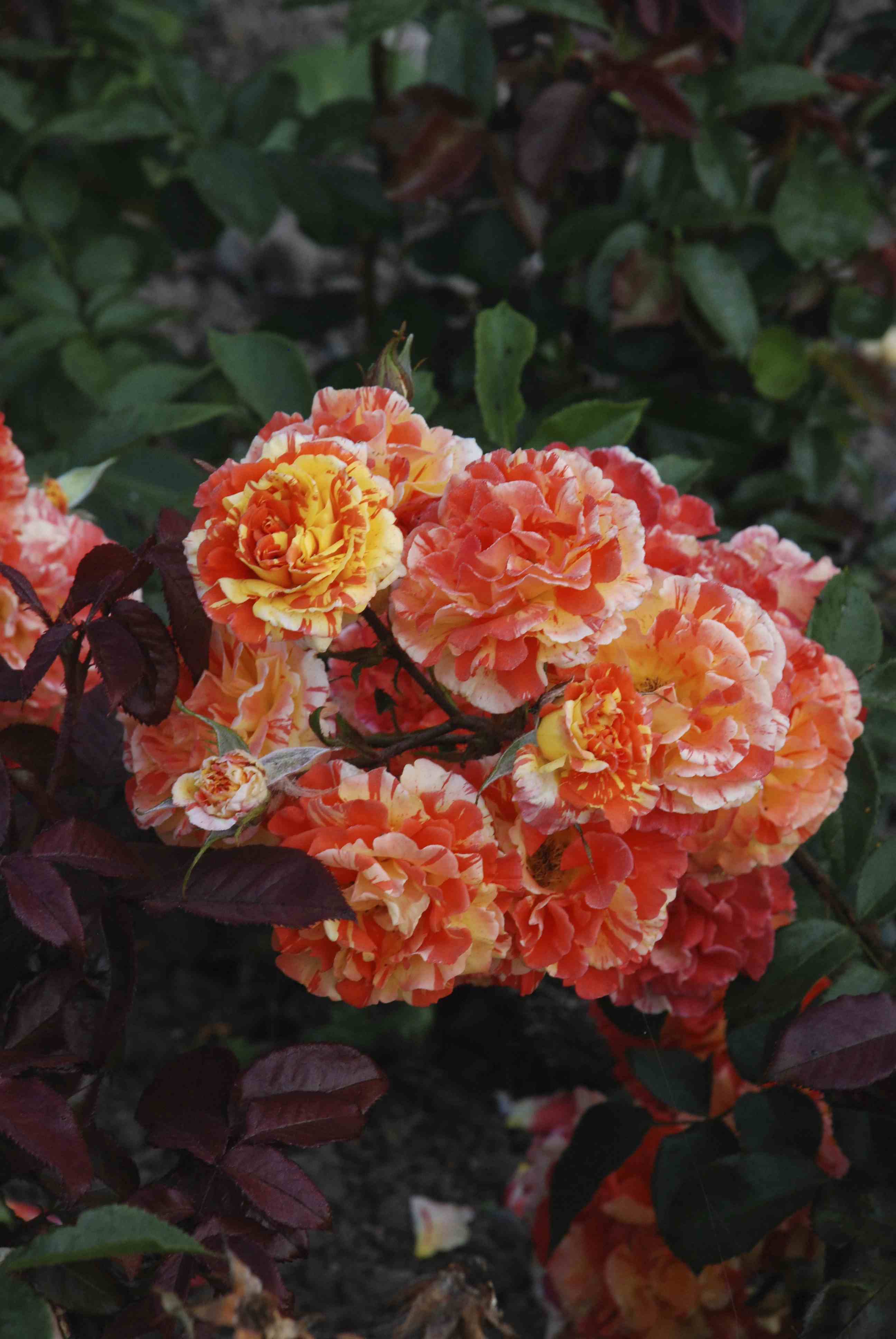
Oranges ‘n’ Lemons (MACoranlem) (above) was bred in New Zealand by Sam McGredy before 1989 and introduced in the USA in 1995. It is a rather upright cluster-flowered rose with double flowers that show their centres when fully open but of good form with 40 petals. The flowers are orange and yellow, as the name implies, with irregular stripes but not so random as to look scruffy. The flowers are about 8cm across and are held in large clusters of a dozen or more on the stronger stems, far fewer on weaker stems. They have a moderate fragrance – this is not one to plant primarily for fragrance but neither is it devoid of scent.
It repeats well so a plant is rarely without flower from late June to November. The flowers are perfectly enhanced by the glossy, burgundy foliage which, to be honest, is almost a good enough reason to grow it. The new growth emerges really dark and then fades to dark green over time but there is usually some red growth showing – a great complement to any border. This is a vigorous, healthy rose, reaching about 80cm high and slightly less in spread, with few thorns. Its health is especially welcome because older orange roses, notably Superstar, were martyrs to blackspot, a trait inherited from Rosa foetida bicolor, the origin of orange colour in modern roses.
A slight flaw is that the colour of the flowers fades in hot sun or when the soil is dry, changing to more apricot and cream. Technically this is a problem I suppose but in the garden it is not a real problem and with the weather being as it is I won’t lose sleep over the risk of blazing sun right now.
The results of the last poll – Whether you had been disappointed by plants you had bought.
66% generally disappointed and 33% got the wrong colour plant. I can’t make much of a judgement from this because there were not many votes. So please vote on this one so we can get some interesting results. And if there is a question you would like posted then let me know.
 The Biking Gardener
No comments yet.