Be careful what you buy – With Saturday Survey
I had a moan, a few days ago, about misleading labeling on a fruit drink. Back to core subjects now but on the same theme; misleading images in gardening catologues.
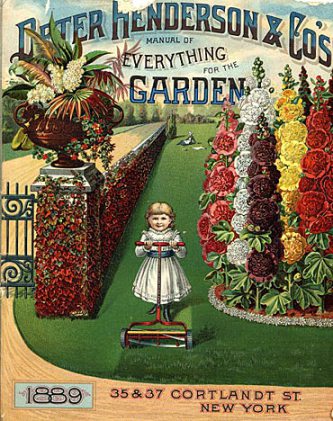
Look at the size of those hollyhocks missus! A fun but absurdly unrealistic catalogue cover. (taken from landscapenotes.com)
Exaggerating the merits of plants is nothing new. Look through old catalogues and plants are frequently described as the finest, biggest, best and, before the advent of photography, the illustrations were often more than complimentary, showing more flowers, bigger flowers and showier flowers than you could possibly expect.
It seems funny to see some of them now, knowing that these illustrations were so exaggerated. But have things really got much better? Photography gave us a period of truth, because photos don’t lie, do they? But there are ways to get around even photographs. The simplest way is to ‘dress’ the scene and we all do this, from getting the group around the Christmas table to sit where we want for a good group photo to food photographers using dry ice to give that, by now cold, dish that steaming effect that tempts us to want to make it. All tricks of the trade.
So when a plant seller wants to do something similar to enhance the appeal of their wares, how far is acceptable?
Some plants are tricky to photograph well. Take lavender; the whole plant is fragrant but the flowers are a bit ‘thin’ and in a normal shot there is a lot of ‘gap’ around the individual spikes. To make them look better than they are it is natural to pick a load and put them together – it looks better in the catalogue or on the label and, to be honest, you need a close up to show how they are different from one another.
But when does it become misleading with a plant like mirabilis (four-o-clock plant or marvel or Peru). Now I really love mirabilis, and not just for the name*. The commonest species is M. jalapa and it is a robust perennial with fleshy leaves and stems that is best grown as an annual. The large seeds are easy to sow individually in pots (as I have just done) ready to plant out in May. The flowers are trumpet shaped and not only is there a wide range of colours but many plants have striped flowers or two colours on one plant – really different. Add to that the wonderful perfume at night (they are called four-o-clock plants because that is when the flowers open) and you have a great plant for the border, reaching about 60cm high and across). The trouble is that the flowers are scattered over the plants and although not quite subtle it is not really a substitute for a petunia. But look at seed packets and you would think that they produce a carpet of flowers.
Now I think this is slightly misleading to buyers, but more importantly it is bound to disappoint the grower who may do everything right and grow them to perfection but the plants never look quite like the packet.
But that is a minor issue. Where the problems really start is with the ability to manipulate digital photographs. Now that art editors can crop individual flowers and move them or add them again and again to images of shrubs and also change colours we move, I feel, from manipulating the truth to downright lies.
I have seen some blatant examples of this with the same flower repeated again and again in an image, colours changed completely to give the impression of a plant with multi-hued blooms and, of course blue roses and black tulips that do not exist. When it comes to colours the catalogue usually puts a disclaimer somewhere to the effect that the colours are as accurate as printing allows. Now I know some colours are difficult to reproduce and that they do want to catch our attention but there are limits.
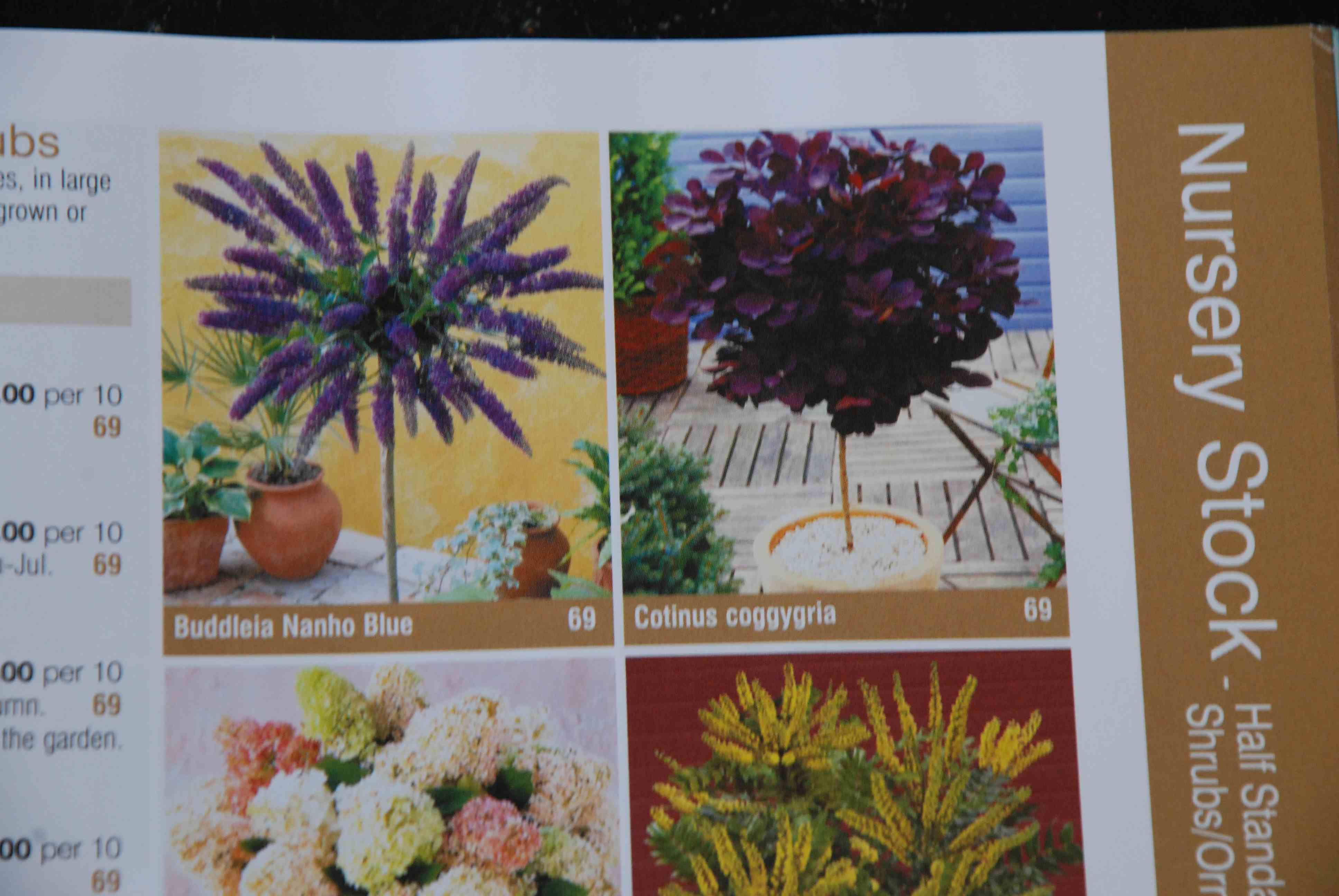
But I will illustrate this moan with a couple of examples from a catalogue (I won’t name it here but as many nurseries use the same photos of Dutch- grown plants you may have it in your magazine rack) that doesn’t rely on modern trickery but a simpler method to confuse. These are ‘standard’ shrubs, trained, or in some cases grafted, on a single stem. Now, ignoring the fact that a standard buddleia or Hydrangea paniculata would be an ugly thing and difficult to support because of its heavy head, what I really object to is that these photos are not of real plants and you could never grow them like this.
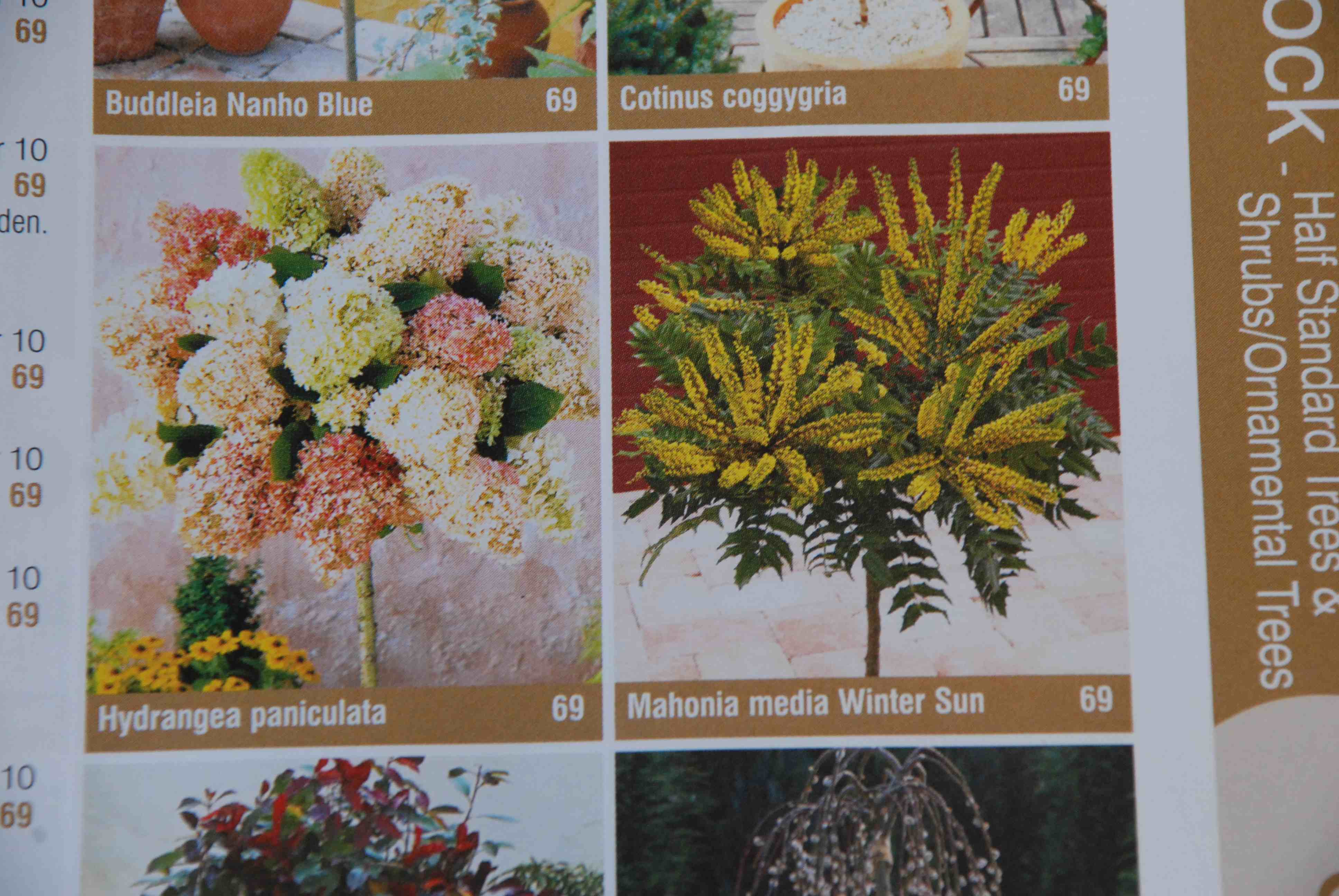
Yes, I will stick my neck out and say that no one, not even a really skilled pruner or bonsai grower, could achieve a look like this. I was not there at the photoshoot but I suspect that these are sticks with a ball of ‘Oasis’ at the top with flowering stems pushed in. Not even ‘Blue Chip’ the new dwarf buddleia, flowers on such short flowering stems and even if it did the stems would not grow downwards. And as for the hydrangea, as most make at least 1m of growth in summer before they produce flowers in late summer there is no way you could achieve this effect. What annoys me is that these illustrations are not to show the flowers but the habit and the habit is fabricated. It is deliberately misleading.
If you ordered a car and it was delivered the wrong colour or only with three wheels you would be protected by law. Why is this nonsense with plants allowed?
Now I have polls sussed, here is the first proper Saturday survey. I will give results of each poll the following week.
You have a week to vote.
 The Biking Gardener
No comments yet.