Hip to be square (with apologies to Huey Lewis)
It’s great how plants can surprise. While most plants have a designated number of petals, and five is the most common number, sometimes a plant will produce a flower with more or less than usual. Strong tulip bulbs often produce flowers with seven or eight petals instead of six and the top flower on iris stems frequently have four or five sets of petals (standards and falls) instead of three.

wonderful geomery in morning glory
You would hardly notice a rose flower or tulip with one petal more or less but when one of my ‘Heavenly Blue’ ipomoeas started producing four-petalled flowers this summer it was impossible to ignore.
Ipomoeas have flowers with five petals but they are fused together to form a funnel. They are things of great beauty, from the evening before they open, when the buds are beautifully rolled like a fresh umbrella, to lunchtime (later on cool days) when they turn from pure blue to mauve and roll up, to drop off the next day.
So while a five-petalled ipomoea has a round outline, these four-petalled flowers were square! They appeared sporadically on just one plant and I could not see any real reason why some were square – they were scattered over the plant.

Nothing matches the pure blue of ‘Heavenly Blue’ – not even meconopsis
I have too many favourite flowers but I have to say I cannot think of a more beautiful flower than a blue ipomoea. It attracts because of its shape and structure and fantastic colour and though myosotidium and meconopsis are blue and rare and tricky to grow, I would still rather have this amenable climber. Although it is not the easiest thing in the world to grow in the UK it is certainly not difficult.
Where to grow it
Ipomoea tricolor ‘Heavenly Blue’ is an annual climber and it won’t take any frost. It also likes sun and it will not grow well in a cold, windy spot. I would always put it in a pot on the patio or grow it in the greenhouse or poly tunnel – this year I planted it among the tomatoes in the greenhouse (not totally satisfactory as it swamped the tops of the toms but I was happy to be greeted by the flowers every morning).
How to grow it
Most packets tell you to soak the seeds before sowing but although I have done this in the past I didn’t this year and the seedlings were still up in a fortnight in a temperature of about 21c (70f). I sowed two seeds per 9cm (3.5in) square pot. I filled the pots with multipurpose compost, dropped two seeds on the surface and pushed them about 1cm deep with a pencil – I do the same with sweet peas and other large seeds. In most cases both seeds germinated and if they did I let them both grow. Don’t be in too much of a hurry to sow them – they cannot be planted out till June (in the UK) and these are fast growers – mid April is soon enough. If you sow too early when it is cool not only will the plants struggle and may develop mottled, variegated growth, they will be a metre high before you can plant them out.
Some people reckon that they won’t flower if you feed them too much but I am not convinced of this and my plants had soil enriched with mushroom compost and were fed with tomato fertilizer and they were healthy and flowered their socks off.
Curiouser and curiouser
One thing I did not expect was that when I cleared the greenhouse I lazily left a few, wayward, stems that were twined around some high wires. They were cut off the main plant that was cleared away and hung there in October. Although the leaves slowly yellowed and died the buds remained and the big ones eventually opened, even though they had been severed from the roots for a month!
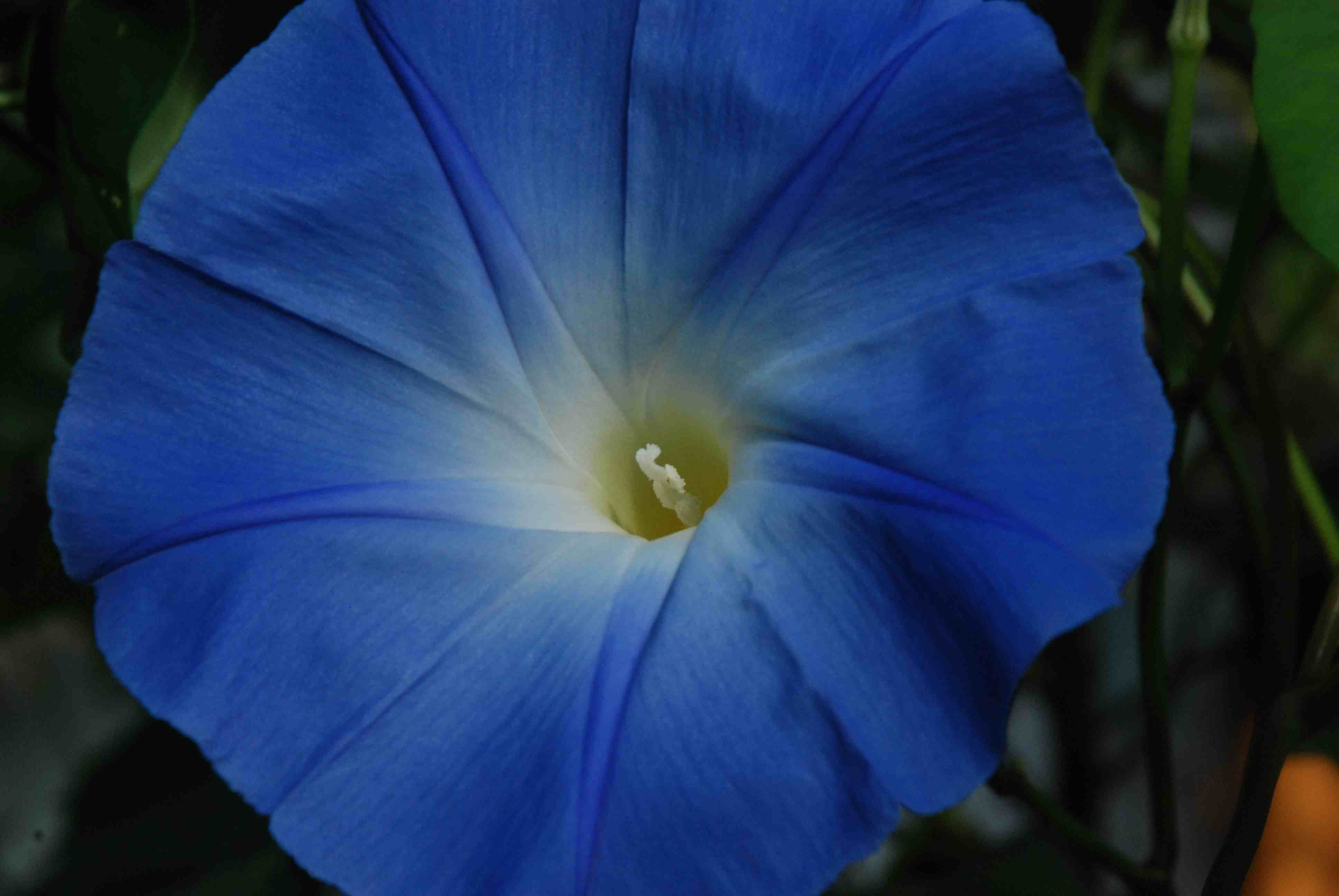
The original is best!
Don’t go fancy
I am a sucker for the unusual and if a common plant is good a rarer form is usually better. But that doesn’t apply to this ipomoea. Striped, red, double and split forms are all travesties and make as much sense as a fat-free tiramisu: if you are going to have it, have the real thing or don’t bother.
 The Biking Gardener
No comments yet.